Purchase invoice vs sales invoice
Purchase invoice vs sales invoice
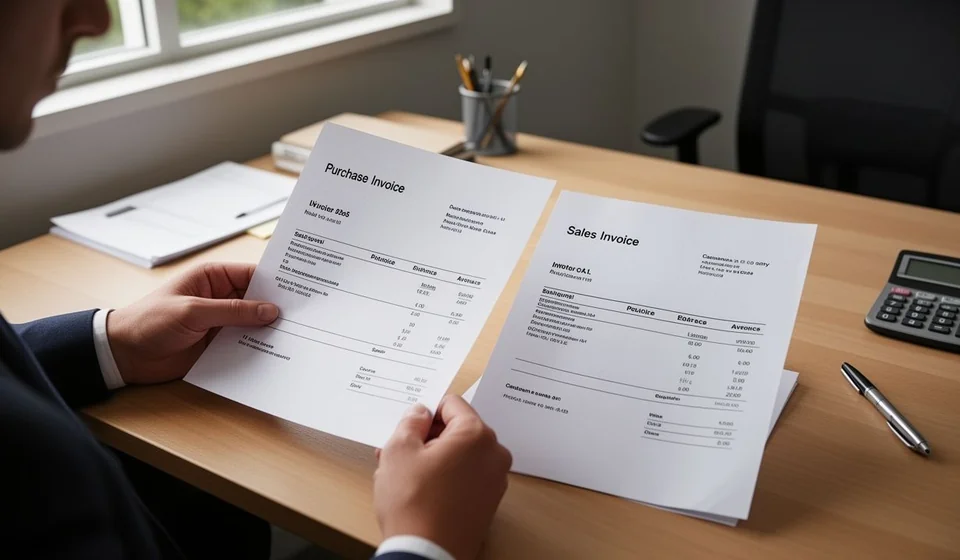
For people who are starting to organize a business's accounting, telling a purchase invoice apart from a sales invoice usually raises more questions than expected. Many believe they are two different documents issued separately, when in fact it is the same invoice seen from the two sides of a single transaction. Mastering this difference is not an academic detail: correct inventory records, clear accounts and the handling of the tax that is passed on or deducted in each transaction all depend on it. In this article we explain what a purchase invoice and a sales invoice are, why the same document plays both roles depending on who receives it, what their key differences are and how they affect inventory and accounting. At the end you will find a side-by-side comparison table and practical recommendations for recording each case without mistakes.What is a purchase invoice?
A purchase invoice is the document that supports the acquisition of goods or services by a business. Simply put, it is the invoice the company receives when it buys merchandise from a supplier: it states who is selling and who is buying, a description of the products or services, the quantities, the prices, the applicable taxes and the total value of the transaction. The name purchase invoice does not mean there is a special format for buying: it describes the role that document plays in your company. For you, the buyer, it represents a purchase because it records goods coming in and a payment obligation. For your supplier, the same paper represents their sale, because it records their merchandise going out and their right to collect. The purchase invoice matters because:- It backs inventory inflows: merchandise arriving at the business must be supported by its invoice before it can be recorded.
- It helps value the cost: the amount paid to the supplier lets you assign a cost to the goods acquired.
- It controls accounts payable: every invoice received represents money owed to a supplier.
- It supports deductible tax: when the applicable rules allow it, the tax paid on purchases can be deducted.
What is a sales invoice?
A sales invoice is the document a business issues when it sells goods or provides services to a customer. It is the invoice you hand to whoever buys from your company: it details what was sold, the date, the payment terms, the prices, the taxes and the total, and it serves as the commercial and legal record of the transaction. As in the previous case, the expression sales invoice describes the document's role for the person issuing it. If you sold fifty units of a product, that invoice represents a sale for your business: the merchandise leaves the inventory and a right to collect is created. For your customer, the very same document is their purchase invoice. The main functions of a sales invoice are:- It backs inventory outflows: every item sold must have its supporting document.
- It records revenue: sales are the main source of income for most businesses.
- It controls accounts receivable: if the sale is on credit, the invoice supports the amount the customer must pay.
- It passes on the tax: the invoice itemizes the tax charged to the customer for the transaction.
The same document, two records depending on who looks at it
This is the point that clears up most of the confusion: every sale and purchase transaction involves two parties, and each one records the invoice from its own position. When one company sells merchandise to another, the seller issues the invoice and files it as a sale; the buyer receives it and files it as a purchase. It is exactly the same paper, the same transaction and the same value. The only thing that changes is the angle from which each company records it in its books. That is why it helps to stop thinking of purchase invoices and sales invoices as two kinds of documents issued separately, and to understand them as the two sides of a single transaction: whoever issues the document records a sale; whoever receives it records a purchase. This idea prevents frequent mistakes, such as filing the same document twice or doubling its effect on inventory.Key differences between a purchase invoice and a sales invoice
Even though it is the same document seen from two sides, each role has very different implications for a business. These are the essential differences:- Issuer and recipient: the sales invoice is issued by the seller and given to the customer; the purchase invoice is received by the buyer and comes from the supplier.
- Effect on inventory: a purchase creates an inflow of stock; a sale creates an outflow of stock.
- Accounting effect: a purchase creates an account payable or a cash payment; a sale creates an account receivable or a cash receipt.
- Tax treatment: on a purchase the buyer may obtain deductible tax; on a sale the seller passes the tax on to the buyer.
- Origin of the document: the sales invoice is produced by the business itself; the purchase invoice arrives from a third party and must be kept as evidence.
- Moment of recording: a sale is recorded when the goods are delivered or the service is provided; a purchase, when the goods are received with their invoice.
Comparison table: purchase invoice vs sales invoice
| Criterion | Purchase invoice | Sales invoice |
|---|---|---|
| Who uses it | The buyer (customer) | The seller (supplier) |
| Who issues it | Issued by the supplier, received by the business | Issued by the business itself |
| Effect on inventory | Inflow: stock increases | Outflow: stock decreases |
| Typical accounting effect | Account payable and more merchandise on hand | Account receivable and less merchandise on hand |
| Tax, in general | Deductible for the buyer, where the rules allow it | Passed on to the customer on the invoice |
| Kardex record | Inflow entry | Outflow entry |
| Common risk | Losing or not filing the invoice received | Issuing the invoice without recording the outflow |
Effect on inventory: inflow vs outflow
The most visible difference between buying and selling shows up in inventory. When you buy merchandise, it enters your store or warehouse: the available stock of that product increases and, in the kardex, an inflow movement is recorded together with its cost. When you sell, the opposite happens: the merchandise leaves the business, stock decreases and an outflow is recorded in the kardex. If those movements are not recorded, inventory loses its reliability: you sell more than you actually have, you overbuy out of fear of running out, or you discover at the end of the period that units are missing without explanation. That is why every purchase invoice should become a stock inflow and every sales invoice a stock outflow, ideally on the same day the transaction happens. Sales also have a value component: sold merchandise must leave the inventory at its cost, not at its selling price. That cost is part of the cost of goods sold, a figure that depends on the valuation method the company uses and that directly affects its results. Keeping the kardex up to date is the most practical way to calculate it with reliable data.Accounting effect: accounts payable and accounts receivable
In the books, purchases and sales are also reflected differently. When you receive a purchase invoice, the business acquires merchandise but has not handed over the money yet: an account payable to the supplier is created or grows if the purchase is on credit; if it is for cash, cash decreases instead. Either way, the entry recognizes an increase in inventory and an obligation or an outflow of resources. With a sales invoice the opposite happens. If you sell on credit, an account receivable from the customer is created: you hold the right to receive that money later. If you sell for cash, cash increases immediately. At the same time, inventory decreases by the merchandise delivered and the revenue from the sale is recognized. Keeping this control lets you answer basic business questions: how much you owe suppliers, how much customers owe you, and whether the cash available covers your obligations. Mixing purchases and sales in one record, or noting them from memory only, is the fastest way to lose that visibility.Tax: passed on and deductible, in general terms
In many countries, sales are subject to a consumption tax such as VAT or its equivalent. One clarification is in order: this explanation is general and does not replace your country's rules. Names, rates and regulations vary by jurisdiction, so always confirm the details with an accountant. That said, in general terms the seller passes the tax on: it is included in the sales invoice and charged to the customer together with the price. The buyer, in turn, receives the invoice with that tax and, where the rules allow it, may treat it as deductible tax: that is, it can be set against the tax the buyer itself passes on in its own sales. A business that both buys and sells acts, in practice, as an intermediary between what it deducts on its purchases and what it passes on through its sales. That is why filing both purchase and sales invoices matters so much: the former usually support deductible tax and the latter the tax passed on. If a purchase invoice is missing, the business may end up paying more tax than it should; if a sales invoice is missing, it loses the evidence for what it charged its customers.Use cases: when each one appears
To fix the ideas, it helps to review everyday situations in which each type of invoice appears:- Purchases from suppliers: when you restock your shop or warehouse, each supplier gives you the invoice that, for you, is a purchase invoice.
- Sales to final customers: when you serve a customer, you issue your business's sales invoice.
- Business-to-business sales: in a wholesale transaction, the supplier issues its sales invoice and the buyer receives it as a purchase invoice: same document, two records.
- Purchases of services: a transport, repair or consulting service also produces a purchase invoice for whoever receives it and a sales invoice for whoever provides it.
- Internal purchases: stationery, tools or spare parts used by the business itself are also supported by purchase invoices, even when they are not merchandise for resale.
How to record purchases and sales without mistakes
An orderly invoice record prevents losses and headaches at the end of the period. These practices help keep it under control:- Record on the same day: note each purchase and sale when it happens, not when you remember it.
- Link each invoice to its movement: a purchase equals a stock inflow; a sale equals a stock outflow.
- Keep supporting documents organized: file received invoices separately from issued ones, by date and number.
- Check stock against the kardex: a regular physical count confirms that the records match reality.
- Ask your accountant: tax requirements vary by country and regime, so validate tax and accounting criteria with a professional.