Accounting in Mesopotamia: the origin of records
Accounting in Mesopotamia: the origin of records
When people talk about accounting in Mesopotamia, they are talking about the first chapter in the history of records. If we look for the moment when human beings began to leave a written record of their goods and their transactions, the answer takes us to the region between the Tigris and the Euphrates rivers, where some of humanity's first cities arose roughly five thousand years ago. There, someone needed to write down how much grain entered and left the storehouses, how many head of cattle belonged to the temple, and how much was given to each worker. To solve that problem, the Mesopotamians created a tool so powerful that it changed the course of history: the inscribed clay tablet. In this article we explain how accounting records were born in Mesopotamia, why the origin of writing was tied to keeping control of grain, livestock and barter, what advantages clay tablets had over the clay tokens and figurines that came before them, how temples became the first administrative and accounting centers, what role the Code of Hammurabi played in regulating transactions, and why the principle of leaving a written record of every operation still holds in modern accounting. If you have ever wondered what ancient Mesopotamia has to do with the invoice, the inventory or the ledger of your business, the short answer is: a lot more than you think.Mesopotamia: the land between two rivers
Mesopotamia means land between rivers and refers to the region between the Tigris and the Euphrates, in the territory that today corresponds mostly to Iraq. Around the year 4000 BC, approximately, the farming communities of that area began to organize into cities; by around 3000 BC urban centers such as Uruk and Ur already existed, with monumental temples, specialized craftsmen, kings and priests, and a network of exchanges that went far beyond the village. The rivers were both wealth and demand: periodic floods forced people to build canals and irrigation works, and those works required coordinating the labor of many people, gathering the harvests and distributing them. The fertile land produced surpluses of barley, wheat, dates, wool and other goods, and surplus is the starting point of all accounting: when a community produces more than it consumes and stores it, lends it or trades it, someone has to keep track of what it owns. That need became critical as barter and credit began to grow. In a small village everyone remembered who owed what to whom; in a city with thousands of inhabitants, public storehouses and temples full of offerings, memory was no longer enough. Between approximately 4000 and 3000 BC, all the conditions for records to be born came together: surpluses to administer, institutions that safeguarded them, and transactions too numerous to trust to word of mouth alone. Only the tool was missing, and that tool was writing.Before writing: clay tokens and figurines
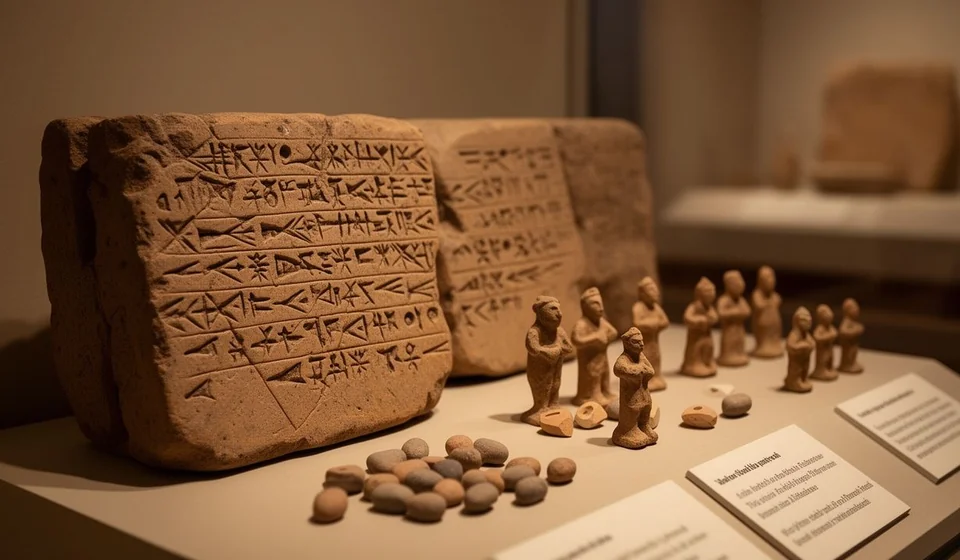
Before the tablets there was a counting system that already used clay. Since approximately the year 8000 BC, communities of the ancient Near East used small clay pieces with geometric shapes: cones, spheres, disks, cylinders and other figurines that archaeologists call tokens. Each shape and size represented a good or a measure: a token could mean a measure of grain, an animal or an amount of oil. It was a kind of accounting with objects: the administrator counted tokens and knew how much corresponded to each operation. Those tokens worked as an external memory: they made it possible to know quantities without relying on people's memory. Over time, to prevent anyone from altering the count, the tokens were kept inside hollow clay spheres called bullae, which were closed and sealed; the impressions of the tokens inside were marked on the surface of the sphere, so the content could be known without opening it. It was a receipt with the declared content shown on the outside. But the system had clear limits. Tokens served to count, but they did not tell the full story of a transaction: they did not say who delivered, who received, on what date or under what conditions the exchange took place. They worked for a simple inventory, but they were not enough for the complex trade, interest-bearing loans and contracts that were already circulating in the cities. The solution came when the marks on clay stopped representing only tokens and began to represent words, numbers and complete operations.The origin of writing was accounting
Around 3400-3000 BC, approximately, in cities such as Uruk a decisive leap took place: the impressions on clay stopped being simple token marks and became signs drawn with a reed stylus on wet clay tablets. Writing was born, and the most revealing fact is that it was not born for poetry or for laws: most of the oldest surviving tablets are administrative and accounting records. They record grain, livestock, beer, oil, worker rations, plots of land and deliveries to the temple. The first scribes in the world were keeping accounts. Over time, the pictographic signs evolved into cuneiform writing, named after the wedge shape, from the Latin cuneus, that the stylus left on the clay. A tablet could combine numbers with signs that named the good, the person, the place and the reason for the transaction. It was no longer only about counting: it was about recording. An entry could state that a certain quantity of barley had entered the temple storehouse, who had delivered it and for what purpose. Centuries later, the same writing would serve for laws, literature and religion, but its first great impulse was economic: leaving a record of goods, exchanges and obligations.Why clay tablets were a revolution
Why did the written tablet prevail over the clay tokens and figurines? Its advantages were decisive, and they are worth listing:- Durability: clay, dried in the sun or fired, withstands the passage of centuries. Thousands of Mesopotamian tablets have reached our days; records kept on perishable materials disappeared.
- Permanent and complete record: the tablet could state who delivered, what was delivered, in what quantity and at what moment. It was not a simple count: it was a written record.
- Symbols with meaning: writing represented words and numbers, not loose objects, and made it possible to record concepts such as debts, loans, interest and balances.
- Possibility of filing: tablets were kept on shelves and in baskets inside temples and palaces; they could be consulted, compared and verified long afterward.
- Value as evidence: a written receipt or contract served as proof before administrators, judges and business partners, and gave confidence to barter and credit.
The temples: the first accounting offices
In Mesopotamian cities, the great economic center was the temple. The local deity was considered the owner of the lands, herds and workshops, and the priests administered those assets in its name: they received the harvests and offerings, stored them and redistributed them as rations of barley, oil, wool and beer for priests, craftsmen, workers and officials. Administering that constant flow of income and expenses required keeping accounts, and from that need real accounting archives were born. Scribes existed for that task: people trained in reading and writing who enjoyed great prestige. They recorded the income and expenses of the storehouses, kept ration lists, registered the loans of grain and silver that the temple granted with interest, and reported to the administrators and the palace. Toward the end of the third millennium BC, in the time of the Third Dynasty of Ur, around 2100-2000 BC, the archives multiplied: receipts, delivery vouchers, worker payrolls and periodic summaries that already distinguished income, expenses and stock. The temple worked in practice as an early accounting office, and the palace adopted the same model to collect tribute, finance public works and support armies. For centuries, the public accounting of Mesopotamia was the accounting of its religious and political institutions.The Code of Hammurabi and transactions
Mesopotamian accounting matured together with commercial law. Hammurabi, king of Babylon who ruled approximately between 1792 and 1750 BC, ordered the compilation around the year 1750 BC of an extensive set of laws that we know today as the Code of Hammurabi: a stone stele with about 282 provisions, discovered in 1901 and currently kept in the Louvre Museum. The code was not an accounting manual, but it regulated economic transactions in detail. Its provisions dealt with loans of grain and silver, interest, debts, deposits, sales, the traveling merchants who acted on behalf of others, wages and liability for losses. Several rules established that certain transactions had to be formalized with a document or before witnesses in order to be claimed, and gave legal value to written records as a means of proof. In that world, the sealed tablet was the supreme evidence that a transaction had taken place. It is important to clarify that the code did not invent accounting: it found it already in practice and protected it. By requiring and backing the written record, it enshrined an idea that remains central: a transaction without a record is fragile, hard to prove and easy to dispute. Law, trade and accounting have been permanently united ever since.Summary: period, type of record and contribution
To visualize the evolution of record keeping in Mesopotamia, it helps to summarize it by period:| Period (approx.) | Type of record | Contribution |
|---|---|---|
| Around 8000-4000 BC | Clay tokens and figurines used to count goods | Counting and remembering quantities without writing |
| Around 3400-3000 BC | First inscribed clay tablets: grain, livestock and barter | Birth of writing as a record of transactions |
| Around 3000-2000 BC | Receipts, ration lists and summaries from temples and palaces | Centralized administration with permanent, verifiable archives |
| Around 1800-1700 BC | Contracts, loans and commercial laws of the Code of Hammurabi | Legal framework that requires and protects the written record of transactions |