Accounting in Egypt, Greece and Rome
Accounting in Egypt, Greece and Rome
Long before spreadsheets, inventory management software and the double-entry method that Luca Pacioli popularized in 1494, there were already people whose job was to record what came in, what went out and what remained in storage. Accounting was not born in a modern office: it was born together with the first great states, at the moment when a king needed to know how much grain his warehouses held, how much he had to collect from his provinces and how much had been spent on a public building. Three civilizations stand out for laying those foundations: Egypt, Greece and Rome. Each one contributed something different. Egypt built an administrative machine that used scribes to control harvests, taxes and granaries. Greece turned public money into a matter that had to be recorded and justified before the citizens. Rome took those records into domestic life and later into the administration of one of the largest empires of antiquity. This article explains how accounting was practiced in Egypt, in Greece and in Rome: who kept the accounts, what materials they wrote on and what legacy they left to the accounting used today.The starting point: why great states needed to keep accounts
Accounting appears when a society produces more than it consumes in a day and needs to manage that surplus. A farmer who grows crops for his own family can rely on memory; a state that stores the harvest of thousands of peasants, feeds officials and soldiers and collects tribute cannot. It needs written numbers, common units of measure and people responsible for making sure the records match reality. That is why the earliest accounting practices on record are linked to temples, palaces and state warehouses. Although Egypt, Greece and Rome evolved independently and at different times, all three shared the same logic: recording inflows and outflows, counting stock, supervising those who handled other people's property and giving an account of it. The difference lay in the level of organization, in who demanded the information and in the material on which it was written.Accounting in Egypt: scribes, papyri and the pharaoh's granaries
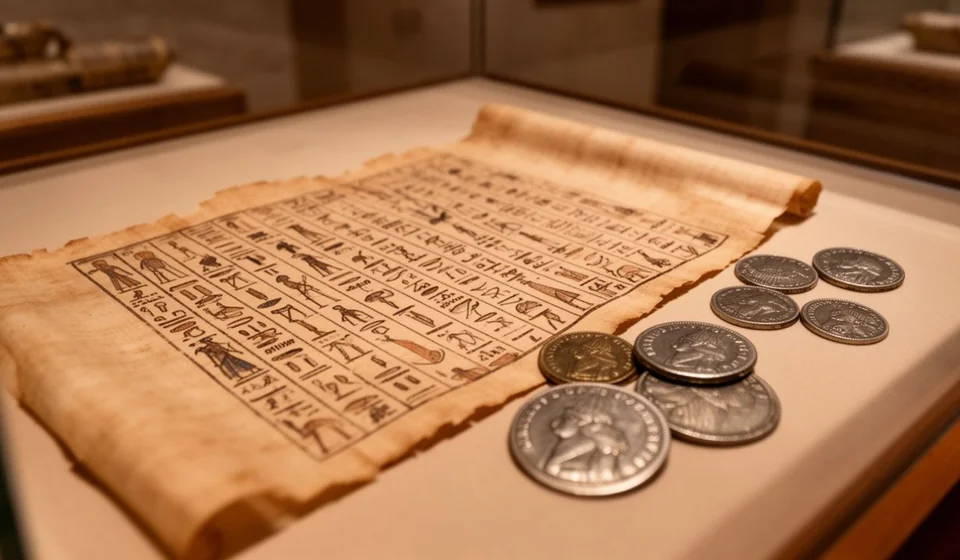
Egypt offers one of the oldest and best-documented examples of accounting administration. Since the unification of the country, around 3000 BC, the Egyptian state centrally controlled agricultural production, the basis of its wealth. The key piece of that system was the scribe, an official who spent years studying writing, arithmetic and units of measure and enjoyed enormous prestige: the scribal career was the surest path to promotion within the pharaoh's administration. In practical terms, the scribe was the first accountant: the professional who measured, recorded, added up and answered for the state's goods. The scribes' duties covered the whole economic activity of the country. They registered harvests at the moment of reaping, recorded the inflows and outflows of the royal and temple granaries, kept track of the taxes each province had to deliver and carried out inventories of cattle, land and goods. Records were kept on papyrus in hieratic script, a cursive version of hieroglyphs that was faster to write, and also on ostraca, fragments of pottery or stone used for minor notes and drafts. Among the surviving documents are lists of rations given to workers, temple accounts and detailed land registers from the New Kingdom that show how systematic the recording had become. The granary was the centre of this accounting universe, a symbol of wealth and power. It held the grain that financed the state: workers' rations, seed for the next sowing, reserves for years of drought and the commodity used to pay officials. Managing such a warehouse demanded constant recording discipline, because any difference between what was written down and what actually existed meant a loss that someone had to explain. Taxes also followed a recorded procedure. Every year, after the Nile flood, officials measured the height reached by the waters with devices such as nilometers and estimated the expected harvest; on that basis they calculated the share each peasant had to deliver. During the Old Kingdom, periodic counts of cattle and property were also carried out to set tributes, a practice very close to what is understood today as inventory control. In short, the Egyptian system already contained several ideas that modern accounting still keeps:- Separation of responsibilities: whoever received the grain, stored it and delivered it operated under written record and control, and the scribe answered for the stock.
- Recording of inflows and outflows: warehouse movements were noted with their date, quantity and destination, much like a modern stock card.
- Periodic inventories: counting cattle, land and products made it possible to compare what was recorded with what really existed.
- Recording as a profession: accounting stopped being an occasional task and became a specialized, trained and well-paid trade.
Accounting in Greece: public money under scrutiny
In Greece the decisive leap took place in the field of public accounting. Archaic Greece, the world of the Homeric poems, was an economy of kings and warriors with little written record; but in the city-states of the classical period, and especially in Athens during the fifth century BC, the management of the community's resources became a regulated and supervised matter. Athenian democracy ran on money belonging to all citizens, and that money demanded accounts. The city received income from many sources: tribute from its allies, taxes on resident foreigners, harbour duties, court fines, rents from sacred lands and the silver mines of Laurium. Those funds entered the public treasuries and from there paid officials, financed fleets, built temples and organized religious festivals. So much income and expenditure required orderly records and, above all, people who would answer for them. Oversight was organized in several layers. Magistrates who handled funds had to present an account of their administration at the end of their term before the council and the courts, and any citizen could challenge their accounts if irregularities were suspected; the Athenians called this review procedure euthyna, a word that conveys the idea of straightening and correcting. Supervision was so important that Athens' treasury was run by boards of elected officials rather than a single person. Among them, ancient sources mention the so-called apodektai, a term that can be translated as receivers of funds, in charge of collecting payments and checking the documentation of the city's revenues; references to this office appear in ancient sources as part of the financial machinery of the democracy. Another remarkable feature was the publicity of accounts. Major expenditures, such as the construction of the great temples of the Acropolis, were recorded on tablets and then carved onto marble stelae displayed in visible places of the city. Any citizen could read how much had been paid for the stone, the transport or the artisans' wages. Athenian public accounting was, in that sense, accounting that answered to the citizens. Greece's contribution can be summarized as follows:- Public accounting: the community's resources were recorded separately from private property, with defined budgets and officials in charge.
- Auditing of officials: anyone who handled other people's money had to justify their accounts at the end of their term, under review by third parties.
- Transparency: the public display of records for buildings and spending turned accounting information into a tool of citizen control.
- Centralized recording: receivers of funds and treasurers kept the documentation of the city's revenues and expenses.
Accounting in Rome: household books, the census and the empire
Rome took Greek and Mediterranean practices and carried them to a much larger scale. In its origins, during the monarchy and the republic, Roman accounting was above all domestic. The head of the household, the paterfamilias, kept control of his property: he noted the family's income and expenses on wax tablets and, over time, those notes were gathered into account books. Historians mention among those records the so-called codex accepti et expensi, a Latin expression that designates the book of receipts and payments used to document a household's transactions; it is worth clarifying that the mention comes from literary and legal sources of the time and that not all authors agree on the details of its use, but in general terms it is recognized as one of the forerunners of the journal. With Rome's expansion, accounting left the household and became an instrument of government. The census was one of its central pieces. Since the time of King Servius Tullius, around the sixth century BC, and throughout the republic, the censors carried out a general census every few years in which every citizen declared his family, his lands and his property. That written declaration was used to classify citizens, distribute tax burdens and decide who had to serve in the army. The census was, in practice, a large economic information system run by the state. Administering the empire demanded even more record-keeping. To govern distant provinces, collect tribute, pay the army and manage the emperor's property, Rome organized a financial bureaucracy with central and local archives. There were officials specialized in keeping registers and guarding documents, generally known as tabularii, and tax collection in the provinces was often contracted out to companies of publicani, private contractors who bid for the right to collect a territory's tributes and paid the state an agreed sum. The army, for its part, kept meticulous records of soldiers, their pay and their supplies, very close to the cost accounting of a large organization. It is worth being precise about the technical reach of Roman accounting: there is no proof that the Romans practiced double-entry bookkeeping, which only spread in the Middle Ages. Their merit was organizing simple, clear and verifiable records and, above all, institutionalizing them: keeping accounts was not an isolated habit of a merchant but a widespread obligation in private life and a tool of the state.Comparison: how Egypt, Greece and Rome kept their accounts
| Civilization | How it recorded | Contribution to accounting |
|---|---|---|
| Egypt | Scribes recorded harvests, granary inflows and outflows and taxes on papyri and ostraca, using official units of measure and periodic counts of goods. | Administrative control of state inventories and warehouses, stock records and the scribe as the first professional accountant. |
| Greece | The city recorded public income and expenditure; magistrates rendered accounts at the end of their term and the accounts of major public works were carved in stone in public view. | Public accounting, auditing of officials, accountability and transparency before the citizens. |
| Rome | The head of the household kept books of income and expenses such as the mentioned codex accepti et expensi; the census declared each citizen's property and the imperial bureaucracy filed tributes, payments and provincial registers. | The domestic account book, the census as an economic information system and accounting applied to the administration of vast territories. |
The legacy of these civilizations in today's accounting
Anyone who today records a sale, counts a warehouse or reviews a treasurer's report is repeating, without knowing it, gestures that are thousands of years old. From Egypt comes the idea that goods must be controlled through records and accountable people: inventory is not a modern invention but a need that the pharaoh's granaries already imposed. From Greece comes the conviction that whoever handles other people's money must give an account of it, an idea at the origin of auditing. From Rome comes the habit of leaving written evidence of transactions and of organizing the state's economic information, together with the census, the remote ancestor of modern statistics and registers. History shows something that is still true: accounting is not paperwork but a way of protecting oneself. The civilizations that practiced it rigorously could feed armies, build temples and govern empires; those that neglected it lost control of their own resources. Keeping track of what comes in, what goes out and what remains is not a luxury of the digital age: it is one of the oldest and most useful practices of humanity.Keep reading: History of the Abacus, from the Salamis Tablet to the official Japanese exam: how people counted before calculators and why the abacus is still alive.