Accounting in the 20th century
Accounting in the 20th century
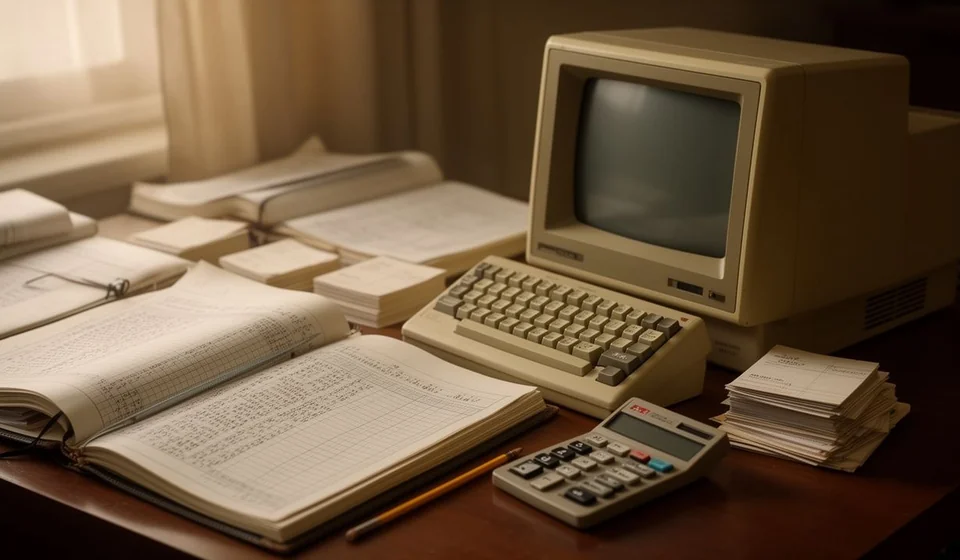
Double-entry bookkeeping was born in the Renaissance, and for centuries accounting remained, above all, a manual craft: bound ledgers, pen and ink, columns added up by hand, and merchants who trusted their bookkeeper. It was the 20th century that turned that practice into a modern discipline. In barely one hundred years, accounting stopped being a recording technique and became a university profession with standards, regulatory bodies, mandatory auditing and, toward the end of the century, computer programs able to process millions of transactions in seconds.
That change did not happen by chance: it was driven by mass taxation, the two world wars, the regulation of stock markets and the computer revolution. This article traces that history decade by decade: the consolidation of the profession, the first attempts at accounting standards, the arrival of the computer in the office, the automation of inventory and the final effort to harmonize accounting around the world.
From bookkeeping to a university profession
At the beginning of the 20th century, accounting was still largely passed on through practice: the bookkeeper learned in the office, copying entries and helping to balance statements. But in the first decades the picture changed. Business schools and university faculties incorporated accounting as a formal degree, with study programs, examinations and professional titles. Little by little, the accountant stopped being an employee who "keeps the books" and became a trained professional, organized in associations and bound by codes of ethics that governed the practice of the craft.
In Latin America that process took hold around mid-century, when several countries regulated the public accounting profession and created their professional associations. Accounting thus gained a status it had not had for centuries: it stopped being a merchant's aid and became a respected university career, and the accountant became a trusted adviser to business owners, banks and the state. That leap was the foundation for everything that followed, because a discipline with standards and trained professionals could aspire to something bookkeeping had never pursued: uniformity and comparability.
World wars, taxes and the state
No single factor pushed accounting forward in the 20th century as much as the income tax. Although precedents existed in the 19th century, it was in the early decades of the 20th century that the tax became massive and permanent. The United States established its federal income tax in 1913, and in Europe the First World War (1914-1918) forced governments to raise revenue urgently, consolidating or creating general taxes on profits in several countries. The logic was simple: to tax profits, the state needed profits to be measured, and businesses needed records they had never kept before: formal ledgers, valued inventories and reliable income statements. Filing a tax return made accounting essential for any business that wanted to operate within the law.
The wars also boosted cost accounting. During the world conflicts, governments bought ships, ammunition, uniforms and food from manufacturers through contracts that paid the cost of production plus a reasonable margin. To know what that cost was, the state demanded detailed information on materials, labor and overhead. In this way cost accounting, which until then had been the concern of a few factory engineers and managers, matured into a central tool of industrial management.
And with taxes came auditing. If reported profits determined how much was paid to the treasury, shareholders, banks and the state itself wanted independent verification of the financial statements. The auditing firms, which had existed since the late 19th century in countries such as England and the United States, grew into large international practices. Measuring, reporting and verifying: that triad, born of taxation and war, gave 20th-century accounting its modern reason for being.
The first attempts at accounting standards
Well into the 20th century, every accountant recorded things as he or she saw fit. The same transaction could be presented in very different ways depending on the company, the country or the professional's judgment, and that was tolerable while owners did as they pleased. But when large companies began selling their shares to the public, investors needed to compare results across companies and across years, and that comparison demanded common criteria.
The 1929 stock market crash and the Great Depression showed the cost of so much freedom. In the United States, the creation of the SEC in 1934, the agency that regulates the securities market, forced listed companies to present audited financial statements under defined accounting principles. From the late 1930s onward, committees of professional accountants began issuing pronouncements to standardize criteria, a process that continued for decades through successive bodies until reaching what is known today as the FASB, the accounting standards setter of the United States. In Europe, standardization was more gradual and ran mostly through the legal route: commercial codes and company laws that set out how to keep books and present accounts.
Standardization was slow, incomplete and different in every country, but it had a historic effect: for the first time, accounting aspired to be a language with rules, not a private practice of each office. That aspiration, born in the 1930s, is the seed of the whole international harmonization movement that would mature at the end of the century.
The computer arrives at the accounting office
The second half of the century brought the biggest revolution in tools since the invention of double entry. In the 1950s the first commercial computers appeared, huge and expensive, and in the 1960s banks, large manufacturers and governments began processing payrolls, accounts receivable and billing on mainframe computers that worked with punched cards and magnetic tape. In the 1970s, minicomputers and microprocessors brought the machine closer to the office, and in the 1980s the personal computer became a desktop item: electronic spreadsheets and general accounting, inventory, accounts receivable and billing programs that even a small business could buy and install without having an IT department.
The change was not only about speed. Accountants stopped adding columns by hand and copying ledgers into final form, and began reviewing screens, reconciling modules and controlling processes. Addition errors disappeared and accounting closings accelerated, going from weeks to days and then to hours. But new responsibilities appeared: data backups, access controls, information integrity. Accounting stopped being a physical book and became a database, and that changed the accountant's way of working forever.
Inventory becomes automated: from the manual card to the digital record
Inventory control sums up that evolution better than any other process. For much of the 20th century, stock was controlled with physical cards, the classic paper stock ledger: one card per product, filed in a drawer or a box, where a person wrote down by hand, entry by entry and issue by issue, every movement. The system worked, but it demanded constant discipline, time to write and space to file thousands of cards; a forgotten entry, a lost card or a late count broke the control and left the theoretical inventory divorced from the real one.
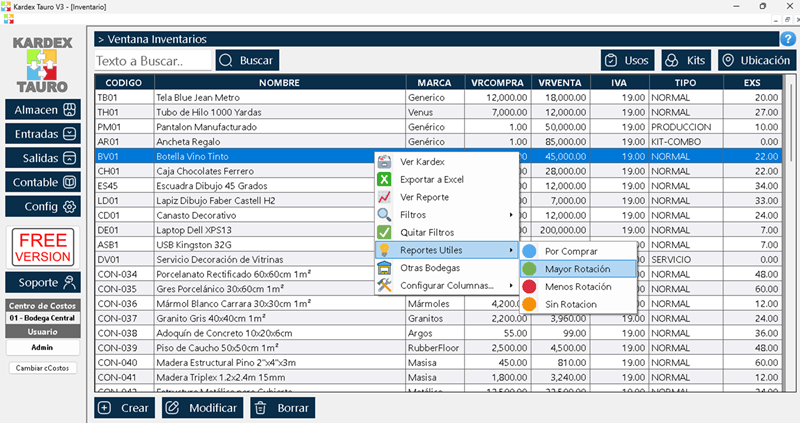
With computerization, those cards became digital records. The bar code began to spread commercially in the 1970s, and in the 1980s and 1990s inventory programs went from recording movements to calculating on their own: minimum stock levels, average costs, inventory valuation and reorder alerts. In the integrated systems that became popular in the 1990s, a sale recorded at the cash register deducts the item from stock in the same instant, and the accountant checks the balance of any product on a screen without searching for a card in a file. The stock ledger did not disappear: it was digitized. The same idea behind the paper card — one record per product, updated with every receipt and every issue — is what software now executes in fractions of a second, with fewer errors and with the information available to the whole company.
Standards bodies and the road to global harmonization
As companies grew and crossed borders, the differences between each country's standards became a concrete problem: a multinational had to prepare different financial statements in every country where it operated, and an investor could not compare companies from different countries without reworking their figures. The answer was the international harmonization effort. In 1973 the international committee that, after being reorganized in the early 2000s, became the body that today issues the International Financial Reporting Standards (IFRS) was created. In that same year, 1973, the FASB, the body that has since issued United States accounting standards, was also established. Intellectual honesty demands saying it that way: there was no single day when "the standards were born", but decades of committees, drafts and debates that gradually shaped today's bodies.
The great wave of harmonization arrived with the new century: the European Union required listed companies to apply IFRS from 2005 onward, and dozens of countries, including many in Latin America, adopted them or used them as a reference to update their local rules. The United States keeps its own framework, US GAAP, and the debate over full convergence remains open. But the direction is clear: at the start of the 21st century, world accounting is moving toward a common language, something unthinkable when the 20th century began.
The 20th century in a timeline
The table summarizes, by approximate decade, the advances that turned accounting into the discipline we know today:
| Approx. decade | Accounting advance |
|---|---|
| 1910s | Massive, permanent income tax in the United States (1913) and Europe; businesses must measure and report their profits. |
| 1930s | After the 1929 crash, the U.S. securities market is regulated (SEC, 1934) and the first mandatory accounting principles begin to be issued. |
| 1940s | War production drives cost accounting and the audit of government contracts. |
| 1950s | The first commercial computers appear; banks and large companies mechanize payrolls and accounts. |
| 1960s | Mainframe computers process the accounting of large companies with punched cards and magnetic tape. |
| 1970s | The bodies that issue today's standards are established (the international committee that preceded IFRS and the FASB in the United States, both in 1973), and the bar code begins to spread. |
| 1980s | The personal computer reaches the desktop: spreadsheets and accounting software affordable for small and medium businesses; the manual stock ledger migrates to digital files. |
| 1990s | Integrated systems become popular: accounting, sales and inventory in a single database, with stock deducted automatically at every sale. |
| 2000s | Global harmonization: the European Union requires IFRS from 2005 onward and dozens of countries adopt them. |
The legacy of the 20th century
When the 20th century ended, accounting was almost unrecognizable compared with the accounting of 1900. Double entry was still the heart of the system, but standards made it comparable across companies and countries, taxes made it essential to the state, auditing made it verifiable and the computer made it instantaneous. Inventory control, once kept on cardboard cards filed in boxes, is now checked on a screen and updates itself with every sale.
That journey leaves a practical lesson: accounting is not a formality invented to annoy businesses, but an information system that the 20th century turned into a profession, a set of standards and a technology. Understanding where it comes from helps to value what exists today: any business, no matter how small, can keep its books and its inventory up to date with tools that, a hundred years ago, not even the most skillful accountant could have imagined.