Web hosting: what it is, types and how to choose

Web hosting: what it is, types and how to choose
When a business decides to have a presence on the internet, the first practical question is usually not which design to pick, but where its website will live. Every site visited on a daily basis, from a personal blog to an online store with thousands of products, is stored on a server that stays on and connected twenty-four hours a day. The service that makes it possible to store, manage and publish a website's files is called web hosting, and choosing it well can be the difference between a page that loads in an instant and one that goes down right when the most visitors arrive.
Hosting may sound like a technical topic reserved for programmers, but anyone who publishes a website needs to understand the basics so they neither overpay nor fall short. This article explains what web hosting is, how it works, what the main types are —shared, VPS, dedicated and cloud—, what to check before signing up, why free hosting deserves caution, and how to migrate a website without losing data or interrupting service.
What is web hosting and how does it work?
Web hosting, also called website hosting, is a service that offers space on internet-connected servers to store a website's files. Those files are what make up the page: text documents, images, style sheets, programming code and, in many cases, databases holding products, customers or orders. A useful analogy is a physical store: just as a shop needs a location to display its merchandise, a website needs a server to store and show its content.
When a visitor types a domain into the browser, a chain of actions happens in a fraction of a second: the browser queries a system called DNS to find out the server's address, connects to that server, requests the page files and displays them on screen. Hosting also includes the supporting services that keep everything running: the server software that delivers the pages, the database engine, email accounts, security measures, backups and the control panel through which the site owner manages everything without touching code.
Shared hosting
Shared hosting is the starting point for most websites. In this model, many sites live on the same physical server and share its resources: processor, memory and disk space. It is the most affordable option because the cost of the server is split among all customers, and providers usually offer it in plans that are very easy to sign up for.
Advantages:
- Low price: it is the most affordable model and often includes a domain and email in the same plan.
- Ease of use: the provider handles maintenance and the customer manages everything from a simple panel.
- Great way to start: it is more than enough for blogs, company sites and small stores with moderate traffic.
Disadvantages:
- Limited resources: if a neighbouring site consumes too much, the performance of the others can suffer.
- Less control: users cannot install applications or change advanced server settings.
- Limited scalability: when traffic grows, moving to a higher plan eventually becomes necessary.
VPS (virtual private server)
A VPS is a physical server divided into several independent virtual machines. Each one works like its own server, with its own operating system, guaranteed resources and administrator access, although they all share the physical hardware with the other VPSs on the same machine.
Advantages:
- Guaranteed resources: every plan gets a fixed share of processor, memory and disk that does not depend on neighbours.
- Administrator access: it allows installing software, adjusting configuration and tailoring the environment to the project.
- Good balance: it offers far more control than shared hosting at a much lower cost than a dedicated server.
Disadvantages:
- Technical skills required: operating system administration and security usually fall on the customer, unless a managed VPS is purchased.
- Medium cost: it is more expensive than shared hosting, though still affordable for most businesses.
- Maintenance responsibility: updates, backups and security monitoring depend on whoever uses it.
Dedicated server
A dedicated server gives a single customer a complete physical machine. Nothing is shared: all the processor, memory, disk and bandwidth are reserved for one site or project. It is the choice of large companies, high-traffic portals and applications that demand steady performance.
Advantages:
- Maximum performance: every resource on the machine is available to the project, with no competition from other customers.
- Total control: hardware, operating system and software can be chosen and configured without restrictions.
- Security and stability: with no shared environment, it is easier to isolate threats and keep the service steady.
Disadvantages:
- High cost: it is the most expensive model, since the customer alone bears the value of the physical machine and its upkeep.
- A technical team is needed: running a dedicated server requires experience in systems, security and networks.
- Risk of oversizing: most small sites do not take advantage of so much capacity and end up paying too much.
Cloud hosting
Cloud hosting runs on a network of interconnected servers instead of a single machine. A site's files are distributed and replicated across several computers, and resources are pooled on demand. If one server fails, another one takes over its load, which reduces site downtime to a minimum.
Advantages:
- Instant scalability: memory or capacity can be increased in minutes, even automatically during high-traffic seasons.
- High availability: because the site is spread across several servers, it withstands technical failures and traffic spikes better.
- Pay as you go: many providers charge only for the resources consumed, avoiding payment for capacity that is never used.
Disadvantages:
- Variable cost: the bill can grow out of control if traffic increases or the configuration is not properly tuned.
- Complexity: some cloud plans require infrastructure knowledge and are not as simple as a shared panel.
- Hard-to-predict pricing: estimating the monthly cost is more difficult than with traditional fixed plans.
Quick comparison of hosting types
The table below summarises the essential differences among the four models to make the decision easier:
| Type | Resources | Relative price | Who it is for |
|---|---|---|---|
| Shared | Shared with other sites | Very low | Blogs, company sites and businesses that are just starting |
| VPS | Guaranteed within a virtual server | Medium | Growing sites and stores that need more control |
| Dedicated | A complete physical server | High | Large companies and high-traffic portals |
| Cloud | Scalable on demand across several servers | Variable | Projects with changing traffic or seasonal spikes |
What to consider when choosing hosting
Beyond the type of plan, there are six concrete points worth checking before paying for any hosting, because they directly affect the experience of visitors and the day-to-day work of the business:
- Speed: solid-state drives (SSD), servers close to the audience and access to content delivery networks (CDN) make the page load fast, which also improves search engine rankings.
- Technical support: the provider must answer questions quickly and in the customer's language, ideally at any hour, because a down website does not wait.
- Space and transfer: it is wise to estimate the size of the site and its expected traffic so you do not hit storage or data transfer limits.
- Included domain: many plans give away the first year of registration, but it is worth checking the renewal price and confirming that the domain is registered in the customer's name.
- SSL certificate: it is the padlock that activates the secure https protocol and protects the data travelling between the visitor and the server; today it is essential for any page and for email.
- Automatic backups: regular backup copies are the site's insurance: after an error, an attack or a bad update, they make it possible to restore everything in minutes.
Free hosting vs paid hosting
Free hosting is tempting, especially for testing ideas, but it is worth reading the fine print. Plans with no cost usually include third-party advertising displayed on the page, minimum limits of space and transfer, subdomains instead of a real domain, little or no backup guarantee and almost no support. The site can also disappear if the provider shuts the service down or if the plan's limits are exceeded.
Paid hosting, even at its most affordable levels, offers what a business needs to operate seriously: its own domain, SSL certificate, professional email, backups, support and stable performance. The practical advice is to use free hosting only for tests, personal projects or demos, and to buy a paid plan as soon as the site represents the image or the sales of a business.
How to migrate hosting step by step
Changing hosting providers does not have to be traumatic if the right order is followed. These are the essential steps of a safe migration:
- Make a complete backup of the current site: files, databases and email configuration.
- Sign up for the new hosting and set up the email accounts and the database on the new provider.
- Upload the site files and restore the database on the new server.
- Check that the site works correctly through a test address or with the domain still pointing at the previous provider.
- Point the domain's DNS servers to the new hosting and wait for propagation, which usually takes anywhere from a few hours to two days.
- Test the site on different devices, confirm that email works and, once everything is stable, cancel the previous plan.
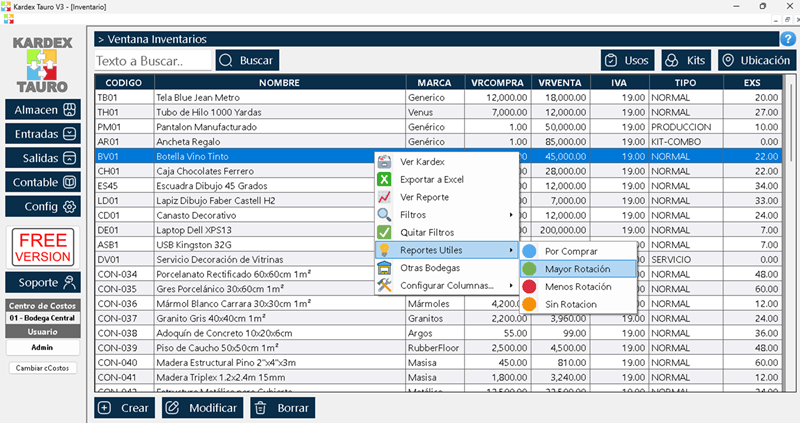
Hosting is the foundation on which any digital project rests, and choosing it wisely saves headaches, lost visitors and unnecessary costs. Whether you are launching a business's first website or operating an inventory management platform such as Kardex Tauro, having a stable, fast and well-backed hosting service is the first step to working online without interruptions.