What is CRUD?

What is CRUD?
When you open an application to register a new customer, look up a list of orders, correct a product price, or delete a record you no longer need, you are performing the four operations behind almost all the software that exists. Together, those operations have a name: CRUD. Understanding what CRUD is means understanding how the information an application handles every day is stored, queried, changed, and removed.
CRUD is the acronym for Create, Read, Update, and Delete, the four basic operations that any system performs on its data: adding new information, viewing it, modifying it, and erasing it when it is no longer needed. Although the term was born in the world of databases, today it applies to any application, website, or management system that works with persistent information.
The real value of the concept is that it works as a common language: no matter the programming language, the database, or the type of business, every application that manages information ends up implementing these four operations in one way or another. That is why understanding CRUD makes it easier to learn any new technology: you already know what it has to solve.
What does each letter of CRUD mean?
Each letter of the acronym stands for an operation with a clear purpose and a question it answers inside the system:
- Create: adds new information to the system. It answers the question “how do I enter a piece of data that did not exist before?”. Example: registering a new customer with their name and email.
- Read: queries or displays stored information. It answers “how do I see the data that already exists?”. Example: showing the list of registered customers.
- Update: modifies existing information. It answers “how do I fix or change a piece of data?”. Example: changing the price of a product.
- Delete: removes information from the system. It answers “how do I erase data I no longer need?”. Example: removing a discontinued product.
These four operations cover the complete life cycle of any record inside an application: information is created, queried while it is useful, updated when it changes, and deleted when it stops being valuable.
Examples of CRUD in everyday life
To see it clearly, imagine a store that manages its products and customers with a management program. Every button the manager clicks corresponds to a CRUD operation:
- Create a customer: the manager clicks “New customer”, fills out a form with name, phone, and address, and saves. At that moment the system creates a brand-new record.
- Read the order list: when opening the orders section, the program queries the stored information and displays it in a table so the manager can review what has been sold today.
- Update a price: when the supplier raises costs, the manager finds the product and corrects its price in the form. The operation modifies the existing record without creating a duplicate.
- Delete a product: if a product is discontinued, the manager selects it, clicks “Delete”, and the record disappears from the catalog.
The same moves repeat in almost any software: on a social network when you post, view, edit, or delete a photo; at a bank when you check your transactions or update your details; in a school system when a student is enrolled, looked up, updated, or withdrawn.
CRUD and databases: the SQL equivalent
Behind almost every application there is a database that stores information in an organized way. CRUD describes the operation from the user's or the application's point of view, while SQL (Structured Query Language) is the standard way to carry it out against the database. Each CRUD operation has a direct counterpart in SQL:
- Create maps to the INSERT statement, which inserts a new record into a table.
- Read maps to SELECT, which queries the stored records.
- Update maps to UPDATE, which changes the values of existing records.
- Delete maps to DELETE, which removes records from the table.
When you click “Save customer” in an application, the program runs an INSERT statement underneath; when the product list loads, it runs a SELECT. This correspondence makes CRUD and SQL two sides of the same coin: the concept describes the intention, and the database provides the mechanism.
Summary table of CRUD operations
The following table summarizes each operation, what it does, an everyday example, and the equivalent SQL command:
| Operation | What it does | Example | SQL command |
|---|---|---|---|
| Create | Adds a new record | Registering a customer | INSERT |
| Read | Queries existing records | Viewing the product list | SELECT |
| Update | Modifies an existing record | Changing an item's price | UPDATE |
| Delete | Removes a record | Removing a product from the catalog | DELETE |
Why does every application use CRUD?
The reason is simple: the information handled by an application has a life cycle, and CRUD covers that cycle from start to finish. Any piece of data that matters to a business — a customer, an invoice, a product, an appointment — is born at some point (create), needs to be queryable (read), changes over time (update), and eventually stops being useful (delete). If any of the four operations is missing, the system is incomplete.
Think about what would happen if an application could create records but never display them: information would be saved and it would be impossible to see it. If it could display records but never update them, any mistake would be locked in forever. And if it could never delete them, the database would fill up with outdated data. That is why CRUD is not a luxury or an option: it is the minimum foundation on which almost any information system is built.
Besides, knowing CRUD helps you read the code of any project. When a developer opens a new application, the first thing they look for is how its main data is created, read, updated, and deleted; with that they understand the overall architecture without reviewing every single detail.
CRUD in the interface: forms and buttons
The end user does not see SQL statements or data structures: they see an interface. On the screen, each CRUD operation takes the shape of concrete elements:
- Create appears as a “New” or “Add” button that opens a form with empty fields to capture the information.
- Read shows up as lists, tables, cards, or detail views that present the stored data.
- Update is offered with an “Edit” button that opens the same form, this time already loaded with the data so it can be changed.
- Delete is provided with a “Delete” or “Remove” button, usually accompanied by a confirmation question to prevent accidental deletions.
Good interface design pairs each operation with clear feedback: a “Customer saved successfully” message, the refreshed list, the new price visible in the table, or a confirmation before deleting. That detail lets users understand that their action actually affected the data.
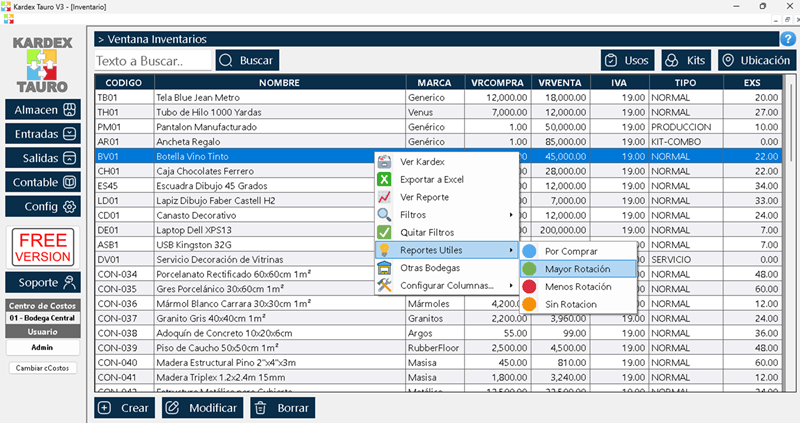
A mental example: an inventory system
To lock the idea in, imagine that you run a small warehouse and use an inventory system to keep track of your products. Every everyday action is a CRUD operation:
- In the morning a box arrives with a new product. You open the form, type name, category, and quantity, and click “Save”. You have just performed a Create: the system runs an INSERT and the product is now in the database.
- A customer asks about that product. You search its name in the system and the application runs a Read (SELECT) that shows the item record with the available stock.
- At noon you receive the supplier's new price list. You open the product, correct the price, and save: that is an Update (UPDATE) on the existing record.
- At the end of the month you decide to drop a product that did not sell. You select it, confirm the deletion, and the system runs a Delete (DELETE) that removes it from the catalog.
The same scheme repeats in invoicing systems, libraries, clinics, online stores, social networks, and thousands of other applications. The technology changes, but the cycle stays the same: create, read, update, and delete.
CRUD is not a concrete technology or a library you install: it is a mental pattern that organizes how software manages information. Knowing it lets you understand any application quickly, communicate with development teams precisely, and recognize — behind every “save”, “edit”, or “delete” button — the operation that is really happening to the data.