What is safety stock?

What is safety stock?
Safety stock, also called buffer stock or reserve inventory, is the extra quantity of a product kept in the warehouse above the demand expected during the replenishment time. Its purpose is not to sell more but to keep a business from running out of goods when something unexpected happens: a supplier order that arrives late, a week of higher-than-normal sales, or a customer who suddenly buys an unusually large quantity.
Anyone who runs a business selling physical products knows the scene: a customer arrives wanting an item that always sells, and the answer is that there is none, but it can be ordered and it arrives in eight days. That lost sale, added to the ones that repeat every month for the same reason, is the visible cost of operating without a well-defined safety stock.
What safety stock is, and what it is not
To apply it correctly, it helps to distinguish it from other concepts it is often confused with. Cycle stock, or normal stock, is the quantity purchased to cover demand between one order and the next; without that stock the business would simply have nothing to ship. Safety stock, on the other hand, is an extra layer that is only touched when reality exceeds the plan.
- Cycle stock: covers expected demand between orders. It is depleted and renewed with every purchase from the supplier.
- Minimum stock or reorder point: the stock level that signals when it is time to place a new order with the supplier.
- Safety stock: the cushion that remains below that level to absorb supplier delays or demand peaks. It should only be used in exceptional situations.
In short: safety stock does not prevent orders from being placed; it prevents a delay or a sales peak from leaving the shelf empty while the next purchase arrives.
Why safety stock matters in a small business
In small companies, inventory is usually the largest investment after payroll. A stockout carries several costs that almost never show up on the income statement, but that are felt directly at the cash register:
- Lost sales: the customer who does not find the product buys from the competition and often does not come back.
- Emergencies and extra costs: to avoid losing the sale, the business ends up buying at retail prices or paying urgent freight that destroys the margin.
- Loss of trust among regular customers: a business that fails to deliver loses the confidence it worked so hard to earn.
- Stopped operations: in businesses that use inventory to produce goods or provide services, a missing part halts jobs and puts delivery dates at risk.
A well-calculated safety stock turns those losses into a small, predictable cost: the money tied up in a few reserve units, which pays for itself with the first sale that is not lost.
How to calculate safety stock: a simplified formula
There are advanced statistical methods that use standard deviations and service levels, but a small business can start with a simplified, practical version. The idea is to compare the worst reasonable scenario against the average scenario:
Safety stock = (maximum daily demand × maximum replenishment time) − (average daily demand × average replenishment time)
To apply the formula you need four figures that any business can estimate from its sales and purchasing history. Let us look at a concrete numerical example:
| Figure | Example value |
|---|---|
| Average daily demand (units sold per day, on average) | 20 units |
| Maximum daily demand (the best-selling day in the period analyzed) | 30 units |
| Average replenishment time (days the supplier takes, on average) | 7 days |
| Maximum replenishment time (length of the most delayed order) | 10 days |
| Safety stock = (30 × 10) − (20 × 7) | 160 units |
In the example, the business sells 20 units per day on average and the supplier takes a week. Normally, it would reorder when 140 units remain, that is, 20 times 7. But since there were days with 30 units and orders that took 10 days, keeping 160 reserve units guarantees that, even in the worst combined scenario, merchandise never runs out and customers are always served.
How much safety stock should each product have?
Applying the same rule to every product is as risky as having no rule at all. Each item has its own demand variability, its own replenishment lead time, and its own cost of running out. A practical starting guide could look like this:
| Product type | Typical behavior | Suggested safety stock |
|---|---|---|
| High-turnover basics with a local supplier | Stable demand and fast replenishment | Low: cover 2 to 3 days of sales |
| Imported goods or items with long freight | Replenishment takes weeks, with risk of customs or transport delays | High: cover several weeks or a full order |
| Seasonal or promotional products | Very concentrated demand that is hard to forecast | High, calculated before the season and reviewed when it ends |
| Critical spare parts or supplies | Sporadic sales, but their absence stops machines or services | High and prioritized, even if they turn over slowly |
| Expensive or slow-moving merchandise | Low demand and high cost of keeping it in storage | Minimum or none: better protected with supplier agreements |
The golden rule is that the cost of keeping a unit in reserve, from tied-up money, space, expiration, or damage, must be lower than the cost of running out. That is why an expensive product that barely sells may not justify a cushion, while a cheap spare part that stops the whole operation does justify one, even if it sits on the shelf for months.
Common mistakes when defining safety stock
Defining safety stock also has frequent traps in small businesses:
- Using fixed values from memory, such as always keeping ten units of everything, without looking at the real demand of each product.
- Calculating the cushion using only the average, ignoring sales peaks and orders that arrive late.
- Never reviewing it: safety stock must be recalculated when the supplier, the delivery time, or sales behavior changes.
- Confusing it with an excuse to hoard: if the cushion is touched constantly, the problem is not the safety stock but the reorder point or the supplier.
The starting point: reliable inventory history
All the formulas above depend on the same raw material: real data about how much is sold, how much is bought, and how long each replenishment takes. Without a reliable record, safety stock becomes just another guess.
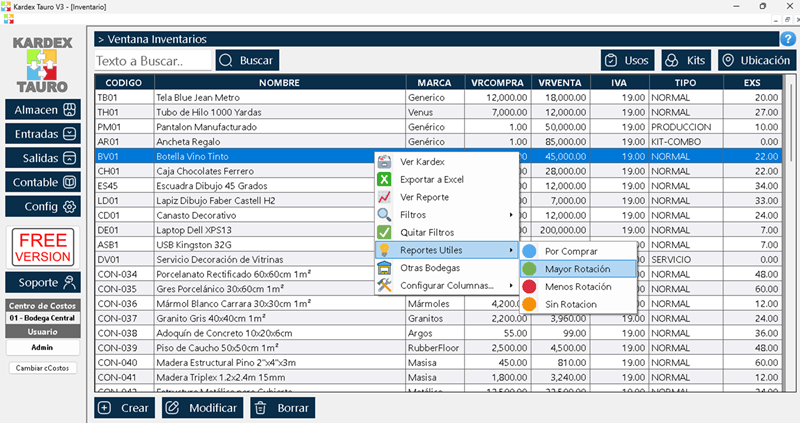
This is where keeping an orderly stock ledger makes the difference. Kardex Tauro records the inbound movements, the outbound movements, and the stock of each product by warehouse, and keeps that movement history organized and chronological. With that information you can look back, identify real demand peaks and actual replenishment times, and calculate the safety stock of each item based on what really happens in the business, not on what you think happens.
A simple decision with concrete results
Safety stock does not have to be an engineering topic. With four figures, a simple formula, and a good movement history, any small business can decide how many reserve units to keep per product, how much money to put into that cushion, and what to do when market conditions change. Defining it today prevents lost sales tomorrow.
If you still record your inventory in notebooks or in scattered spreadsheets, the first step is to have a reliable history of inbound movements, outbound movements, and stock by warehouse. That is the foundation on which a well-calculated safety stock is built, and it is exactly what Kardex Tauro puts within your reach, without complications, designed for businesses like yours.
