Stock Control

Stock Control
If your business sells physical products, stock control defines whether each day of effort turns into profit or stays trapped on a shelf. Without it, a company can sell a lot and still lose money: goods that expire, repeat purchases made by mistake, and stockouts that drive customers away. Here we explain what stock control is, why its absence costs so much, which methods a small business can apply without large investments, and which indicators will tell you whether you are doing it right.
What is stock control and how is it different from inventory
Stock control is the process of permanently watching over the goods in your business: how much comes in, how much goes out, how much remains, and how much should remain according to your records. Its goal is not only to know what you have, but to keep the right amount of each product at the right time: enough to serve customers without delay, but not so much that capital sits frozen in boxes that never move.
Inventory is one part of that process, not the whole process. Inventory is the count or the list of products and quantities available at a given moment: a photograph. Stock control is the movie: the record of every movement that explains how that photograph came to be. A company can carry out a flawless year-end count every December and still suffer losses all year if nobody watches the goods between one count and the next. Confusing the two concepts is the first mistake: doing an inventory is not controlling stock; it is merely looking at it once.
Why you lose money without stock control
When stock is managed from memory or in notebooks that nobody updates, money is not lost in a single blow: it leaks quietly, every single day. These are the most common leaks:
- Tied-up capital. Every product that has spent months in the warehouse is money that is not working: it generates no sales, takes up space and, over time, loses value or becomes obsolete.
- Lost sales from stockouts. When a customer asks for a product and there is no stock, you do not lose only that sale: you lose trust and, often, the customer.
- Buying blind. Without reliable information you buy too much, creating excess inventory, or too little, causing shortages just when the product is needed most.
- Shrinkage nobody can explain. Damaged, expired, misplaced or stolen products go unnoticed for months; when the shortage finally shows up, nobody knows what happened or who is responsible.
- Decisions based on false data. If the record says 50 units and there are really 12, every decision made from that number will be wrong: orders, promotions, budgets and even the taxes you declare.
In a small business, where the margin for error is thin, these leaks can eat a significant share of annual profit. The good news: almost all of them are avoided with discipline and method, not with expensive technology.
Basic stock control methods every small business can apply
You do not need an automated warehouse or a logistics team to start controlling stock. Three simple practices solve most of the problems described above.
Periodic physical counts
A physical count compares, on a defined schedule, what the records say with what is really on the shelf. Instead of counting everything once a year, many companies use cycle counting: each week or month they count the most important products or one section of the warehouse, so the whole inventory is verified several times a year without stopping operations. Every difference found points to a cause worth fixing: a poorly made record, an unrecorded sale, a misplaced product.
Reorder point and minimum stock levels
The reorder point is the stock level that, once reached, tells you it is time to order again. It is calculated from two pieces of data: the units you sell during the supplier delivery time, plus a safety margin for unexpected events. An essential complement is the minimum stock level: the level below which the product enters the risk zone. Setting clear minimums avoids both stockouts and last-minute nervous buying.
Classifying inventory by importance
Not every product deserves the same attention. ABC classification helps you prioritize: A products are few but concentrate most of the sales or value, and demand strict control and frequent counts; B products have medium importance; C products are numerous, low-value or slow-moving, and do not justify the same effort. That way the team focuses its time where money is really made or lost.
Key indicators for measuring stock control
What is not measured cannot be improved. These five indicators let you know, with numbers, whether your stock control is working:
| Indicator | How it is calculated | What it reveals |
|---|---|---|
| Inventory turnover | Cost of goods sold / average inventory | How many times stock is sold and replaced in a period. Low turnover means tied-up capital. |
| Inventory coverage | Average inventory / average daily sales | How many days you could keep selling without receiving goods. Very high coverage reveals excess stock. |
| Stockout rate | Unfilled orders / total orders | How often you run out of a product. A high rate means lost sales caused by poor planning. |
| Inventory accuracy | (Actual units counted / recorded units) x 100 | How reliable the information in the system is. A value below 95 % means records must be reviewed. |
| Dead stock | Value of products with no movement / total inventory value | How much capital is trapped in products that do not sell and should be liquidated or returned. |
You do not need to calculate them all on day one: pick two or three, measure them regularly and watch the trend. The goal is not a perfect number, but catching problems in time, before they become losses.
How to implement stock control step by step
Bringing order to your stock is not a one-year project, but it does not happen by itself either. This six-step path works for most small businesses:
- Organize the warehouse and define locations. Every product needs a known, stable position so that counting and order picking are fast.
- Clean up the catalog. Identify obsolete, damaged or slow-moving products and decide their fate: clearance, return or write-off.
- Set minimums and reorder points. Give each important product its minimum level and reorder point based on turnover and supplier lead times.
- Record every movement in one place. Every inflow and outflow of goods must be noted the same day, in the same system, by the person in charge: this is the step that transforms operations the most.
- Schedule periodic counts. Set a cycle-count calendar and someone clearly responsible for correcting discrepancies.
- Review the indicators monthly. One hour a month spent on turnover, stockouts and accuracy is enough to adjust minimums and correct deviations.
The stock ledger: the record behind all stock control
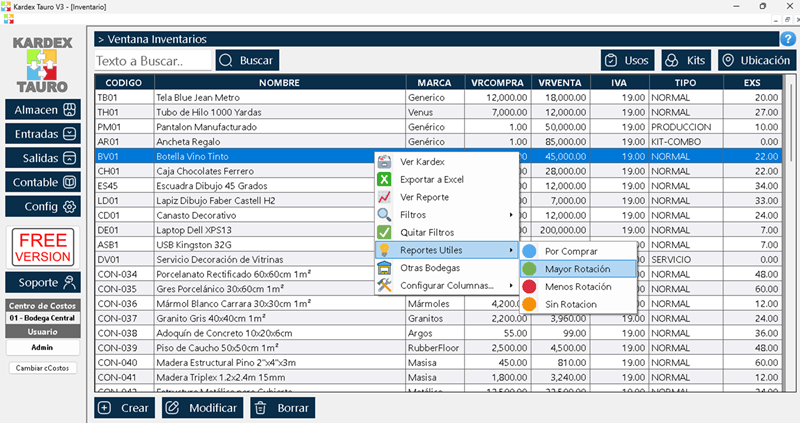
The heart of stock control is the stock ledger: the chronological record of every movement that affects a product stock level. Without a reliable stock ledger there is no control at all, because every decision rests on knowing exactly what came in, what went out and when. On paper, the stock ledger becomes a notebook that is hard to keep up to date; in a program like Kardex Tauro, the record is generated automatically: when you make a sale the stock is deducted, when you receive a purchase it is added, and every movement is saved with its date, concept and balance. Kardex Tauro also handles several warehouses or branches as independent cost centers, so a transfer between locations is recorded as an outflow in one warehouse and an inflow in the other, without duplicating units. That gives you up-to-date stock in every warehouse and a history behind every purchase or adjustment decision.
Start today, even if it is small
Stock control does not require expensive technology or extra staff: it requires method and consistency. Start with the basics: organize the warehouse, set minimums, record every movement and count with discipline. As the business grows, notebooks and spreadsheets will no longer be enough, and that is the moment to lean on an inventory system like Kardex Tauro, built for small businesses that want professional control without complications. The best day to start was yesterday; the second best is today. Your warehouse, your finances and your customers will notice it.