How to Update Inventory with an Invoice
How to Update Inventory with an Invoice
In a small business, every sale should leave a clear trail: what was sold, what remains in the warehouse, and what the customer owes or has already paid. Yet for many shopkeepers, the invoice and the inventory live in separate worlds: the invoice is issued, and the stock is deducted afterward, by hand, or sometimes never. This article explains why that mistake is costly and how Kardex Tauro updates inventory automatically at the exact moment a sales invoice is finalized.
The problem: invoicing and deducting stock as separate tasks
When the sale and the stock deduction are two different tasks, something eventually fails. The salesperson records the invoice at the register or in the notebook and promises to "deduct the merchandise later." That later can mean the end of the day, the end of the week, or never. Over time, the classic signs of an outdated inventory appear:
- The system says there are 12 units of a product, but only 7 are on the shelf.
- Products that no longer exist get sold, because nobody deducted the previous sales.
- Physical counts do not match, and nobody knows whether the error comes from purchases, sales, or unrecorded losses.
- The customer receivables do not match the invoices that were actually issued.
The root of the problem is not a lack of good intentions on the team: it is that the process depends on memory and duplicated manual work. Every step done by hand is an opportunity for error, and in a business with few employees, those opportunities multiply.
The most serious part is that the discrepancy is not noticeable on the first day. A business can sell for weeks with an outdated inventory and only discover it during the physical count, when it is already too late to know what happened to the missing merchandise.
What a sales invoice does in Kardex Tauro
Kardex Tauro solves the problem by joining both worlds: the sales invoice is not only a collection document, but the trigger that updates the inventory. When a sales invoice is finalized, the system does three things automatically:
- It deducts the stock from the inventory for each product sold.
- It generates the outbound movement in the stock ledger, the record that shows what left, when it left, and who bought it.
- It records the account receivable or the cash income depending on the case: if the customer pays in full, the income is recorded; if the payment is partial or on credit, an account receivable is created for the outstanding balance.
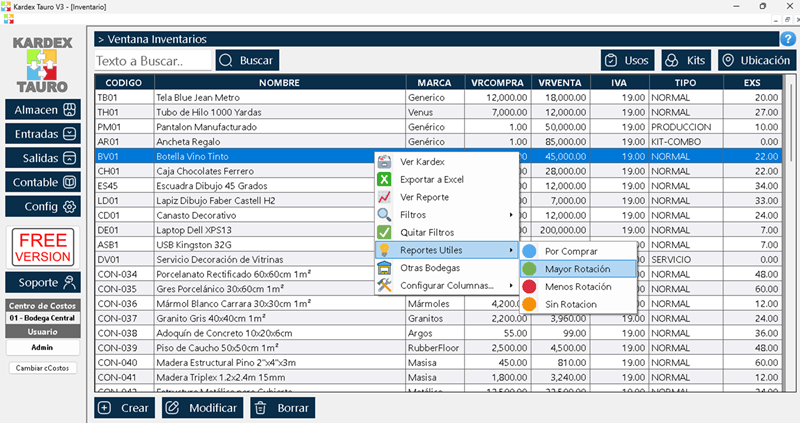
Notice that you never type a movement into the stock ledger: that window is a read-only history that the program feeds by itself with every invoice, purchase, transfer, loss, or return. Nobody can erase or modify a sales outflow, which protects the information against errors and manipulation.
What happens exactly when you finalize the invoice
In Kardex Tauro there is a key difference between saving and finalizing. While the invoice is open or in draft it can be edited, but it does not affect the inventory. It is when you choose "Finalize now" that the document is closed and the system runs the whole update in a single instant. The following table summarizes what happens at each moment:
| Moment | What happens to the inventory | What happens in the stock ledger and receivables |
|---|---|---|
| The invoice is saved as a draft | Nothing: stock does not change | No movements or charges |
| The invoice is finalized | Sold units are deducted; the system verifies that no more than the available stock is sold | The outbound movement is generated automatically in the stock ledger |
| Full payment in cash | Stock already deducted | Cash income is recorded; no account receivable is created |
| Partial payment or credit | Stock already deducted | An account receivable is created for the outstanding balance |
| The customer returns the merchandise | Returned units are added back to the inventory | The inbound movement or return is generated in the stock ledger |
A worked example: a credit sale
Let us look at a concrete case. The business sells toolboxes at 120,000 pesos each and has 25 units in stock. A customer buys 3 toolboxes, for a total of 360,000 pesos, and pays 100,000 in cash; the remaining 260,000 stay on credit. This is how the operation looks before and after finalizing the invoice:
| Concept | Before the invoice | After finalizing the invoice |
|---|---|---|
| Stock of toolboxes | 25 units | 22 units (3 went out) |
| Stock ledger of the product | No sales movement | Outflow of 3 units with a balance of 22 |
| Customer's account receivable | 0 pesos | 260,000 pesos recorded automatically |
| Cash and daily income | 0 pesos from this sale | 100,000 pesos recorded as income |
In addition, the system verifies in real time that you cannot sell more units than are available: if only 2 toolboxes were left, it would not allow invoicing 3. That verification prevents impossible sales that damage the trust in the business. And if the deduction were done by hand, forgetting it only once would be enough to leave the inventory out of sync forever; with Kardex Tauro, the stock of 22 units is recorded in the same second the invoice is closed.
Careful: quotes do not deduct inventory
A frequent question is whether a quote affects the stock. The answer is no. A quote is only a promise of sale: the customer has not bought yet, the merchandise is still in the warehouse, and it can be sold to someone else. Use it when the customer is deciding, comparing prices, or preparing a formal purchase order. When the customer accepts the quote, it becomes a sales invoice, and only at that moment, when the invoice is finalized, is the stock deducted. This distinction avoids a common mistake: quoting separately and ending up deducting the inventory twice, once when quoting and again when invoicing.
And if the customer returns the merchandise
Returns are also part of the cycle. When a sales return is recorded in Kardex Tauro, the system reverses the effect of the invoice on the inventory: the returned units are added back to the stock and the corresponding inbound movement is generated in the stock ledger. In practice, this avoids penalizing the merchandise twice: if the return did not restore the units, the business would lose from its system products that still physically exist in the store. In this way, the inventory picture always reflects the reality of the business, even when sales come back.
Benefits of invoicing with integrated inventory
When the invoice updates the inventory automatically, the business wins on several fronts at the same time:
- Always reliable inventory: stock goes down at the exact moment of the sale, not when someone remembers to deduct it.
- Less duplicated work: the task of invoicing and deducting separately, with its related errors, disappears.
- Traceability to answer "who did we sell this to?": the stock ledger keeps the complete history of every outflow by product, date, and customer.
- Receivables and cash up to date: every invoice leaves its financial record without manual calculations or loose notes.
- Physical counts that match: if the physical count does not match the system, the stock ledger allows tracing the exact origin of the difference.
An invoice that updates, an inventory that matches
Updating the inventory with the invoice is not an accounting luxury: it is the difference between a business that knows what it has and one that guesses. Kardex Tauro was created in Colombia for companies with up to 50 employees, with invoicing that deducts stock, generates the stock ledger movement, and records receivables or cash in a single step. If you want to stop deducting inventory by hand and make sure every sale is recorded from start to finish, request a demonstration of Kardex Tauro and see how your inventory starts to match from the very first invoice.