How to Organize a Physical Inventory Count

How to Organize a Physical Inventory Count
A physical inventory count is the moment of truth for stock control: it is when you compare what the system says you have with what is actually in your warehouse. Organizing it well not only prevents endless shifts counting boxes, but also produces reliable data to reconcile your stock ledger, detect shrinkage early, and buy based on reality. Here we show you, step by step, how to prepare and run an orderly and efficient inventory count.
What is an inventory count and why should you do one?
An inventory count means physically verifying, unit by unit, the real stock of each product and comparing it with the balance recorded in your management system. It is the only procedure that tells you with certainty whether what you believe you have matches what you actually have. Without this check, errors pile up silently: incorrectly filled orders, unrecorded receipts, expirations, and misplaced items distort the information until one day the system says there are 40 units and only 12 are on the shelf.
Running periodic counts allows you to:
- Detect discrepancies early: find shortages or surpluses while it is still possible to investigate their cause.
- Protect your merchandise: repeated shortages in the same item reveal control problems, internal theft, or process errors.
- Buy with real information: avoid running out of key products or piling up dead stock.
- Keep the stock ledger reliable: the expected balance is only useful if it is periodically confirmed against the physical count.
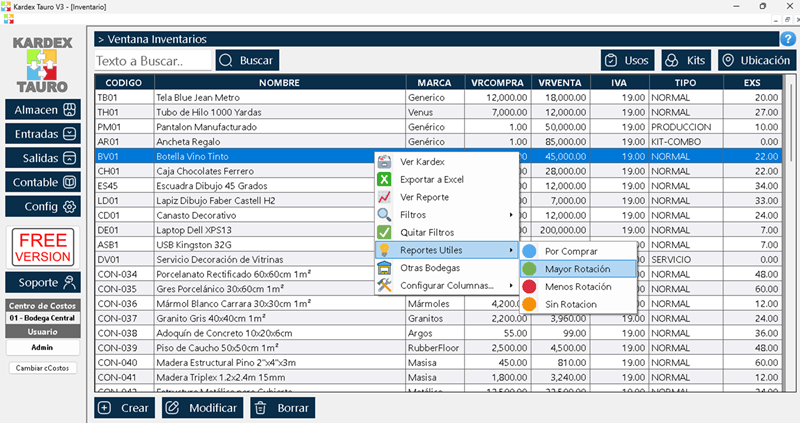
In Kardex Tauro, the program keeps the expected stock record of each product in its Warehouse module; that balance is the reference you reconcile the count against.
Before the count: preparation defines the result
Most failed counts do not fail on count day but in the days before. A messy warehouse, unrecorded documents, or a poorly chosen schedule turn any count into chaos. Spend at least a week preparing:
- Set a date and time outside operational peaks —a weekend, a closing day, or the start of the shift— and notify the whole team in advance.
- Cut off operations: define the exact moment from which no goods will be received or shipped during the count. Every pending document must be recorded or clearly identified before you begin.
- Organize the warehouse into zones: assign letters or numbers to each aisle, rack, and level, and group similar items that are often confused.
- Prepare the count sheets: print one form per zone with the product code, description, and location, leaving the quantity blank so counters are not influenced.
- Get your tools ready: clipboards, markers to flag what has been counted, a calculator or barcode scanner, and a defined place to receive the completed sheets.
- Plan for difficult products: items sold in bulk or by weight need a special procedure, such as weighing a sample and projecting the total.
Full count or cycle count: choose your method
Not every business needs to count everything at the same time. The full count checks every item at once, typical of year-end close or an audit; the cycle count counts by rotating zones or product families throughout the year, with less disruption to operations. Many warehouses use the full count as an annual backup and cycle counts as ongoing control.
| Method | When to use it | Suggested frequency | Effort |
|---|---|---|---|
| Full count | Year-end close, audits, or migration to a new system | 1 to 2 times per year | High: requires stopping operations |
| Cycle count by zone | Ongoing control in medium warehouses | Rotate zones monthly or quarterly | Medium: only the counted area stops |
| Cycle count by family | High-turnover or critical products | According to ABC classification (see below) | Low: few items per session |
A micro-business with a small warehouse can run full counts quarterly; a company with 50 employees and several warehouses usually combines both methods.
On count day: organize the work
With preparation complete, count day should follow an orderly routine:
- Gather the team and assign zones: each pair receives its sheets and a specific zone; nobody counts outside it.
- Count in independent pairs: one person counts and writes; the other verifies aloud and supervises. This reduces human error at the source.
- Mark what has been counted: use a marker or label on each shelf or box reviewed to avoid double counting or gaps.
- Record batches and expiry dates too on the same sheet if your business tracks them: they will help you purge stock nearing expiration.
- Hand the sheets to the coordinator: each sheet must be signed by the pair that completed it.
Double counting is not a luxury: when two people count the same item independently and the results match, confidence in the figure is high. If a critical product shows a difference between the first and second count, do a third before concluding.
Reconciliation: match the count against the stock ledger
Once the physical sweep is finished comes the most important stage: reconciliation. Compare the count sheets, item by item, with the expected stock balance recorded in Kardex Tauro. For each product, the result will be one of three:
- It matches: the physical quantity agrees with the system balance. No action is required.
- Shortage: there are fewer units than expected. Before adjusting, check the whole zone, confirm the item is not misplaced, and review the latest stock ledger movements.
- Surplus: there are more units than expected. Check whether there were unrecorded receipts, undocumented returns, or shipping errors.
Investigation is key: do not turn a location error into shrinkage or an unrecorded receipt into a mysterious surplus. Only after ruling out operational causes should you move on to adjustments.
Confirmed discrepancies: shrinkage and inventory adjustments
When a shortage is confirmed, it must be formalized in the system so the stock ledger reflects reality again. In Kardex Tauro, the Physical Counts window is designed precisely for this: negative differences detected in counts are recorded as shrinkage or decreases, and the program also includes inventory adjustments to correct the balance when the difference has no supporting commercial document. Every adjustment must carry a clear reference —for example, "Shortage in physical count of June 30, main warehouse"— because that text stays in the history and will be your best ally in the next audit.
Not every shortage means theft. The most frequent causes in small businesses are:
- Shipping errors: more units were delivered than invoiced, or the wrong item was picked.
- Receipts or issues that were never recorded at the time.
- Damaged, expired, or misplaced merchandise inside the warehouse that was never written off.
- Natural shrinkage from handling, packaging, or storage, especially in liquids, grains, and fragile goods.
- Customer returns that came in without a document or were put back in the wrong place.
Recording each cause lets you see patterns: if the same item fails in every count, something is wrong with how it is handled; if shrinkage is concentrated in one zone or one shift, the problem is process or control related. Document, adjust, and keep measuring.
How often should you count? Follow the ABC classification
Counting everything with the same frequency wastes effort. The ABC classification prioritizes products by importance: A items are the highest value or fastest movers (few references, big impact), B items have medium importance, and C items are numerous but of low value or movement.
| Class | Criterion | Count frequency | Example |
|---|---|---|---|
| A | High value or high turnover | Monthly or quarterly | Costly spare parts, best seller |
| B | Medium value and turnover | Semiannual | Mid-range catalog line |
| C | Low value or slow movement | Annual | Cheap accessories, slow movers |
Combine this policy with an annual full count: cycle counts keep control during the year and the general sweep confirms the total reconciliation of the warehouse and its stock ledger.
Organizing an inventory count does not have to be a headache. With good preparation, double counting, disciplined reconciliation, and well-documented adjustments, your warehouse becomes a reliable source of information for decision-making. When the count is over, Kardex Tauro will help you reconcile every difference: check the expected balance in the Warehouse module, record negative differences as shrinkage or decreases from the Physical Counts window, and apply inventory adjustments with full traceability. If you are not using it yet, ask for a demonstration and see how a well-kept stock ledger turns every count into an opportunity to improve your business.