Inventory software for hardware stores
Inventory software for hardware stores
Running a hardware store really means managing a giant catalog of products sold by the unit, by the kilo, by the meter, or by the gallon. A single shelf can hold hundreds of references — screws, washers, nails, and wall plugs that differ from one another by millimeters. When the business grows, with a second location, more employees, or more suppliers, manual control becomes unsustainable. The answer is not buying more notebooks; it is adopting inventory software for hardware stores that records every receipt and every issue, protects the money tied up in merchandise, and lets you make decisions with real, up-to-date data. In this article we explain why your hardware store needs it, which features you should demand, and how to implement it without disruption.
Why manual control is costing your hardware store money
A hardware store can easily handle between three thousand and twenty thousand active references, from the cheapest nail to the most expensive power tool. To put the challenge in perspective, think about what happens when a customer asks for a two-inch nail in a business managed with notebooks and paper sheets:
- If that reference has no registered code, the salesperson depends on memory or has to walk through the warehouse looking through boxes that all look alike.
- If nobody knows how many units are left in stock, you risk selling what you do not have or turning away a sale when the merchandise is actually available.
- If the purchase from the supplier was never recorded, nobody knows what was really paid for each batch, what the correct cost price is, or when the payable invoice comes due.
- If several employees are serving customers, each one ends up keeping their own version of what is in stock, and nobody has the complete picture.
- If a product sells slowly, such as paints, sealants, or adhesives, it can spoil or expire on the shelf before anyone notices.
Each of those information gaps turns into silent losses: misplaced merchandise, theft that goes undetected, duplicate purchases, cash imbalances, and customers who go elsewhere to buy what you could not confirm you had in stock.
Notebooks and Excel: allies that fall short
Notebooks and spreadsheets served their purpose when the hardware store was very small and run by a single person. But they have structural limits that no amount of manual tidiness solves: they cannot serve several users at once, they do not deduct stock when an invoice is issued, they do not prevent selling an out-of-stock product, and they cannot tell the merchandise in one warehouse apart from another. The comparison below summarizes what changes when you move from a spreadsheet to specialized software:
| Aspect | Notebook or Excel | Hardware store inventory software |
|---|---|---|
| Control by reference and code | Manual, prone to typing errors | Automatic and centralized in a catalog |
| Stock card or movement history | Very hard to rebuild later | Complete record of receipts and issues |
| Invoicing that deducts stock | No, you must subtract by hand separately | Yes, in real time when invoicing |
| Multiple warehouses or points of sale | Requires duplicated, unreliable files | One system with separate stock levels |
| Multiple users with permissions | No way to know who did what | Profiles with permissions and traceability |
| Detecting shortages and shrinkage | Only with frequent physical counts | Alerts, stock cards, and periodic counts |
In short: the spreadsheet is a recording tool, not a control tool. Inventory software does both: it records every movement and makes sure stock levels always match what is actually in the warehouse.
Key features hardware store software must have
Not every accounting program works for a hardware store. Before choosing, make sure the tool includes at least these functions:
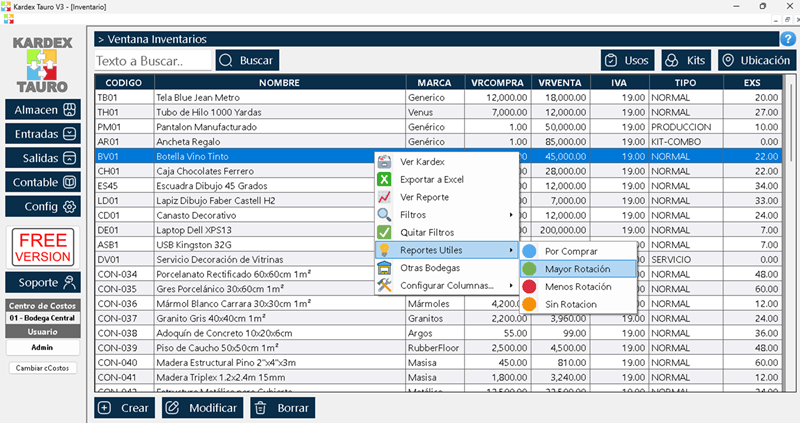
- Products with codes and groups. The catalog must let you create each product with its own code or a barcode, name, brand, unit of measure, purchase and sale prices, and taxes. Groups such as fasteners, tools, paints, or plumbing let you search and filter merchandise in seconds.
- Warehouses and cost centers. If the business has a depot, a branch, or several points of sale, the program must keep independent stock per warehouse and link every movement to a cost center, so you know exactly where you make money and where you lose it.
- Stock card (stock ledger). This is the heart of control: every receipt and every issue is recorded with date, document, quantity, unit cost, and balance, so you can always explain how any product reached its current stock level.
- Purchasing from suppliers. The module must let you create purchase orders, receive merchandise against the order, and have that receipt automatically feed the stock card and the supplier's accounts payable.
- Invoicing that deducts stock. When you issue a sales invoice, the system subtracts the merchandise from the corresponding warehouse in real time. No subtracting by hand at the end of the day and no selling products that no longer exist.
- Shrinkage and decrease control. Damaged, expired, lost, or stolen products must leave the inventory through their own document that records the reason, so shrinkage is never mistaken for a sale or hidden in an imbalance.
- Users with permissions. The manager, the salesperson, and the warehouse keeper should not see or do the same things. User permissions protect information, prevent accidental deletions, and let you know who made each inventory movement.
How to choose the right software for your hardware store
Before signing a contract or downloading any program, evaluate at least these five criteria:
- That it is designed for retail trade: you do not need an expensive industrial system, but an agile tool to operate behind the counter.
- That it adapts to how you sell: electronic invoicing or POS printer, cash and credit sales, and several points of sale if you have them.
- That it is easy to use: if your sales team cannot master it within a week, it will create resistance, errors, and incomplete data.
- That it offers support in your language, clear documentation, and frequent updates, preferably with local backing in your country.
- That it guarantees data safety: automatic backups and data export so you never lose your history if something fails.
A practical rule: compare the program's annual cost with the value of the merchandise you cannot control today. If a tool prevents losing even a small part of what goes missing every year, it pays for itself.
How to implement it in your hardware store
Getting started does not have to be traumatic if it is done in stages and with method:
- Clean up the catalog before typing anything: remove dead references, standardize names, and assign short, logical codes.
- Carry out a complete initial physical count and enter those real balances as the system's opening balances.
- Train the staff with real cases: a sale at the counter, a purchase from a supplier, a return, and a stock count.
- Start with a single warehouse or point of sale and expand once the team masters the process.
- Schedule periodic cycle counts of the fastest-moving references and adjust differences with shrinkage or adjustment documents.
Kardex Tauro: software built for small businesses like your hardware store
Kardex Tauro is an inventory program developed in Colombia, designed for small companies of up to fifty employees, hardware stores included. In a single system it brings together the warehouse, invoicing, purchasing, and stock card modules — everything we have described: a product catalog with codes and groups, stock by warehouses and cost centers, purchase orders to suppliers, sales invoices that automatically deduct merchandise, documents for shrinkage and decreases, and users with different permissions. It is the natural alternative to manual sheets: simple to operate, suited to the reality of Colombian retail, and with the level of control your investment in merchandise deserves.
Is your hardware store still relying on notebooks, loose sheets, and your salespeople's memory? Then every day you are taking an unnecessary risk with your working capital. Get to know Kardex Tauro, try it with your own references, and take the step toward serious, orderly, reliable inventory control. Your warehouse, your cash register, and your customers will notice it from the first week.
