Why Doesn't Your Inventory Add Up?
Why Doesn't Your Inventory Add Up?
You count the boxes in the warehouse: there should be forty-two. The system says there are forty-eight. You check again and count once more: forty-two. Nobody remembers an odd sale or an obvious theft, no supplier picked up merchandise and, yet, month after month the figure on the screen does not match the one on the shelf. If you own a hardware store, a shop or any small business that keeps stock, this scene sounds familiar: the dreaded inventory mismatch.
Inventory mismatches are not a mystery or a business curse: they are the result of movements that happen in the real world but were never recorded, or were recorded incorrectly. Every unit that leaves the warehouse through a sale, a return to the supplier, a breakage, an expiry or a simple oversight, and is not written down at that moment, becomes an invisible difference that builds up until the physical count exposes it.
How you notice that inventory does not add up
Before talking about causes, it helps to recognize the symptoms. These are the most common ones:
- The system says there is stock, but the shelf is empty: the shortage shows up in the fastest-moving and highest-value products.
- Unexplained surpluses: the count finds more units than the system reports, a sign of receipts or issues recorded incorrectly.
- Differences that repeat on the same items: if the same product mismatches month after month, the problem lies in one specific process, not in luck.
A small, occasional difference between the system and reality is expected. The problem starts when the shortage repeats, grows or concentrates on expensive items: at that point it is no longer bad luck, it is a broken process.
The most common causes of inventory mismatches
These are the typical causes behind almost every mismatch in small businesses, how to recognize them, and what to do about each one:
| Cause | How you notice it | How to prevent or fix it |
|---|---|---|
| Sales made without invoicing or without deducting stock | The merchandise left, but the system still shows it as available | Nothing leaves without a document: the finalized invoice deducts the stock |
| Internal theft | Small, repeated shortages, especially in expensive or easy-to-hide items | Restrict warehouse access, count frequently and review stock ledger movements on a regular basis |
| Shrinkage, breakage and expired goods not recorded | Units go missing precisely in fragile, perishable or delicately packed products | Record the shrinkage or the write-off at the moment it happens, not when the count comes |
| Typing errors in receipts and issues | Differences on a single product, with a movement history that does not match | Check each document against what actually came in or went out, and correct the movement |
| Customer returns recorded incorrectly | The merchandise is back on the shelf, but the system never restored it | Record the return as soon as you receive the product, so the stock goes back into the stock ledger |
| Mixing units and measurements | Differences in odd multiples: twelve units over here, one box over there | Define a single unit per product and enforce it strictly on every document |
| Counts done poorly | The result changes from one count to another with nothing coming in or going out | Count zone by zone with a fixed procedure and repeat when the figure is not reliable |
| Transfers not recorded | Units are missing in one warehouse or branch and show up as extras in another | Record every transfer as a movement; each location's inventory then balances on its own |
Notice one detail: almost all of these causes share the same origin. It is not that inventory loses itself: it is that there was a real movement —a sale, a breakage, a return, a transfer— and that movement left no trace in the system.
Movements without a trace: the true source of mismatches
The most typical case is the sale. The salesperson hands over the merchandise, the customer leaves happy, and the invoice is issued later. That promise to invoice afterwards is one of the main mismatch factories: the merchandise is gone, but the system still says it is there. This is why the order of documents matters so much: a quote is not a sale, so it should not deduct stock; it is the sales invoice, once finalized, that deducts inventory and generates the stock ledger movement. If merchandise in your business leaves under quotes that never turn into invoices, shortages are guaranteed.
Something similar happens with returns: the customer brings a product back, the clerk receives it and puts it back on the shelf, and nobody records it. The merchandise is physically there, but the system treats it as sold: it shows as extra in reality and missing on paper, or the other way around. A properly recorded return restores the stock and closes the cycle.
Transfers and shrinkage complete the picture. If you move merchandise between the warehouse and the store without a document, the difference gets split between both inventories. And when a product breaks, expires or gets damaged, that loss is also a movement: if you do not record it as shrinkage at the moment, the count will find it later, with no one responsible and no explanation.
The physical count: the real picture of your inventory
The physical count is not an annual punishment: it is the only way to know what is actually in your warehouse. The key is what you do with the difference. In Kardex Tauro, when the physical count shows a negative difference —there are fewer units than the system reports— you record it as shrinkage, and the stock ledger ends up matching reality. It is not about polishing the figure: it is about making the inventory tell the truth, even when the truth is a loss.
For the count to be useful, do it methodically: count by zones and by shelves, always use the same unit of measure and, if something does not convince you, count twice before adjusting. In businesses with heavy movement, the ideal is to count in cycles: a group of products every week, instead of the whole warehouse once a year. That way, differences are discovered while they are still small and can still be explained.
Six steps to get your inventory to balance again
- Do a complete, reliable physical count: without a real starting point, no later adjustment is useful.
- Clean up your catalog: remove duplicate products, unify units of measure and deactivate the items you no longer sell.
- Record the adjustments: turn the count differences into documented shrinkage or adjustments, not into silent corrections.
- Close the door to untraced movements: a finalized invoice for every sale, a recorded return for everything that comes back, and a documented transfer for every change of warehouse.
- Assign responsibility: a single person authorized to enter the warehouse and to make inventory adjustments.
- Count in cycles: review a group of products every week and compare it against the stock ledger.
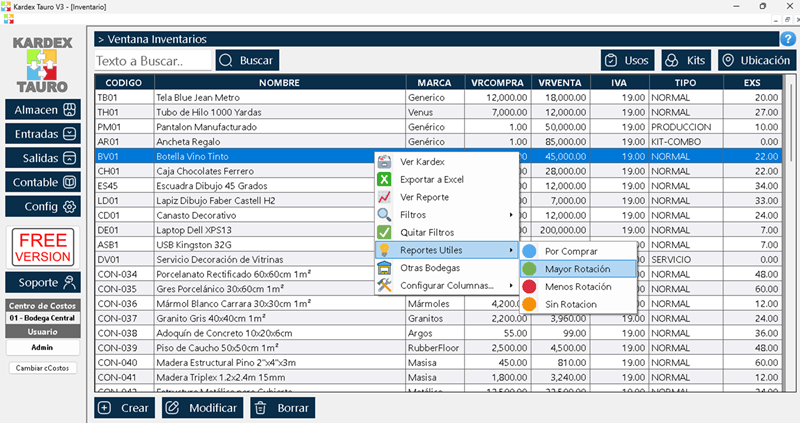
Kardex Tauro supports you in each of these steps: the automatic records it generates with every invoice, return or shrinkage entry are what keep mismatches from coming back.
Inventory does not balance by itself: it balances with method
No small business is condemned to live with mismatched inventory. A mismatch always has a cause, and causes always have a solution: record every movement at the moment, with the right document and the right unit. When the invoice deducts, the return restores, the transfer is documented and the shrinkage is recorded, the system and the shelf start telling the same story again.
Start with the simplest thing: do a good count, adjust the differences and set the rule that nothing comes in or goes out without its document. Within a few weeks, mismatches will stop showing up on your closing nights, and the figures you review will finally be the real ones.