How to Improve Inventory Turnover

How to Improve Inventory Turnover
If there are boxes in your stockroom that have not moved for months, while you finance that merchandise with the cash you need to pay suppliers, employees and utility bills, the problem is not demand: it is inventory turnover. This indicator measures how quickly your merchandise is sold and replenished, and improving it frees up cash, reduces losses from expiration or obsolescence, and lets you operate with less money tied up in stock. In this article we explain what it is, how to calculate it, what it reveals about your business, and which practical strategies you can apply in your store, hardware shop, stationery shop or distribution business.
What inventory turnover is and why it matters to a small business
Inventory turnover is an indicator that answers a simple question: how many times, during a period, usually a year, does the business sell and buy back its inventory? Each time an item is sold and replenished, the inventory is said to have turned over once. A business with high turnover buys, sells and reinvests smoothly; one with low turnover keeps paid-for merchandise sitting idle that produces no income until it finally goes out the door.
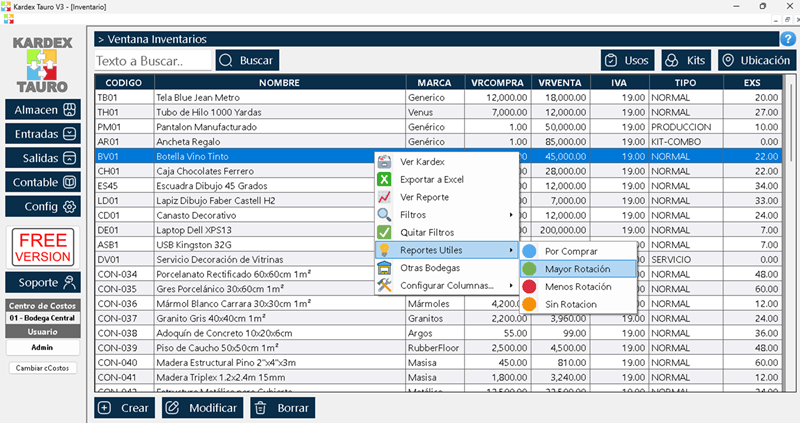
For a small business this number matters twice as much. Working capital is limited and is split between cash, receivables and inventory: money placed in a box that does not sell is money that cannot be used to take advantage of discounts, cover expenses or deal with the unexpected. Besides, stagnant merchandise gets damaged, expires, goes out of style or becomes obsolete, and ends up being sold below its cost or written off as a total loss. That is why turnover is not a topic for accountants alone: it is a daily cash topic. When your stock records are up to date, for example with an inventory program such as Kardex Tauro where the movement history shows what came in, what went out and what remains of each item, you can know with data which products turn over well and which ones are asleep, without relying on loose sheets or on memory.
The inventory turnover formula
The most common way to calculate it is:
Inventory turnover = Cost of goods sold ÷ Average inventory
The cost of goods sold is what the merchandise you sold during the period cost you, not what you invoiced for it. If during the year you sold products that cost you 120 million, that figure is your cost of goods sold. Average inventory is obtained by adding the beginning and ending inventory of the period and dividing by two: (beginning inventory + ending inventory) ÷ 2. The average is used instead of a single balance because stock levels change every day, and looking at just one day would give a distorted reading.
Let us look at a complete example. A cleaning products distributor closed the year with a cost of goods sold of 120 million. It started the period with 24 million in stock and ended it with 16 million, so its average inventory was 20 million. Its turnover is then 120 ÷ 20 = 6 times per year: on average it fully renewed its stockroom six times in twelve months. To express it in days, divide 365 by the turnover: 365 ÷ 6 ≈ 61 days. That is how many days, on average, the merchandise stayed in storage before being sold.
| Calculation element | Example value | How it is obtained |
|---|---|---|
| Cost of goods sold for the year | 120,000,000 | Sum of the cost of all merchandise sold in the period |
| Beginning inventory | 24,000,000 | Stock balance at the start of the year |
| Ending inventory | 16,000,000 | Stock balance at the end of the year |
| Average inventory | 20,000,000 | (24,000,000 + 16,000,000) ÷ 2 |
| Inventory turnover | 6 times per year | 120,000,000 ÷ 20,000,000 |
| Days of inventory | Approximately 61 days | 365 ÷ 6 |
What high or low turnover means
High turnover means merchandise sells quickly, cash comes back soon and the risk of obsolescence is low. It is the expected behavior for food, cleaning supplies and fast-moving consumer goods, which must leave before they expire. But the extreme also raises a flag: if turnover is too high, you may be running out of stock, losing sales because of shortages and paying urgent freight charges for last-minute orders.
Low turnover, on the other hand, points to tied-up capital: money is buying dust on the shelves. That brings storage costs, risk of damage, expiration or outdated products, and it eventually forces you to sell off merchandise at discounts that eat into your margin. It can also reveal poorly planned purchases, unattractive prices or items badly located inside the store. The goal is not the highest possible figure, but a healthy turnover for your type of business and for the margin of each product line. If your result is below what is reasonable for your sector, you have a clear opportunity to improve. And to find it, the best approach is to go down to the detail: the record of entries and exits kept in Kardex Tauro, together with the current stock of each item, lets you calculate turnover product by product without loose sheets and tackle first the articles that are holding the most of your money.
Six strategies to improve inventory turnover
There is no single measure that solves the problem: improving turnover means combining purchasing, selling and control decisions. These are the highest-impact strategies for a small business, with the way to apply each one and the effect you can expect.
| Strategy | How to apply it | Expected effect |
|---|---|---|
| Smaller, more frequent purchases | Replace large monthly orders with biweekly or weekly purchases adjusted to what you actually sell | Less capital tied up in the stockroom and fewer leftovers at month end |
| Promotions for slow movers | Find the items with no sales for 60 or 90 days and offer them in bundles, at a discount or in high-traffic spots | Turns idle inventory into available cash |
| ABC classification of products | Rank your items by share of sales and pay more attention to those that generate most of the income (group A) | Focuses control and purchasing where the money is |
| Supplier negotiation | Ask for longer payment terms, split deliveries, moderate-volume discounts or the chance to return slow movers | Reduces the financial cost of holding inventory |
| Clearing obsolete stock | Remove expired, damaged or dead items from the shelves through special sales or controlled exits | Frees up space and stops the loss from growing |
| Better demand forecasting | Base purchases on sales history by season and by item, not on gut feelings or routine reorders | Purchases better matched to what customers actually ask for |
Which strategy to apply first
If you do not know where to begin, follow this practical order:
- Measure first. Calculate your total inventory turnover with the formula above and write it down as your starting point.
- Go down to the detail. Review turnover by line or by item using the movement history of your stock ledger and identify the products with no sales for more than 60 days.
- Start with purchasing. The fastest, no-investment measure is to reduce order sizes and increase their frequency. Try it for a month on your fastest-turning lines.
- Move what is idle. Launch a focused promotion on the items found in the previous step and measure how long they take to leave.
- Measure again. After a month or a quarter, repeat the calculation with the same method and compare: the trend will tell you whether your decisions are working.
The first step to improving any indicator is being able to measure it with reliable data. If your inventory records live in notebooks, spreadsheets or scattered files, you probably do not know your real turnover today or which products are dragging it down. Keeping your stock ledger up to date, recording every entry and exit with its balance per item as a program like Kardex Tauro allows, turns that question into a quick lookup: the movement history and the current stock give you the basis to calculate turnover by product and decide your purchases with numbers instead of gut feelings.
Improving inventory turnover does not require expensive campaigns or remodeling your stockroom: it requires measuring with a method, buying with judgment, moving what is idle and recording every movement. Apply the formula, review your stock by item and choose two or three strategies from this list for the coming month. The cash you recover will repay the effort many times over.