How to Control Inventory and Invoicing
How to Control Inventory and Invoicing
A business can issue invoices all day long and still have no real idea of how much merchandise is left. It sells, it collects, it hands over the product… and the inventory still says exactly what it said before the sale. The invoice tells one story and the stockroom tells another. At first the difference goes unnoticed; a few weeks later it shows up at the worst possible moment: when a customer asks for ten units of a product the system says are in stock, but the shelf is empty.
That mismatch is rarely caused by theft or a careless employee: it is almost always caused by a process that separated two things that should work together. The sale, the inventory and the money are three sides of the same event. If the invoice is issued on one side and the stock is deducted on the other — or never deducted at all — the business ends up with imaginary stock, an unreconciled cash drawer, and customers who owe money that nobody wrote down. Controlling inventory and invoicing as a single process, rather than as two separate notebooks, is the difference between managing the business and simply hoping it balances out.
In this article I explain why inventory and invoicing must be integrated, which documents take part in the process, how a program like Kardex Tauro handles them, and what concrete benefits a small company gets when every invoice is immediately reflected in its stock and its cash.
Why inventory and invoicing must be integrated
Think of the sales invoice as the signal that tells the business the merchandise has left. If that signal never reaches the inventory, the system stops being a mirror of reality and becomes a file of intentions. Selling without deducting stock is the fastest way to create mismatches: the program shows ten units, you sell three, and the program still shows ten, when only seven are left on the shelf. Nobody made a serious mistake: the mistake is that the sale and the inventory live in separate worlds.
The problem multiplies when the business sells on credit. If the invoice does not automatically record the account receivable, someone has to remember to write down in a notebook who owes what. And memory, in a busy shop, is the worst receivables system that exists. The same applies to cash: a cash sale that is not recorded is money that comes in and disappears from the books. That is why invoicing, inventory, receivables and cash modules are not separate luxuries: they are pieces of the same machine.
The documents that link the sale to the inventory
Every document a business issues or receives has a precise effect on stock and on money. When those effects are recorded automatically and consistently, control takes care of itself. This table summarizes what happens with each document:
| Document | Effect on inventory | Effect on cash or receivables |
|---|---|---|
| Sales invoice | Deducts stock and generates the corresponding stock ledger movement | Records the payment in cash if paid on the spot, or creates an account receivable if sold on credit |
| Quote | None: it does not deduct merchandise or alter stock | None: it records no money movement |
| Sales return | Adds the stock back into the warehouse | Reverses the record: refunds the money through cash or reduces the customer's account receivable |
| Credit note | Adds stock back when it accompanies returned merchandise | Voids or reduces the invoice amount and adjusts the customer's balance |
| Purchase invoice | Increases stock and updates the product cost | Creates an account payable to the supplier or records the cash outflow |
The golden rule is simple: no sales or purchase document should be recorded only halfway. If a sale touches the cash drawer but not the inventory, or a purchase touches the warehouse but not the accounts payable, the mismatch is only a matter of time.
How the process is controlled: the integrated flow of a sale
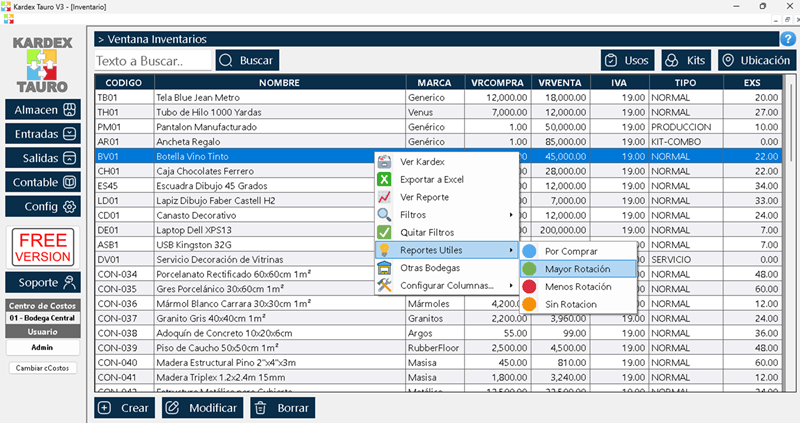
In Kardex Tauro, control does not depend on someone remembering to deduct stock after selling: the program does it the moment the sale is finalized. The typical flow of a sale works like this:
- A quote or order is prepared for the customer. At this point the document is only a sell: the program does not deduct stock with a quote.
- When the sale is confirmed, the corresponding invoice is finalized.
- At that moment the system deducts the stock of every product sold and generates the corresponding stock ledger movement.
- Depending on the payment terms, the program records the amount in cash, if the sale was paid on the spot, or in accounts receivable, if it was on credit.
- If the customer returns the merchandise, the return adds the stock back and voids the original cash or receivables record.
Notice what happens with the quote: since it is not yet a sale, it must not touch the inventory. If every quote deducted stock, the system would show shortages of products that never left. That distinction between documents that commit merchandise and documents that actually take it out of the warehouse is what keeps stock honest.
Besides invoicing and the stock ledger, Kardex Tauro includes accounts receivable, accounts payable and cash modules. With them, money is also integrated into the same process: you know how much customers owe you, how much you owe, how much cash is on hand, and which merchandise backs every number.
Benefits of integrating inventory and invoicing
When every invoice deducts, every return adds stock back and every payment is recorded, the benefits show up in daily operations:
- Real stock: the balance shown by the system matches what is on the shelf, because every outflow and inflow was recorded.
- Fewer errors: nobody has to write things down twice or remember to deduct; the system does it when the invoice is finalized.
- Clear receivables: you know who owes you, how much and since when, with no loose notebooks or lists.
- Reconciled cash: cash sales match the money actually received.
- Better purchasing decisions: knowing your real stock, you decide what to reorder and when, without overbuying or running out.
- Fast closings: balancing the day or the month stops being an ordeal and becomes a review.
Tips to start controlling from today
- Always invoice through the program, even small sales. A sale that is not invoiced is a sale that is invisible to the inventory.
- Define each customer's payment terms clearly: cash or credit. That decision determines whether the system records the sale in cash or in accounts receivable.
- Use quotes to offer and invoices to sell, and do not mix the two documents.
- Reconcile the cash drawer and review receivables at least once a week.
- Run cycle counts on your fastest-moving products to confirm that the system and the warehouse still agree.
Controlling inventory and invoicing is not about working harder; it is about letting each document do its job automatically. When the sale deducts stock, the return adds it back and the money is recorded in cash or receivables, the business finally works with numbers that match reality. And that is the foundation of every good decision: knowing for certain what you have, what you sold and what you are owed.