Accounting Errors Related to Inventories

Accounting Errors Related to Inventories
For a small or medium-sized business, inventory is usually the most significant current asset on the balance sheet and the basis of cost of sales, the largest line in the income statement. In spite of that importance, inventory accounting is one of the areas where mistakes repeat most often: outdated valuations, shrinkage that nobody records, transactions booked in the wrong period, and permanent gaps between what the books say and what is actually in the warehouse. Every failure, no matter how small it seems, distorts cost of sales, profit and the value of assets, and ends up affecting credit, pricing and investment decisions. This article reviews the most common accounting errors related to inventories, explains how they affect financial statements and proposes practical controls to prevent them.
The six most common errors and how to fix them
These are the errors that accountants and managers of small businesses find most often when they review the inventory accounting:
| Accounting error | Typical consequence | How to correct it |
|---|---|---|
| Not valuing inventory at the end of the period | Cost of sales and profit calculated with outdated costs | Run the valuation with the method defined in the accounting policy before issuing reports |
| Ignoring shrinkage, expirations and obsolescence | Overstated assets and hidden losses | Record write-offs and adjustments with supporting documents and review slow-moving items |
| Booking purchases in the wrong period | Costs and profit assigned to the incorrect period | Record the purchase in the period in which the goods are received and controlled |
| Not reconciling physical and book inventory | Differences that grow month after month without explanation | Run cycle counts and adjust with properly documented reports |
| Mixing valuation methods | Incomparable figures and non-compliance with the accounting policy | Choose a single method per type of inventory and apply it consistently |
| Not separating inventory by warehouse or cost center | It is impossible to tell where goods are lost or damaged | Set up warehouses and cost centers and record each movement in its real location |
1. Not valuing inventory at the end of the period
Valuing inventory means assigning a cost to the ending stock by applying the method chosen in the accounting policy, such as weighted average cost, FIFO or specific identification. When the company does not run that valuation at the close, the subsidiary ledgers keep old entry costs and cost of sales is miscalculated as a balancing figure. The effect is double: the asset appears at a value that does not correspond, and the profit of the period is distorted. Valuation is not a year-end formality; it should be executed at every monthly close, before the financial statements are issued.
2. Ignoring shrinkage, expirations and obsolescence
Shrinkage from handling or damaged packaging, expired products and obsolete references are a reality in almost every business. If they are not recorded, the book inventory stays above the value that can really be recovered, and the loss remains hidden inside the asset. The right approach is to document each write-off with evidence, such as a report or a shrinkage form, record the adjustment and periodically review slow-moving stock to make provisions or write off what can no longer be sold. A company that never adjusts for shrinkage ends up believing it has more merchandise than it can sell and makes decisions based on wealth that does not exist.
3. Booking purchases and sales in the wrong period
The cut-off error consists of recording a purchase or a sale in a month different from the one it belongs to. It is common when the supplier's invoice arrives after the merchandise, or when documents are recorded using the date of the voucher instead of the actual date of the transaction. As a result, the cost of sales, the profit and the ending inventory of a period are calculated with items that belong to another one. To avoid it, a clear rule should be set: the purchase is recorded when the goods are received and under the company's control, and the sale when the goods are delivered or invoiced, according to the defined policy.
4. Not reconciling physical and book inventory
When the figures in the system are never compared with what is in the warehouse, differences caused by losses, recording errors, badly processed returns or deliveries without invoices accumulate silently, and the surprise at the end of the year can be significant. The recommended practice is to run cycle counts during the year, prioritizing the warehouses and references with the highest turnover and value, plus a full physical count at least once a year. Every difference must be analyzed, reconciled and adjusted with a signed report. The goal is not to change the system so it matches the warehouse, but to understand why they do not match.
5. Mixing valuation methods
Applying one method in one period and a different one in the next, or using different methods for identical references, breaks the comparability of the financial statements and contradicts the accounting policy. The financial reporting standards applicable to small businesses require the chosen method to be applied consistently to inventories of similar nature and use; changing it is only justified when the new policy provides more relevant and reliable information. The practical approach is to document the method in writing and make sure the software or the spreadsheet always applies it in the same way.
6. Not separating inventory by warehouse or cost center
If all products are recorded in a single group, regardless of the warehouse, point of sale or project they belong to, it is impossible to know where merchandise is lost, damaged or left behind, and the real profitability of each line or branch cannot be measured either. Separating inventory by warehouse and cost center makes it possible to control the merchandise where it actually is and hold each person in charge accountable. When several locations are managed, every inbound or outbound movement should indicate its source and destination warehouse from the very first record.
Impact on the financial statements
Inventory errors do not stay in a subsidiary ledger; they move directly into the financial statements. If the ending inventory is overstated, cost of sales looks smaller and profit looks larger than it really is; if it is understated, the opposite happens. On the balance sheet, an inflated inventory overstates current assets and equity, and can lead the company to request credit with guarantees that do not exist or to distribute profits that have not actually been generated. Distorted figures also ruin key indicators such as inventory turnover, working capital and gross margin, which are exactly what banks, partners and potential investors review.
How to prevent these errors in day-to-day operations
Most of these errors are prevented with discipline and simple procedures:
- Define in writing the valuation policy, the treatment of shrinkage and the cut-off rules for transactions.
- Run cycle counts of the fastest-moving references and a full physical count every year.
- Reconcile every month the inventory subsidiary ledger against the accounting records and the count results.
- Control the documents: every inbound and outbound movement must have support and be recorded the same day.
- Review slow-moving stock every quarter to detect obsolescence in time.
- Train the staff in the warehouse and in billing so they understand the accounting impact of their records.
The role of integrated software
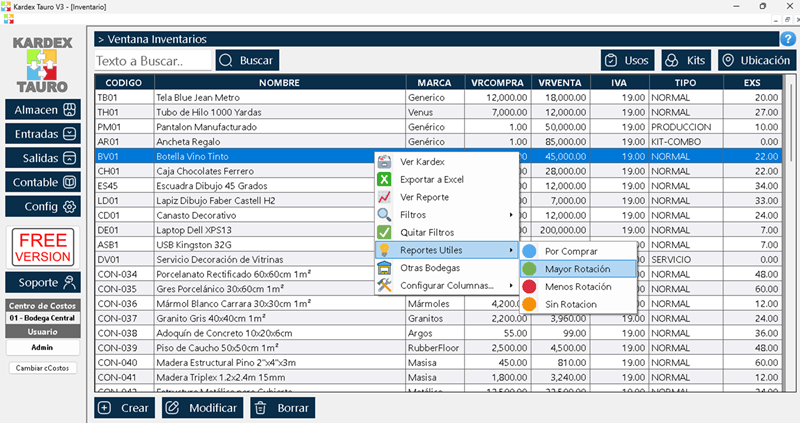
In practice, the best defense against human error is a system that records movements automatically and keeps them connected with the accounting. Kardex Tauro, for example, integrates inventory with the accounting and receivables and payables modules: when a purchase or an invoice is finalized, the program generates the stock ledger movement and updates the accounts payable or receivable at the same time, so inventory, accounting and receivable information is never recorded twice or left behind by omissions. It also supports cost centers and warehouses and tracks shrinkage, which is exactly what prevents the errors described in this article. With a program such as Kardex Tauro, the accountant spends less time correcting and more time analyzing.
Well-kept inventory records are not an accounting luxury: they are the basis for knowing how much it costs to sell, how much the company really earns and which assets it can count on. Reviewing current processes, correcting the typical errors and relying on a system that automates the records are the steps that separate a small business that controls its inventory from one that only guesses at it.