How to Reduce Inventory Costs
How to Reduce Inventory Costs
If you run a small business, you probably think of inventory as an asset: merchandise you bought that will someday turn into sales. But while that merchandise sits in your warehouse, it is also one of the biggest sources of expense in your company. Money sitting idle on shelves does not pay salaries, does not cover utilities, and cannot be invested in anything else. Understanding what your inventory really costs you, and taking concrete action to reduce it, is one of the fastest ways to improve the cash flow of a small business.
This article does not offer magic formulas. It offers the opposite: an orderly method to identify the costs your inventory is generating today, and a practical plan to reduce them without running out of merchandise to sell.
What Costs Does Holding Inventory Generate?
When people think about the cost of inventory, they almost always remember only the purchase price of the goods. But reality is broader: every product sleeping in your warehouse generates a chain of costs that accumulate month after month. These are the main ones:
| Type of cost | What it consists of | How to reduce it |
|---|---|---|
| Tied-up cash | Capital invested in merchandise that has not been sold yet and produces no return. | Buy only what you need and speed up turnover with ABC classification and frequent purchases. |
| Storage | Space, shelving, utilities and warehouse rent. | Free up space by clearing out slow movers and organizing the warehouse by how often items go out. |
| Shrinkage and damage | Products damaged, expired or lost through poor handling or lack of control. | Record shrinkage, watch expiration dates and take care of storage conditions. |
| Obsolescence | Merchandise that loses value due to seasons, fashion or technology changes. | Sell the oldest stock first and clear out items that no longer move in time. |
| Insurance | Policies whose value is calculated on the merchandise insured. | Keep only the level of stock needed to operate normally. |
| Staff and administration | Hours your team spends counting, organizing, searching and controlling stock. | Use a reliable record of stock and costs that reduces manual work. |
The sum of these six items can turn a "good purchase deal" into a silent financial burden. That is why the first goal is not to buy cheaper, but to buy better and hold only what you will really sell.
First Step: Know What You Have, Where It Is and What It Costs
You cannot reduce what you cannot measure. If you do not know how many units of each product you have, what you paid for them, and how long they have been in the warehouse, every purchasing or discount decision is made blind. An up-to-date inventory record is the foundation of the whole cost-reduction process.
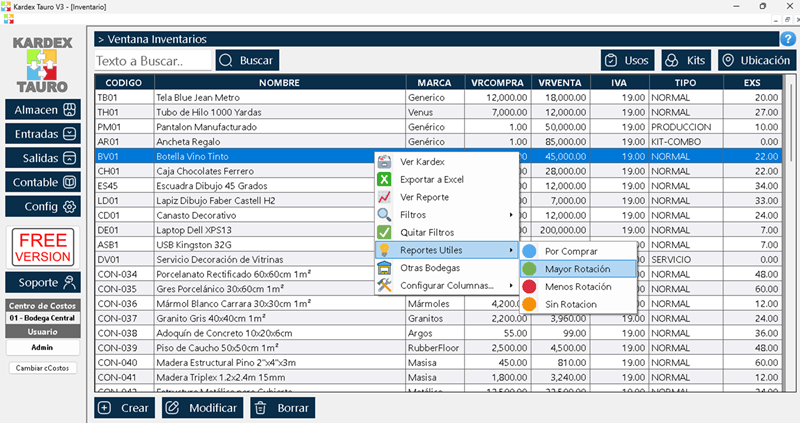
Keeping that record does not mean filling endless notebooks or spreadsheets. A program such as Kardex Tauro records merchandise inflows and outflows with their costs and updates the average cost of each product every time you register a purchase. That way you always know the real value of what you have in the warehouse, instead of the approximate value you remember from the last invoice.
ABC Classification: Focus First Where the Money Is
Not all products deserve the same attention. In almost every business, a small group of products concentrates most of the value of the inventory, while many others represent very little. ABC classification helps separate them into three groups so that control is focused where it is needed most:
| Class | What kind of products it groups | Where to focus management |
|---|---|---|
| A | Few products that concentrate most of the inventory value. | Strict control: frequent counts, periodic review of stock and costs, purchases adjusted to real demand. |
| B | Products with medium value and turnover. | Periodic control: weekly or biweekly review of levels and orders. |
| C | Many products with low value or slow turnover. | Simple control: less frequent orders and monthly review. |
ABC classification is not done once: it should be reviewed from time to time, because a product in class A today may stop selling and move to class C. The key is that control effort follows the money.
Buy Smaller and More Often
Large purchases look attractive because of volume discounts, but they have a hidden cost: a batch that takes months to sell keeps generating storage, insurance and tied-up cash the whole time. In many cases, the discount you earned by buying big is later lost in the costs of holding unsold merchandise.
Buying smaller quantities more frequently lets you match inventory to real demand, free up space and reduce tied-up cash. For this to work, you must know the selling pace of each product, information that comes from the sales history in your stock ledger, not from intuition.
Improve Turnover and Clear Out Obsolete Stock
Turnover tells you how many times a product is sold and replenished in a period. A product with low turnover is a candidate to become a cost: it takes up space, ties up value and may become obsolete. Practical actions to improve it include selling the oldest units first, placing slow movers in visible spots, offering them in bundles with fast movers, and checking expiration dates well in advance.
When a product no longer sells, the worst thing you can do is keep it waiting for a sale that will probably never come. Clearing it out at a discount, returning it to the supplier when the agreement allows, or donating it for a tax benefit recovers at least part of the money and frees space for merchandise that actually moves.
Negotiate with Your Suppliers
Your supplier is an ally in reducing inventory costs, not an adversary. Many negotiations go beyond the unit price: longer payment terms, partial deliveries of the same order, smaller minimum order quantities, returns of slow-moving merchandise and early-payment discounts. Each of these conditions reduces the need to hold your own stock.
A small business that knows its turnover numbers and its costs per product negotiates from a much stronger position than one that only asks for "a better price".
The Right Safety Stock: Without Running Out
Reducing inventory does not mean running out of merchandise. Stockouts also cost money: lost sales, customers who go to competitors, and emergency purchases at high prices. The goal is the middle ground: a safety stock that is small but sufficient to cover normal supplier delays.
The right size of that buffer is calculated by looking at the real consumption of each product over recent months, not by guesswork. Fast movers deserve a wider margin; slow movers need almost no buffer at all. In this way you reduce tied-up cash without risking customer service.
A Five-Step Action Plan
- Bring your record up to date: make sure stock levels and costs for every product are current in your inventory system.
- Classify your inventory: separate products into classes A, B and C according to their share of total value.
- Identify hidden costs: list products that do not move, items close to expiration and stock taking up more space than needed.
- Adjust purchases: reduce batch sizes for A and B products and increase order frequency according to real demand.
- Clear out the excess: apply discounts, bundles or returns to slow-moving merchandise and use the freed space for what actually sells.
Executing this plan just once already produces visible results in your cash flow. But the real savings appear when the discipline is maintained: inventory reviewed frequently, purchases that follow demand, and products that do not pile up out of habit. Tools such as Kardex Tauro help sustain that discipline by showing stock levels and costs per product at all times, even separating operations by warehouse or cost center and recording the shrinkage that used to go unnoticed. Less money idle in the warehouse means more capital available to grow your business.