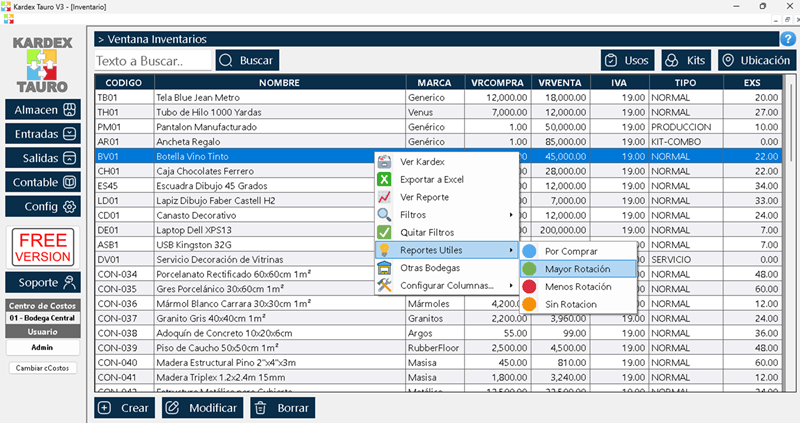
How to Control Inventory in a Factory
How to Control Inventory in a Factory
When a small company decides to manufacture its own products, inventory control changes completely. It is no longer enough to know how many units of each item are on the shelves: now you must know how much raw material is available, how much material is being transformed on the production floor, and how much finished product is ready to be sold. These are three different inventories moving at the same time, and if you only control one, the other two become a mystery that you discover too late, when you run out of inputs to fulfill an order or when finished products appear that nobody knows which materials were used to make them.
The most common mistake in small factories is not a lack of physical order, but a lack of records of transformations. Raw material leaves the warehouse, becomes work in process, and then becomes finished product, but if no document records that journey, the inventory shown by the system never matches what is physically in the plant. This article explains how to control inventory in a small factory: what types of inventory exist, how to record entries and exits, how to control raw material consumption in production, and how to record shrinkage so that the numbers always tell the truth.
The three inventories that coexist in a factory
Every manufacturing process holds three types of inventory that must be controlled separately, because each one has a different origin, movement, and purpose. Raw material is everything that arrives from the supplier and has not yet been transformed. Work in process is material that has already left the warehouse and is being cut, assembled, painted, or packed on the shop floor. Finished product is the final output of the line, ready for sale or delivery. Mixing them up is the root of almost every inventory problem in factories.
| Type of inventory | Example in a factory | How to control it |
|---|---|---|
| Raw material | Wood boards, paint, hardware, and screws in a furniture factory | Record every purchase as a warehouse entry and every withdrawal to production as a raw material consumption linked to a production order |
| Work in process | Furniture partially assembled, sanded, or waiting for paint in the workshop | Control it by difference through open production orders: what has already been consumed but not yet received as finished product is still in process |
| Finished product | Completed furniture, packed and ready to deliver to the customer | Record production receipts as the line delivers units, with partial entries until the planned quantity is completed |
Work in process is rarely counted physically every day, and it does not need to be. It is controlled by difference: if a production order consumed raw materials worth one hundred units and has not yet returned anything as finished product, those one hundred units are in process. That is why factory inventory control depends on every consumption and every receipt being recorded against the correct order.
Record every entry with the right document
Every item that enters the factory must be recorded with the document that matches its origin. Raw materials purchased from suppliers are recorded as warehouse entries, just like any purchase, and from that moment they become part of available stock. But the finished product that comes off the production line is not a purchase: it is the result of an internal process, and it must enter inventory as a production receipt. Recording finished product as if it were a purchase breaks traceability, because the system loses the link between what was manufactured and the raw materials consumed to make it.
The production order, the center of factory control
To control inventory in a factory, recording isolated entries and exits is not enough: you must know what each batch was made for and with which raw materials. That is why the process starts with a production order, the document that formalizes which product will be made, in what quantity, who produces it, and who requests it. In Kardex Tauro, a production order is created with products configured as a production line, and while the document remains open it can be edited without affecting inventory. Once finalized, the order is locked and ready for execution in the workshop.
When the order is created, inventory does not move: the order is the plan. Movements happen later, at two moments that must be documented: when raw material leaves for production and when finished product returns to the warehouse. If those two moments are always recorded, the factory knows at all times what it has, what it is producing, and what it still needs to produce.
Raw material consumption linked to production
Every time production staff withdraw raw material from the warehouse to manufacture, that withdrawal must be recorded as a warehouse consumption. In Kardex Tauro, when a consumption is made with a production order as its destination, the consumed products are linked to that specific order, and the trail of which input was used in each batch is never lost. When the document is finalized, the consumption automatically deducts stock from inventory and generates the record in the stock ledger as an output of merchandise. The system also validates that you cannot consume more units than are available in the warehouse.
Think of a concrete example: production order number 15 plans to make one hundred dining tables. For that, a warehouse consumption is recorded that takes the boards, paint, and hardware out of the warehouse. The moment that consumption is finalized, raw material stock drops immediately and the material is associated with order 15. When someone later reviews that order, they see exactly what was consumed and in what quantities.
If consumptions are not recorded, the raw material inventory will always show more than what actually exists. That is the main cause of stockouts in small factories: the system says material is available, but that material was already transformed into work in process days ago and nobody deducted it.
Receiving the finished product
As production advances and delivers units, the receipt of finished product is recorded. There is no need to wait for the whole batch to finish: Kardex Tauro allows partial entries as the line delivers, and each receipt increases the stock of finished product and is recorded as an entry in the stock ledger. Of course, you cannot enter more units than were planned in the order, because that would mean receiving material that has no support in any consumption.
This moment closes the cycle: raw material left the warehouse with a consumption, was transformed in the workshop, and returns as finished product with a receipt. If both movements are recorded, the cost of what was manufactured is backed by real consumptions and inventory reflects the truth of the process.
Manufacturing shrinkage must also be recorded
Every factory has unavoidable losses: material damaged during cutting, units that come out defective, broken packaging, inputs that expire or spill during handling. If those losses are not deducted from inventory, the system reports stock that physically does not exist, and the physical count never matches the record. That is why shrinkage and decreases are a mandatory part of control: they are the document that formalizes the permanent exit of products due to deterioration, damage, expiry, or obsolescence. When a shrinkage is finalized, stock is deducted and the movement is recorded, so the system inventory matches what is actually in the plant.
Recording shrinkage does more than keep inventory tidy: it also reveals where money is being lost. If a factory records high, recurring shrinkage in the same operation, that data indicates that the process has a quality or material-handling problem worth fixing.
A simple routine for controlling factory inventory
Factory inventory control does not require complicated processes, but rather consistency in a few steps that must be repeated in every production cycle:
- Plan with production orders. Before manufacturing, create the order with the product, the planned quantity, and the responsible area.
- Record consumptions as soon as raw material leaves. Do not wait until the end of the shift or the end of the month: the later you record, the easier it is to forget what was used and in which batch.
- Receive finished product in batches. Enter units as the line delivers them, so the product is available for sale without waiting for the whole batch to finish.
- Record shrinkage on the same day it happens. A damaged product that is not deducted today will be an unexplained difference at the next physical count.
- Review the status of orders regularly. An order that stays open for too long means material in process that has not been closed, or a production run that was never completed.
- Perform physical counts and compare with the system. Reconciling what the program says with what is on the shelves is the final proof that control is working.
Controlling inventory in a factory is not about counting finished product: it is about controlling the entire flow, from the raw material that enters to the shrinkage that is discarded, passing through every consumption and every production receipt. When production orders, raw material consumptions, finished product receipts, and shrinkage are all recorded in the system, the small factory knows how much each batch costs to produce, how much material it really has, and when it must buy. That knowledge turns inventory from a headache into an advantage: produce with what you have, buy only what is missing, and never discover the problems when it is already too late.