How to Control Inventory in a Small Business

How to Control Inventory in a Small Business
A small business does not need a warehouse department or a full-time stock manager to keep an organized inventory: it needs a method. When there are already dozens or hundreds of items on the shelves, the owner's memory is no longer enough: stock stops balancing, you buy too much and too little, and nobody knows for sure how much there is. Controlling inventory in a small business is not a matter of expensive technology or specialized staff: it is a matter of simple rules applied every day.
Step 1. Give every product a code from day one
The first step is to give every product a unique identity. The name is not enough: two suppliers can sell almost identical items under different names, and the same product can arrive in different presentations. Assign each item a short, stable code and use it everywhere: in purchases, in sales, in counts and on shelf labels.
Also define the unit of measure for each item, whether unit, box, kilogram or meter, and respect it in every record. Mixing units is one of the most common causes of differences: recording receipts in boxes and issues in units, without converting, corrupts any system no matter how good it is.
Step 2. Record every receipt and every issue at the moment it happens
The golden rule of inventory control is simple: if something comes into or leaves the warehouse, it gets written down. It does not matter whether it is a purchase, a shipment, a transfer or shrinkage: every movement must be recorded on the same day it happens, ideally at the exact moment.
The temptation to write it down later is the number one enemy of inventory: when recording is postponed, the information arrives incomplete, with errors, or never arrives at all. Build the habit of recording each movement as soon as it happens: a purchase is recorded when the goods are received and verified, not when the supplier's invoice arrives; a sale is recorded when the product is delivered, not at closing time.
Step 3. Invoice every sale: the issue is born from the invoice
In most small businesses, inventory is lost in sales that are not invoiced or are invoiced incorrectly. If the salesperson hands over the product and the issue is only recorded when someone remembers, stock will always be out of sync. The issue should be born from the same sales document: when invoicing, the system automatically deducts stock and keeps the history of each product ready to consult.
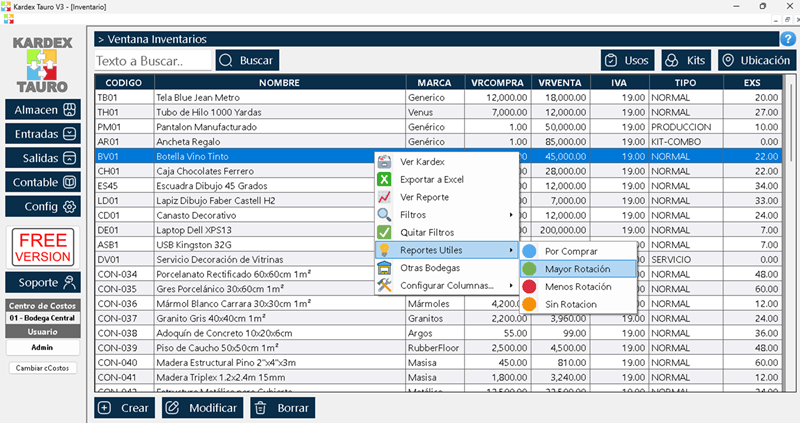
Kardex Tauro was designed exactly for this: the sales invoice deducts stock and generates the stock ledger record for each item automatically. It is a tool built for small businesses of up to fifty employees that need large-company results without hiring additional staff.
How to run these processes with no dedicated staff
The question every small business owner asks is who does all this when there is no warehouse manager. The answer is that each task is shared among the people who are already there, with realistic frequencies:
| Process | How to do it with no dedicated staff | Frequency |
|---|---|---|
| Receiving purchases | The person present in the business receives the goods, checks them against the supplier's invoice and records them the same day. | Every time goods arrive |
| Sales and shipping | The sale is invoiced at the moment it happens and the issue is recorded automatically. | Immediately |
| Physical count | Count whole sections or product families, not the entire warehouse at once. | Weekly or monthly, rotating |
| Differences and adjustments | Review each one against the stock ledger record and let only the owner or an authorized person correct them. | Whenever one appears |
Step 4. Count inventory with a method and on a schedule
The periodic physical count is the proof of the pudding: it confirms that what the system says matches what is actually on the shelves. With no dedicated staff there is no need to close down to count everything at once: count by sections or by families, on a rotating basis, so that every item is counted at least once a month.
For the count to be useful it must follow a method: nobody counts from memory, quantities are written down on a form, and differences are investigated before they are corrected. If units are missing, it is worth knowing whether the cause was a recording error, shrinkage, theft or a shipment that was never invoiced.
Step 5. Clear rules: who receives, who ships, who corrects
Inventory control depends less on tools and more on knowing who does what. In a small company everyone ends up handling the goods, and that is fine as long as the rules are clear: one authorized person receives and verifies purchases, another, or the same one, handles shipping, and only the owner or a manager with permission can correct differences or void movements.
Kardex Tauro manages users with permissions, so each person sees and does only what corresponds to them: the salesperson invoices, the supervisor receives goods and adjusts stock, and the administrator consults the reports. The program also lets you organize the business by warehouses or cost centers, ideal when there are several points of sale, a separate warehouse or projects sharing inventory.
Step 6. Load your opening inventory properly
No system can fix a messy starting point. Before starting to use software, you must carry out a complete and reliable physical inventory with the code, name, unit and actual quantity of every product. If that base is wrong, everything built on top of it will drag the error along for months.
Kardex Tauro lets you import the opening inventory from Excel: the information is organized in a template, reviewed and loaded in minutes, without typing product by product. The start-up becomes a job of a couple of hours instead of weeks, and the system starts operating on day one with real figures.
Excel or software: signs that it is time to switch
Excel is an excellent starting tool, but it has a natural limit: it depends on someone maintaining the formulas, it does not control who edits what, and every typing error spreads silently. These signs indicate that the spreadsheet is no longer enough:
- Stock has to be corrected by hand every week because it never balances.
- Two people check the inventory at the same time and each sees a different figure.
- Sold-out products are offered, or orders are turned down for items that are actually available.
- Time is wasted reconciling the spreadsheet, the invoices and the physical counts.
When several of these signs appear, the cost of not switching has already exceeded the cost of switching. Inventory software for small businesses eliminates double entry, keeps a record of every movement and delivers stock, turnover and value reports in a few clicks.
Inventory control is a daily decision
Controlling inventory in a small business does not require a full department: it requires a code for every product, a record of every movement, an invoice for every sale, periodic counts done with a method, and clear rules about who does each task. When those habits are followed every day, the owner knows how much they have, how much it is worth and what they need to buy.
