How to Control Stock in a Kitchen
How to Control Stock in a Kitchen
A restaurant kitchen is, in practice, a warehouse with stoves. Fresh food, dry goods, drinks and packaging share its shelves, fridges and freezers, and they come in almost every day. Because everything moves fast and little lasts more than a week, when stock is not controlled the classic symptoms appear: you buy too much and throw away expired food, the main ingredient of the day's special runs out during the lunch rush, and at the end of the month nobody knows whether the kitchen made money or lost it.
Controlling stock in a kitchen does not mean turning the cook into an accountant. It means keeping three simple routines: know what comes in, know what goes out, and count what is left from time to time. Here we explain how to put them into practice in a small restaurant, using the principles of an inventory program designed for businesses with up to fifty employees.
Record what comes in: the purchase does not end with the invoice
Control starts at the kitchen door. When the order arrives, someone has to receive it, check the quantities against the invoice, weigh or count every item and inspect perishables before storing them. If the receipt is not recorded, tomorrow's ingredient appears as if it did not exist. That is why one person should be in charge of receiving, the goods should be recorded the same day they arrive, and expiry dates and batches should be noted on perishables.
Each ingredient must exist as a product, with its unit of measure —kilograms, liters, units— and its cost. The product file keeps the value of the last purchase and every receipt updates it: when the price of tomatoes goes up, the cost of your dishes stays real. This matters in a kitchen because food prices change often, and an outdated cost ruins any later calculation.
Record what goes out: kitchen consumption
The key is understanding that cooking is not selling. The sale is recorded when the customer pays, but the ingredients left the pantry before that. If you only record sales, the system will keep showing the chicken that was already cooked and served as available stock. The raw materials that become dishes leave the inventory as internal consumption, not as a sale.
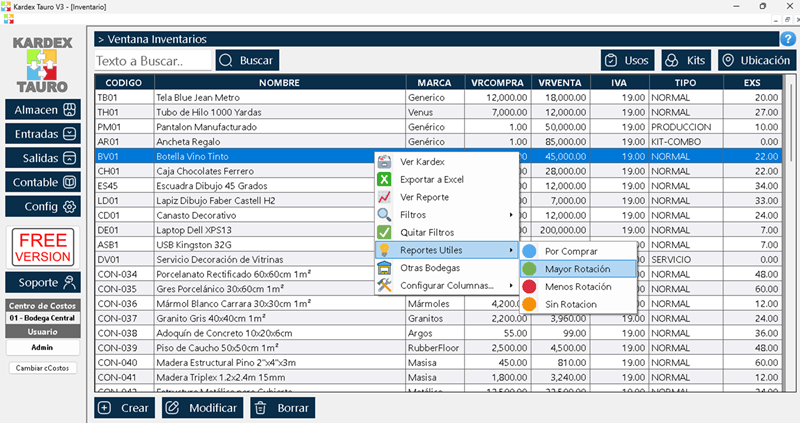
That is exactly what Internal Consumption in Kardex Tauro do: documents that formalize the exit of products for internal use —such as raw materials that are transformed or food that is prepared—. When they are finalized, the stock of each ingredient is deducted automatically and the movement is recorded in the stock ledger; the system also checks that there is enough stock before allowing the exit. In practice, at the end of each shift you record a consumption with the real quantities used —rice, protein, oil— naming who receives the ingredients and who requests them.
If every dish is a recipe, define it with its components
When the menu is stable, it helps to treat each dish as a composite product: the Kits window in Kardex Tauro lets you define the recipe of a Kit or Production Line product, with each component and its exact quantity per unit. The system checks stock and deducts the right amount of each component when the dish is prepared or sold; thirty portions of the day's special are documented in a single movement, with their raw-material usage statistics.
Where everything that leaves the pantry goes
| Type of exit | Example in the kitchen | How it is recorded | Effect on stock |
|---|---|---|---|
| Internal consumption | Ingredients used to cook the menu | Internal Consumption | Deducts stock when finalized |
| Shrinkage or write-off | Damaged or expired food and unusable leftovers | Shrinkage or Decrease | Deducts stock and records the cause |
| Sale | Dish or drink served to a customer | Sales invoice | Deducts the product and records the income |
Shrinkage is not a mystery: record it
Every kitchen has losses: the onion that went bad, the milk that expired, the burnt portion, the leftover salad. The problem is not that they exist, but not knowing how much is lost or why. Shrinkage is the permanent exit of an ingredient with no compensation, and it must be recorded with its cause: spoilage, damage, expiry, preparation error or leftovers. With the person responsible and the reason documented, a shortage stops looking like a mistake or something suspicious; and when you review the shrinkage list by cause, patterns appear —what spoils most, on which shift— so you can fix the source instead of accepting it.
Most common causes of shrinkage and how to fight them
| Food | Most common cause | Practical measure |
|---|---|---|
| Vegetables and fruit | Moisture damage or poor rotation | Check the fridge every two days; first in, first out |
| Dairy | Expiry before it is used | Buy smaller amounts more often |
| Meat and chicken | Broken cold chain | Thaw only what you will use |
| Day's preparations | Leftovers that cannot be reused | Cook according to real demand |
Count the fridge and the pantry often
Reality always wins, even when the system is well fed. A physical count compares the records with what is actually in the fridge, pantry and freezer. You do not need to count everything in one day: a rotating count by family works better —perishables twice a week, dry goods and drinks weekly, and a general count at the end of the month— with two people: one counts and one writes down.
Count differences must be recorded so the inventory balances: in Kardex Tauro, the negative differences found in physical counts are recorded as shrinkages or decreases, and surpluses are adjusted as well. If the count always shows less than the system, the problem is the records, not the fridge: review which exits are not being documented.
Never run out of the day's special
Running out of the main ingredient of the day's special costs you the sale and the customer's trust. To avoid it, set a reorder point for every critical ingredient: the minimum level at which you can still operate while the replacement arrives, based on average daily use, the supplier's delivery time and a safety margin. Before ordering, check the current stock and buy only what is missing; many programs also let you set a minimum stock in the product file so the system warns you.
| Ingredient | Daily use | Stock in the kitchen | Reorder point |
|---|---|---|---|
| Tomatoes | 4 kg | 6 kg | 5 kg |
| Chicken | 8 kg | 15 kg | 10 kg |
| Rice | 6 kg | 20 kg | 8 kg |
| Oil | 2 liters | 4 liters | 3 liters |
For the day's special, plan one day ahead: check what is in the fridge, build the specials around what is about to expire and order only what is missing. That way the menu rotates stock instead of generating emergency purchases.
Know what your cooking costs
Stock control and food cost are the same task seen from two sides. If consumptions are recorded with values —the cost of each ingredient according to its last purchase—, at the end of the month you add up what the kitchen used and compare it with sales: the food cost percentage. If it goes up while prices have not changed, review portions, shrinkage and preparation waste. To close the month, use the inventory equation: opening stock plus purchases, minus consumptions and shrinkage, must equal the final count. If it does not balance, something left without a document; with the stock ledger at hand, the cross-check takes minutes.
A routine you can actually sustain
- Every day: record goods received and the shift's consumption at closing time.
- Every two or three days: check the fridge, set aside what is about to expire and plan the menu around those products.
- Every week: rotating count of one product family and a review of shrinkage by cause.
- Every month: general count, food cost closing and comparison with sales.
The kitchen will always move fast; what can change is the order of the records: documented receipts, consumption per shift, shrinkage with its cause and periodic counts that bring the system in line with reality. That way, a small restaurant always knows what it has, what it lacks and how much it costs to cook. In a business where the margin is won or lost in the kitchen, that is the difference between working blind and working in control.