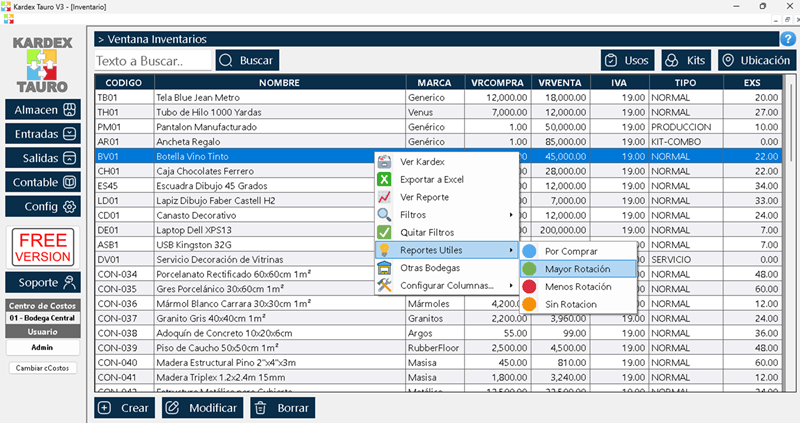
Inventory Program with Invoicing
Inventory Program with Invoicing
Selling is easy when the business is small and everything fits in your head. The problem starts when you can no longer remember how many units are left of each product, how much your customers owe you, or why the cash drawer does not match the sales. An inventory program with invoicing brings merchandise, sales and money together in one system: each transaction is recorded once and everything else happens on its own.
For a small business, keeping inventory in a spreadsheet or a notebook and invoices somewhere else is the most common cause of discrepancies. Merchandise leaves through the door with every sale, but the stock record is updated later, if it is updated at all. Here we will look at what it should include, why it is better to integrate both functions, and how to choose and implement one.
The Problem of Keeping Inventory and Invoicing Separately
When stock records and invoicing live in different places, every sale forces you to write twice, in two systems that do not talk to each other. That duplicated work is the gateway for mistakes: an invoice is voided and the stock is not restored, a return is received and nobody records it, a price changes and the list keeps the old value. At the end of the month, the physical inventory does not match the book inventory, and nobody knows why.
The following table summarizes what changes between keeping everything separate and using an integrated program:
| Aspect | Inventory and invoicing kept separately | Inventory program with invoicing |
|---|---|---|
| Sale recording | Entered twice: once in the invoice and once in the inventory | Entered once, and the invoice deducts stock automatically |
| Stock control | Updated at the end of the day, late and with errors | The balance reflects every sale the moment it happens |
| Errors and mismatches | Frequent and hard to trace and fix | Rare, and when they occur they are located in seconds |
| Time invested | Hours every week typing, reconciling and correcting | Minutes; the system does the repetitive work |
| Cash and receivables | Kept apart and almost never matching sales | Each invoice records cash or an account receivable immediately |
What an Inventory Program with Invoicing Should Include
Not every program advertised as "inventory" or "invoicing" software serves the same purpose. For a small business, the system should include at least the following modules:
- A product catalog with codes. Every item must have an internal code, name, purchase price, sale price and unit of measure. With codes, the salesperson does not depend on memory: items are found by code or with a barcode scanner, with no confusion between similar products or wrong prices.
- Sales invoicing that deducts stock. The invoice is not just a document for the customer. When it is finalized, the system must subtract the sold units from inventory, update the value of the merchandise and keep a record of the movement. As it happens at the very moment of the sale, the balance you consult is always the real one.
- Quotations and purchase orders. A quotation is not a sale: the customer may accept it or not, so it must not touch inventory. The program should tell apart documents that do deduct stock, such as invoices and returns, from those that do not, such as quotations and purchase orders.
- Sales and purchase returns. When a customer returns a product, the unit must go back into the balance and the value must be reversed from cash or from the customer's account. By hand, it is one of the processes that causes the most mismatches; with the system it takes seconds and the full history remains.
- Accounts receivable, accounts payable and cash. Selling on credit cannot mean losing track of the money. The program must show who owes the business and whom the business owes, and record payments, supplier payments and petty cash expenses.
- Users and permissions. Not everyone should be able to void an invoice or change a price. With defined users, every transaction is linked to the person who made it, which keeps operations orderly and reduces the risk of alteration.
Why Integration Prevents Mismatches
A mismatch appears when two records that should agree do not agree. If the sale is on the invoice but not in the inventory, there is a stock mismatch. If the sale is in the inventory but the money does not show up in the cash drawer, there is a cash mismatch. When inventory and invoicing live in a single program, that conflict cannot happen, because there is only one transaction. That is what Kardex Tauro does: when the sales invoice is finalized it deducts stock, generates the inventory record and books the amount in cash or as an account receivable, all in the same operation.
Think about the end of the day: whoever keeps everything separate must reconcile cash receipts, the day's invoices and merchandise outflows, and if something does not match the investigation begins. With an integrated program, all three figures come from the same source and closing the day takes minutes.
Integration also protects the figure that is hardest to recover: the cost of goods sold. When the system deducts stock using the recorded purchase price, the business knows how much it truly earned on each sale, and that real margin allows you to decide which product to promote, which one to clear out and when to renegotiate with the supplier.
How to Choose the Right Program
Before buying or subscribing, take the time to verify that it meets these conditions:
- That the catalog, the invoice and the inventory are one single module, not separate programs that are later "synchronized".
- That the sales invoice deducts stock automatically and generates the inventory record with no extra steps.
- That it handles quotations, purchase orders and returns without unbalancing the stock.
- That it includes cash, accounts receivable and accounts payable, because inventory control does not end at the warehouse.
- That it is simple for the counter staff to operate and does not require accounting knowledge in daily work.
- That it works without depending on a permanent internet connection; the business cannot stop because the network fails.
- That the provider offers support, training and updates, and that the program grows with the business.
How to Implement It Step by Step
Getting an inventory program with invoicing up and running does not take weeks if you do it in order. This is the recommended path:
- Do the initial count. Physically count everything in the warehouse and the store, with its purchase cost, so the starting balance is the real one.
- Load the catalog. Register every product with its code, name, unit and prices before the first sale.
- Set the program up. Define taxes, payment terms, document numbering and each user's permissions.
- Train the staff. Practice with test invoices until those tasks feel as natural as serving a customer.
- Reconcile during the first days. Compare the system balance against a quick physical count every few days, so any starting difference is corrected in time.
One System to Sell, Control and Collect
Kardex Tauro integrates inventory and invoicing in one program, as we have seen: the sales invoice deducts stock, generates the inventory record and books cash or an account receivable; it also handles purchase orders, quotations that do not deduct inventory, returns, accounts payable and receivable, and cash. It does not require accounting knowledge to operate, and the staff sell, invoice and control merchandise from one single place.
Stopping the habit of keeping inventory and invoicing separately is, for most small businesses, the change that eliminates the most mismatches with the least effort. The program does not sell for you, but it does make sure that no sale goes unrecorded, no merchandise outflow goes undeducted and no peso goes without its place in the cash drawer or in the receivables ledger.