How to Control Sizes and Colors in Inventory

How to Control Sizes and Colors in Inventory
In a clothing store, inventory is not made of loose garments but of combinations. A basic T-shirt sold in five sizes and four colors is not a single product: it is twenty different products, each with its own demand, its own sales pace and its own quantity on the shelf. The store that treats them as one keeps hitting the same symptoms: the best-selling size runs out before anyone notices, the colors that do not move pile up in the back room, and the end-of-month count never adds up, because the word T-shirt says nothing about what is really there.
Controlling sizes and colors does not require big-warehouse software or a team of analysts. It requires three simple decisions: give every variant its own code, record its receipts, issues and sales individually, and review the results by season. Here we explain how to do it in a small store, with criteria that any business with up to fifty employees can put into practice.
Why size and color matter in a clothing store
Clothing has a trait that other products do not share: the same item is made in many almost identical versions that buyers do not consider interchangeable. Someone who wears size M will not take the L just because it is similar, and a shopper looking for the blue shirt will not accept the gray one as a replacement. To the customer, every size and every color is a different product. If the store does not treat them that way, the information it gets is useless.
The key question of the business is: how many units of the blue M shirt are there? If the record only answers basic T-shirt: 120 units, the question remains unanswered. That grouped figure hides the shortage of blue M and the surplus of gray XL at the same time. And when purchases are made by replenishing the total, the mistake repeats itself: more stock arrives of what is already piling up and less of what is missing.
Controlling by variant brings concrete benefits:
- Avoidable stockouts: you can see which size is running out before the customer asks for it.
- Better use of capital: every purchase is split according to what each size and color actually sells, not by guesswork.
- Counts that add up: when you count by code, every physical garment has an exact place in the records.
- Cleaner seasons: at the end you know what was left over and what should be ordered differently next time.
Code every variant: the basis of control
The first step is for every combination of reference, size and color to have a unique code. The most practical way is the composite code: a single code that brings the three pieces of data together in a fixed order. The basic T-shirt (CAM), size M and color blue becomes CAM-M-BL, and the same shirt in size S and black is CAM-S-BK. The code can be read at a glance, and any employee can build it without checking a list.
For the composite code to work well, set the rules from day one:
- Short codes: two or three letters for the reference (CAM, JEA, SHI), one or two for the size (S, M, L, XL, or the number itself when sizing is numeric, like 34, 36, 38) and two or three for the color (BK, BL, WH, RD).
- Fixed order: reference plus size plus color in every garment, with no exceptions and no mid-course changes of criteria.
- No ambiguity: avoid accented characters, spaces and letters that are easy to mistype, such as O with zero or I with one.
- An agreed color list: define the code of every color in advance and use it consistently, so navy blue and sky blue do not end up mixed under a single code.
The result looks like this, with the stock of one family of garments:
| Reference | Size | Color | Code | Stock |
|---|---|---|---|---|
| Basic T-shirt | S | Black | CAM-S-BK | 8 |
| Basic T-shirt | M | Black | CAM-M-BK | 12 |
| Basic T-shirt | M | Blue | CAM-M-BL | 3 |
| Basic T-shirt | L | White | CAM-L-WH | 0 |
| Classic jeans | 34 | Blue | JEA-34-BL | 6 |
| Classic jeans | 36 | Blue | JEA-36-BL | 0 |
Notice two things. First, the numeric size of the jeans goes into the code as it is (JEA-34-BL). Second, the table immediately reveals the real problem: blue M is about to run out and white L already has zero units, even though the family as a whole looks well stocked. That reading is impossible when everything lives under a single code.
Register every variant as its own product
Once the code is defined, every variant is registered as an independent product in the inventory, with its full name (Basic T-shirt M blue, Classic jeans 36 blue), its unique code and its own stock. That is the standard practice of clothing stores that keep real control: even if it looks like the same garment, in the records they are separate lines, each one with its own stock and its own history.
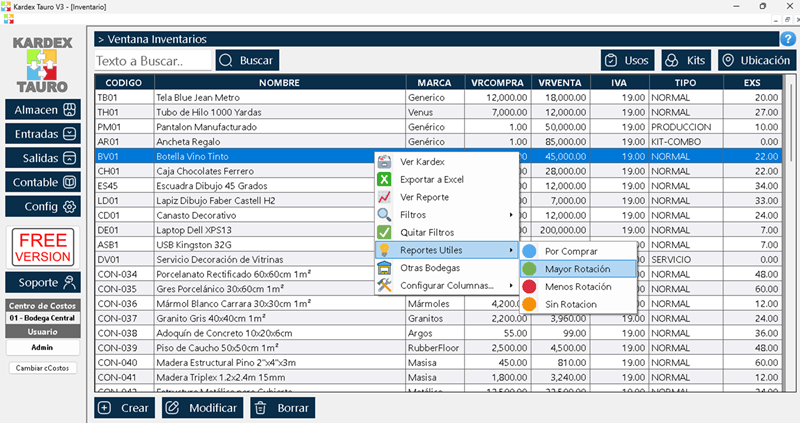
Not every inventory program offers special fields for size and color. When they do not, the right answer is not to give up on control but to treat every variant as another product; the system works well as long as the code and the name are clear and the rule of one code per combination is respected. Kardex Tauro, an inventory program built for businesses with up to fifty employees, supports exactly this way of working: every variant is created as a product with its own unique code, the Inventory module shows the stock of each of those products, and the Stock ledger keeps the chronological history of their movements, so you can always see what came in, what went out and what remains of every size and color. Groups and subgroups also help keep things tidy, holding the T-shirts family with all its variants so that searches and reports stay easy to read.
When registering, keep three details in mind:
- A name that explains itself: write the size and the color in the product name, because that is what the salesperson will see when searching and selling.
- A minimum stock per variant: set a minimum quantity for each one and not for the whole family, so the alert tells you when blue M is running low, not when the T-shirt is.
- One person in charge of the catalog: a single employee creates the new variants and checks that nobody duplicates codes.
Count stock by variant
The physical count is where size and color control is won or lost. Counting T-shirts is not enough: you have to count codes. Prepare a sheet with the codes of one family in the same order as the table, print it or carry it in a spreadsheet, and walk through the store writing next to each code what is on the shelf and what is in the back room. Two people per zone are usually enough: one counts and the other writes, and they swap roles on the next family.
When you finish, compare the sheet against the system stock, code by code:
| Code | Physical count | System | Difference |
|---|---|---|---|
| CAM-S-BK | 8 | 8 | 0 |
| CAM-M-BK | 11 | 12 | -1 |
| CAM-M-BL | 3 | 3 | 0 |
| CAM-L-WH | 1 | 0 | +1 |
Differences must be investigated before adjusting: it may be a wrongly recorded sale, a return that never came back in, or a garment left in the fitting room. The important thing is that the discrepancy is limited to one exact code instead of a global figure with no explanation. In a small store, one count per family every two weeks plus a full count at month-end keeps the records believable without paralyzing the business.
Record sales by variant
Everything above holds together if the sale is recorded against the exact variant leaving the store. When a blue M shirt is sold, the register deducts CAM-M-BL, not T-shirt in general. If the salesperson records only the item, the system will keep showing blue M available even when not a single one is left.
Three habits keep the register from ever skipping the variant:
- Search by full name: since the product is called Basic T-shirt M blue, the salesperson finds it and picks it without guessing between variants.
- Labels per variant: if the store prints barcode labels, every variant carries its own; scanning the garment eliminates typing errors and speeds up the line.
- Size exchanges as two movements: when a customer returns the blue M and takes the blue L, record the return of CAM-M-BL and the sale of CAM-L-BL, so the history keeps reflecting reality.
With sales by variant, the month-end reports answer the questions that really matter: which color ran out first? Is size M sustaining the turnover, or was it a one-week mirage? Are there colors that have not sold a single unit in two months? That information guides the next purchase and separates healthy stock from dead stock.
Manage by season
Clothing is bought by season and sold in short cycles, so variant-level control has to be seen through that lens. When placing the opening order, spread the quantities by size and color based on what the previous season sold: ordering the same amount of every size is almost always a mistake, because demand rarely spreads evenly.
During the season, review the movement by variant every week. Sizes and colors that do not move should go to the window display, be combined with other garments or be promoted before clearance arrives; waiting until the end only guarantees bigger leftovers. Fast-moving variants, on the other hand, deserve immediate replenishment even when the whole family seems to have stock.
At the end, do the final reading by variant: which sizes were left over, which colors remained and how much they represent of the total. That list decides what is kept for next season, what is cleared and what is never ordered again. The most valuable figure for the next purchase is not how much sold in total, but which exact combinations sold and which ones sat still.
Controlling sizes and colors is, in the end, a four-step discipline: code every combination, register it as its own product, count it by code and sell it by code. None of it demands expensive technology or complex processes; it demands consistency. The store that keeps these habits always knows what it has, what it is missing and what it should order, and in a clothing business that is practically half the battle.