When to Make an Inventory Adjustment
When to Make an Inventory Adjustment
The inventory of a small business rests on a simple promise: what the stock card says must match what is physically in the warehouse. That promise holds while every receipt and every issue is recorded correctly, but daily operations bring events that no record anticipates: a box arrives incomplete, a package breaks on the shelf, a customer returns a product already counted as sold, or an expired item is discovered when nobody buys it anymore. At that moment the theoretical balance stops reflecting reality and a difference is born. The inventory adjustment exists to bring both values back in line. Knowing when to make one, who must authorize it and how to record it without losing traceability is what keeps a stock card reliable all year long.
What Is an Inventory Adjustment
An inventory adjustment is a movement that corrects the recorded quantity of a product so that it matches the real quantity. If the stock card shows 40 units of an item and the physical count finds 37, an issue of 3 units must be recorded; if the count finds 43, a receipt of 3 units is recorded. The correction is not made to the past: it is made today, so the balance is right from here on.
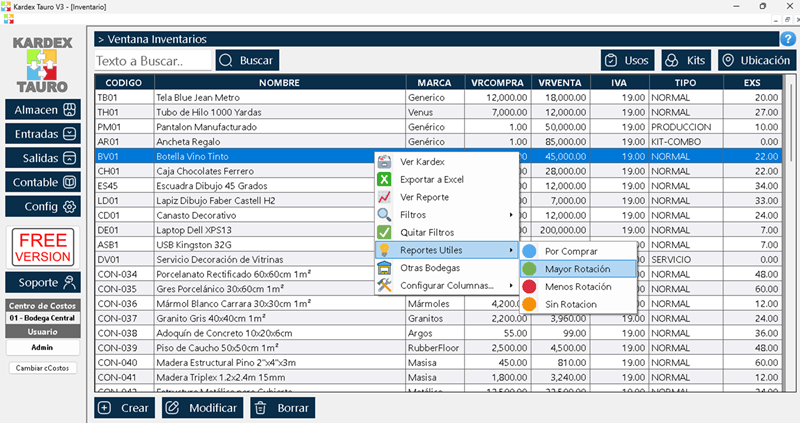
In Kardex Tauro adjustments are recorded inside the system, not outside of it. For example, when a physical count produces a negative difference, that difference is recorded as shrinkage and the balance is corrected; when a surplus appears, the matching receipt is recorded. In this way the stock card keeps the complete history of the product, because every movement —purchase, sale, shrinkage or adjustment— is recorded with its date and the person responsible.
Adjusting is not about disguising or punishing. It is a normal control operation that protects the most valuable figure in the business: knowing for certain how much you have. A well-made adjustment does not hide an error: it recognizes it, quantifies it and leaves evidence so it does not happen again.
Situations That Call for an Adjustment
Before deciding whether a product needs an adjustment, first check whether the difference can be explained by a pending movement: a purchase received but not recorded, a sale shipped but not entered, or a transfer between warehouses with no document. If the movement exists, record it and the difference disappears by itself. Only when there is no reasonable explanation among pending movements, or when the difference persists after a second count, is an adjustment justified. The most common situations in a small business are summarized in the following table:
| Situation | When to apply the adjustment | How to document it |
|---|---|---|
| Physical count difference | When the period count does not match the stock card balance and a second count confirms it | Count worksheet with date, quantities and person in charge; recorded as shrinkage or surplus |
| Shrinkage from breakage or spills | When it happens or, at the latest, at closing time that day | Shrinkage form signed by the person who reports it and the person who authorizes it |
| Expired or damaged products | When they are removed from the warehouse or the sales floor for disposal | List of products with quantities, reason and final destination |
| Recording error | When a duplicate receipt or issue is detected, or one with the wrong quantity or product | Correction that references the original movement instead of deleting it |
| Unexplained surplus | When the count exceeds the balance and no pending movement justifies it | Surplus record stating the likely cause |
| Opening inventory | When the system is launched or a period begins with real quantities on hand | Signed opening inventory record with the supporting count |
| Unrecorded return | When a customer returns goods or goods come back to the warehouse without a document | Return receipt with date, product, quantity and person in charge |
Physical count differences
The physical count is the X-ray of the inventory and the main source of adjustments. When an item is counted and the result does not match the balance, do not adjust right away: count again and review the receipts and issues of the period. If the difference persists, it is adjusted, and the system goes back to matching what is actually on the shelves.
Shrinkage, breakage and expired products
Shrinkage is a natural part of running a business: a bottle falls, a package breaks, a product expires on the shelf. The rule is to treat these events as business facts and not let them pile up silently. Every loss is reported, quantified and recorded. A business that never records shrinkage is not a perfect business: it is a business that is not seeing it, and sooner or later it will see it all at once in the count.
Recording errors
Not every difference is physical: many are born at the keyboard. A purchase typed twice, a sale recorded against the wrong product, or a quantity entered with an extra zero inflates or deflates the balance while the warehouse never moves. Once the error is identified, it is corrected with an adjustment that is cross-referenced with the original movement: the reference, the date and the cause are noted, and the record makes clear that it is a correction and not a new transaction.
Unrecorded returns
A return from a customer or a supplier that comes back into the warehouse without a document creates an invisible surplus: the goods are physically there, but the system does not know them. If the return can no longer be recorded as a formal return, the receipt is adjusted and its origin documented, so the inventory of the next period does not carry the same ghost.
Surpluses and the opening inventory
Surpluses are usually the friendly face of an error: more product than the system reports almost always means an unrecorded receipt or an issue entered too low. Even so, they must be adjusted and documented, because an inflated balance today becomes a confusing shortage tomorrow. The opening inventory is a special case: when the system is launched, the real quantities are loaded as a receipt movement backed by the count worksheet; without that document, every later number loses its support.
How to Make the Adjustment Without Losing Traceability
A well-made adjustment leaves a complete trail: which product was adjusted, how many units, for what reason, on what date and who authorized it. That information turns the correction into learning: if shrinkage concentrates on one product, you change suppliers; if errors always repeat on the same day, you tighten control at that moment. The recommended procedure is as follows:
- Verify the difference: confirm it with a second count and review pending movements before touching the balance.
- Identify the real reason: shortage, surplus, shrinkage, expiry or the correction of an error, and write it down on the document.
- Record the adjustment with the correct movement type: in Kardex Tauro shrinkage and surpluses have their own records, so the correction stays classified and documented.
- Keep the supporting document: worksheet, shrinkage form or receipt, with date and signatures.
- Check the resulting balance and confirm that it matches reality.
- Analyze the frequency: if the same item is adjusted every month, attack the cause and not just the symptom.
The golden rule is to never delete a movement to fix a balance. If a record is wrong, it is corrected with another record that explains it. The history of the product stays intact and any review finds its answers.
Who Must Authorize the Adjustment
The person who found the difference should not be the one who decides the adjustment, because it affects two valuable things: the quantity of merchandise available and the cost assigned to it. In a small business, authority is defined with a simple rule:
- The warehouse or store manager reports the difference and proposes the adjustment, because that person knows the operation.
- The owner, the manager or the accountant authorizes it, because that person answers for the numbers of the business.
- Nobody adjusts without a supporting document, not even the owner: the authorization signature backs the movement and prevents convenient adjustments.
Separating who reports from who authorizes is not distrust: it protects everyone. An adjustment authorized by a single person, with no review, opens the door to turning a shortage into a simple it was adjusted and that is that.
What Effect Does the Adjustment Have on the Stock Card
The stock card records every movement of a product and the adjustment is one more: merchandise comes in or goes out, the balance is updated and the cost is recalculated. If 3 units are adjusted out, the value of those units leaves the inventory and the period result reflects that loss; if a receipt is adjusted in, the balance and the value available grow. That is why the adjustment is not a minor accounting formality: it is the operation that keeps the stock card telling the truth.
In Kardex Tauro, adjusting with authorization and with documentary support is the recommended practice for any business with up to fifty employees: every adjustment is recorded, every stock card keeps its history, and the decision of when to adjust stops being an act of faith and becomes a control procedure. An inventory that is adjusted with method is not an imperfect inventory: it is an inventory that is known.