How to Know If Your Inventory Is Well Controlled

How to Know If Your Inventory Is Well Controlled
A well-controlled inventory is not one that never fails, but one that always warns you in time. For the owner of a shop, a workshop or a small distribution business, the goods in stock are usually the most valuable asset in the company: they are money that has not yet become sales. That is why knowing whether that inventory is truly under control is not an auditing luxury, but a condition for deciding calmly what to buy, what to promote and what to expect from the month's sales.
The good news is that evaluating it does not require being an accountant or an auditor. Good control leaves visible signs that any owner can check with their own eyes in an afternoon of work, comparing what the records say with what is physically on the shelves. These are the signs that an inventory is well controlled and, at the end, a quick self-assessment you can run this very week.
Differences Between the System and the Physical Count Are Minimal
The most reliable sign of control is the gap between what the system says should be in stock and what you find when you count. When inventory is well controlled, that difference is small and, when it appears, it has an explanation: a typing error, a box stored in the wrong place, shrinkage that was not recorded at the time. When control fails, on the other hand, the differences are large, constant, and nobody knows what causes them.
To check this, you do not have to count the whole warehouse. Pick ten or fifteen representative products, the best sellers and the highest-value items, and count them one by one. Kardex Tauro has a physical count window that lets you enter the quantity found and immediately compare it with the product's recorded balance. If five out of ten references show large differences, control has flaws that deserve prompt attention; if the differences are one or two units and are easy to explain, the inventory is healthy.
Every Movement Has Its Complete Document
A well-controlled inventory leaves a trail. Every purchase is backed by its invoice or receiving document, every sale by its sales invoice, every loss by a shrinkage record and every correction by a justified adjustment. The golden rule is simple: if a document does not exist, the movement should not exist. Documents are the inventory's memory: when they are missing, differences cannot be explained and the owner ends up balancing the books blindly; when they are complete, any inconsistency can be traced in minutes.
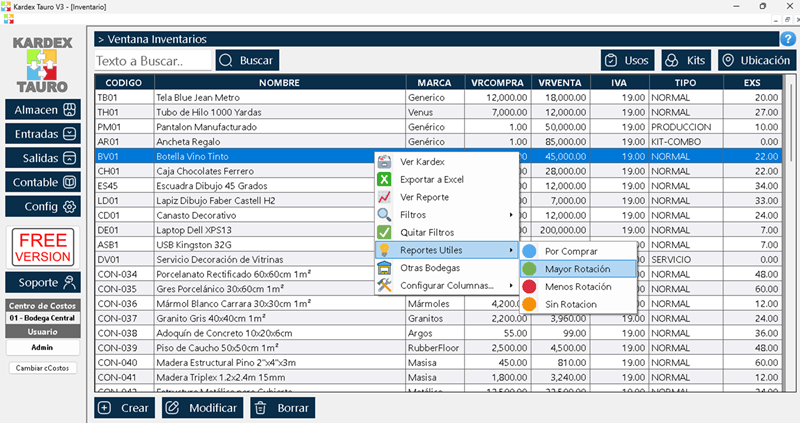
A serious inventory program helps sustain that discipline. Kardex Tauro records every movement, whether purchases, sales, shrinkage or adjustments, and the invoice automatically deducts stock when it is issued, so the balance reflects real outflows without depending on anyone's memory. Opening the card of a product and finding its complete history, with dates, documents and consistent quantities, is one of the clearest signs that control is working day to day.
What Is on the Shelves Is What the System Shows
Beyond counting, control shows up in daily operations: the merchandise a customer asks for exists, the product the salesperson looks for is where it should be, and the balance you check matches what you are about to ship. When this fails, the business sells what it does not have, promises what it cannot deliver, and loses customers because of an outdated record, not because of a lack of goods.
There is a simple exercise to measure this: for one week, every time someone checks the system to confirm that a product is in stock, have them note whether they actually found it or not. If most checks match reality, the inventory reflects what exists; if surprises are frequent, there are leaks that no year-end count will solve on its own.
Merchandise Turnover Is Healthy
A well-controlled inventory also shows up in the sales numbers. Healthy turnover means that goods come in and go out regularly, that the money invested in products is recovered and reinvested, and that little capital stays frozen in the stockroom. Inventory is an investment only while it moves; when it sits still, it becomes an expense: it takes up space, ages, gets damaged and ties up money that could be working.
An excess of old inventory is usually a symptom of impulse buying or of outflows that are not recorded: because the system does not show reality, the business keeps buying what it does not sell. Reviewing which products have not moved in more than three months is a quick way to measure the health of turnover. If the list is short, control is doing its job; if it is long, the problem is not sales but information.
Shrinkage Is Measured and Under Control
Every business loses merchandise: expired, damaged, stolen or misplaced products. The difference between a controlled business and one that is not is not the absence of shrinkage, but knowing how much is lost, why it is lost and what is done to prevent it from happening again.
When shrinkage is recorded the moment it occurs, with its cause and the person responsible, the system stays true to reality and the owner obtains a valuable figure: the real cost of what is lost. Known and decreasing shrinkage is a sign of control; shrinkage that only shows up in the year-end inventory, accumulated over months, is the opposite sign. In well-controlled businesses, shrinkage records are not hidden or excused: they are reviewed every month like any other business indicator.
Periodic Counts Are Up to Date
The physical inventory should not be an annual event of terror, but a routine. Businesses with good control count periodically, by sections, by categories or by cycles, and keep that schedule up to date. They do not wait until December to find out how the stockroom looks: they know all year long.
Counting often has an extra advantage: differences are detected while they can still be investigated, with the merchandise recently moved and the memory of whoever handled it still fresh. A business that has already done its count for the month, compared the results against the system and acted on the differences found, can honestly say that its inventory is under control.
Summary Table: Signs of Good Control
| Sign of good control | How to verify it | Expected result |
|---|---|---|
| Minimal differences between system and count | Count ten or fifteen key products and compare against the recorded balance. | Differences of one or two units, with a clear explanation. |
| Complete documents for every movement | Open the cards of three products and check that every balance has its supporting document. | Every entry and exit with date, document and person responsible. |
| Real stock on hand | For one week, check stock inquiries against the shelf. | Most inquiries match the physical merchandise. |
| Healthy turnover | List the products with no movement in the last three months. | Short list and little capital frozen in the stockroom. |
| Controlled shrinkage | Review last month's shrinkage records, with cause and person responsible. | Known, explained and decreasing losses. |
| Periodic counts up to date | Confirm the date of the last count and what was done with its differences. | Recent count, compared, with actions on the findings. |
Quick Self-Assessment in One Hour
If you want to know for sure how your inventory is doing, set aside one hour and follow these steps in order:
- Count ten key products, the best sellers and highest-value items, and compare them against the system. Note each difference.
- Open the cards of three of those products and check that all their movements have supporting documents.
- Generate the list of products with no movement in the last three months and count how many there are.
- Ask for last month's shrinkage records and review whether every loss has a cause and a person responsible.
- Confirm the date of the last physical count and what actions were taken on the differences found.
Give one point for each positive result: minimal differences, complete documents, stock that matches, turnover with few slow products, explained shrinkage and counts up to date. If you got five or six points, your inventory is well controlled: focus on keeping the routines. With three or four, control exists but has gaps: first strengthen the recording of movements and the counting schedule. With fewer than three, do not panic, but act: start by documenting every outflow and schedule a full count within the next month.
Inventory control is not achieved overnight: it is built with small, constant routines. Tools like Kardex Tauro help keep records up to date and bring differences to light early, but the discipline of using them well belongs to the owner. If this self-assessment showed weak signs, remember that the first step to controlling an inventory is precisely knowing how it is: you have just taken it.