How to Code Products for Inventory
How to Code Products for Inventory
If someone in your business asks for "the oil they use for the fryer" and ends up with the cooking oil instead, you already know why inventory needs codes. Descriptions are fine for talking, but they are not good for identifying: each person names a product the way they see fit, the same item shows up under three different names in the notebook, and nobody can say, without going to look, how many units of each reference are really on hand.
Coding products means giving every item a unique, short and stable identifier that sets it apart from any other. That code becomes the common language between the stockroom, the invoice, the purchase order and the physical count: once a code identifies a product, two people can talk about the same item without describing it, and inventory stops depending on memory. In this article we look at why you should code, which rules to follow, how it works in different types of business and which mistakes to avoid.
Why code your products?
A product has a name, but the name is not enough. "500 g coffee" could be ground, instant or a bag for the machine; "milk" could be whole, skimmed or powdered; "screw" says nothing about its diameter or length. When the description falls short, the business makes up for it with informal notes that show up in some places and not in others, and the inventory ends up as a collection of guesses. The code closes that gap: every variant gets its own identifier and the name becomes a complement, not the identity.
Coding brings concrete benefits to the day-to-day work:
- Identification without ambiguity: code ASE-004 stands for exactly one product, no matter how each person names it.
- Faster, more reliable counts: during the physical count you record the code instead of an improvised description, and differences are spotted without argument.
- An orderly history: every movement is linked to an identifier, so you can follow the product's life from purchase to sale.
- Fewer typing errors: typing a long description always leaves room for mistakes; a short code is written, checked and corrected in seconds.
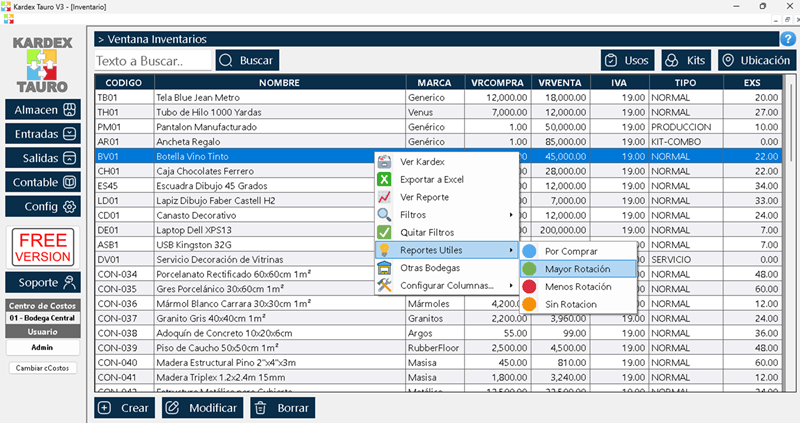
For coding to work, inventory is organized into families or groups of products, and each product belongs to one family. An inventory and stock ledger program such as Kardex Tauro works with this same logic: each product is handled with a unique code and classified into a group or category. This means you do not need a perfect plan before you start: the code identifies the product and the group keeps the family it belongs to in order.
Practical rules for good coding
There is no universal code: every business designs its own according to what it sells. What does repeat are the rules. A good code meets five conditions:
- Unique and never reused: it is assigned once and is not used again, even if the product runs out or is removed from the catalog. If a code is repeated, the movements of two products get mixed and the inventory is contaminated.
- Short: five to twelve characters is enough. A short code is quick to type, fits on the label and is easy to check at a glance.
- No spaces or troublesome characters: no accents, no dots, slashes or long dashes. Codes travel through keyboards, spreadsheets, scanners and reports, and a strange character is the first source of errors. A plain hyphen between the family and the number is fine.
- Meaningful: the most practical option is to combine the family prefix with a number sequence: ASE-001, ASE-002, ASE-003. Anyone who knows the rule can tell, just by looking at the code, which group the product belongs to.
- Stable: the code of a product does not change over time. If the product already has movements, changing its code breaks its history and forces you to correct old documents.
The following table summarizes the rules with side-by-side examples:
| Rule | Done right | Why it works |
|---|---|---|
| Short | ASE-003 | It is typed and read in seconds, even on a small label |
| No accents or strange characters | LAC-001 | It can be typed on any keyboard and no scanner misreads it |
| Family + sequence | TOR-014 | The prefix shows the group and the number tells the product apart within it |
| Unique and never reused | PNT-002 stays free forever | No movement can be linked to two different products |
Examples by type of business
Each business defines its own families according to what it sells. What matters is that the prefix is short, easy to understand and written down on a reference sheet that everyone can check.
Corner store or small grocery
The most natural families are beverages, dairy, grains and cleaning products. With the family-plus-sequence rule, BEB-001 is a beverage, LAC-004 is a dairy product and ASE-002 is a cleaning item. When a new product arrives in the same family, you take the next free number and the code is ready.
Hardware store or building materials store
A hardware store should separate at least fasteners, tools, paints and pipes. That way TOR-018 identifies one specific screw, HER-005 a tool and PNT-002 a paint, and an order for "everything that is TOR" is packed without guessing sizes.
Sewing or textile workshop
Fabrics, threads, zippers and buttons are easy to confuse if you only use the name. With prefixes such as TEL, HIL, CRE and BOT, each roll or pack is identified by its code, and the fabric cut for an order is made against the exact reference.
The following table shows how coding looks when applied to these three businesses:
| Business | Family | Code | Product |
|---|---|---|---|
| Corner store | Dairy | LAC-001 | Whole milk, 1-liter bag |
| Corner store | Cleaning | ASE-004 | Liquid hand soap, 1 liter |
| Hardware store | Fasteners | TOR-018 | 2-inch self-tapping screw |
| Hardware store | Paints | PNT-002 | White vinyl paint, gallon |
| Sewing shop | Fabrics | TEL-010 | Khaki drill, per meter |
| Sewing shop | Zippers | CRE-003 | Metal zipper, 45 cm |
Common coding mistakes
Coding usually fails out of habit, not for lack of tools. These are the most frequent mistakes and how to avoid them:
- Using the description as the code: typing "fryer oil 1L" every time you record a movement is slow and error-prone, and the description does not tell "fryer oil 1L" from "fryer oil 1 liter". The description goes along with the code; it does not replace it.
- Creating extremely long codes: sequences such as OIL-FRYER-2025-BATCH-A3-1LT are hard to type, read and remember. If the code does not fit on one line or one label, it is not a code: it is a paragraph.
- Repeating codes: giving the number 001 to two different products, or using the code of a discontinued product for a new one, mixes the movements and turns inventory into a puzzle that never adds up.
- Coding by location: a code such as SHLF3-ROW2 says where the product is, not what it is. When the box moves to another shelf, the code stops making sense and every record is wrong.
- Keeping the rule in someone's head: if the family and prefix table is not written down and visible, every employee ends up inventing their own format and the business ends up with several different coding styles.
From code to label
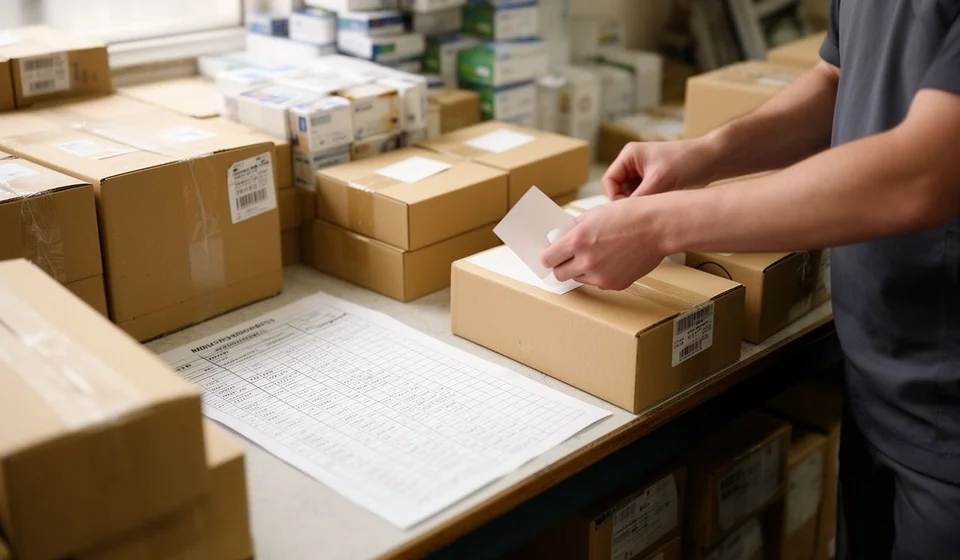
A code that only lives on the computer is a list; a code becomes useful when it travels with the product. That is why the last step is to link every code with its physical label:
- Write the family and prefix table on a simple reference sheet and leave it where movements are recorded.
- Create the products in the system with their code, description and group or category.
- Print the label with the code as text and, if the system allows it, as a barcode.
- Stick the label in the same place on every package, so the person looking for it finds the code without turning the product around.
- Check the reading: scan the code or read it by hand and confirm that the system shows the expected product before putting the goods away.
With the code on the label, receiving goods and invoicing a sale no longer depend on written descriptions: the code is read and the system recognizes the product instantly. Kardex Tauro integrates barcode readers, so the printed code becomes the key to your inventory: with one scan the product is identified in seconds, without typing descriptions or relying on memory.
Coding your products is an investment of one afternoon that pays off every day. Start with a simple family table, assign the first codes, print the labels and adopt the rule that no product comes in without a code. Within a few weeks, inventory stops being a mystery and starts being a reliable number.
