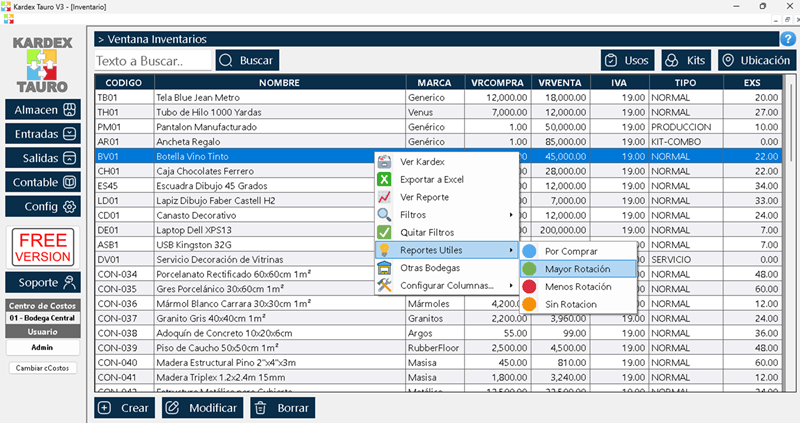
Inventory Program vs Excel

Inventory Program vs Excel
Keeping inventory in a spreadsheet is, for many businesses, the natural first step. It costs nothing extra, it is easy to learn, and it works while the operation is still small. But a moment arrives when the very qualities that made Excel useful become the problem: the sheet grows, it fills with formulas, several people touch it, and it stops being reliable. That is where the real question of this article appears: is Excel still the best tool to control inventory, or is it time to move to an inventory program?
There is no single answer for everyone. A business that is just starting does not need the same thing as one that issues invoices every day and has staff in the warehouse, at the register and in purchasing. So, instead of giving opinions, it is better to compare with concrete criteria: control by product, automatic stock ledger, invoicing, users and errors. That is what we will do here, thinking of small businesses with up to fifty employees, which is exactly the size these solutions are designed for.
When Excel is still enough
Excel is not the enemy: for a certain type of operation it remains a valid and even convenient option. In general, the spreadsheet is enough when the business handles few references, sales are written down at the register or in a notebook, and only one person updates the file. If no one else depends on that data to buy, invoice or dispatch, the risk of information getting damaged is low.
It is also enough in the early stage, when the goal is only to understand what sells and what stays. At that point, a list of products with approximate quantities is enough to avoid buying blindly. The problem is never starting with Excel; it is staying with Excel once the operation has outgrown it. What matters is recognizing the moment of change in time.
Signs that Excel is no longer enough
How do you know that moment has arrived? The signs repeat themselves in almost every business that grows without changing its tool:
- Formulas break: someone deletes a row, pastes a cell over another one or drags a formula, and the total ends up wrong without anyone noticing.
- Several people work on the same file: each one saves their own version, and in the end no one knows which one is real.
- There is no automatic stock ledger: every receipt and every issue must be recorded by hand, movement by movement, and it is easy to skip one.
- The invoice does not deduct stock: items are sold and invoiced, but inventory is adjusted later, or never.
- The physical count never matches: and since the record is not reliable, you cannot tell whether merchandise is missing or the mistake is in the sheet.
Any of these signs, on its own, already justifies reviewing the decision. Two or three together are a clear alert: inventory stopped being a file and became the heart of the operation.
Excel vs inventory program: direct comparison
To compare without opinions, let us look at the six points that appear most often in the daily operation of a small business:
| Aspect | Excel | Inventory program |
|---|---|---|
| Control by product | Depends on someone keeping the sheet up to date, reference by reference. | Each product has its own record with stock, cost and movements up to date. |
| Automatic stock ledger | Must be built by hand, with formulas that break easily. | Each purchase and each sale generates the stock ledger movement on its own. |
| Invoice that deducts stock | The sale is invoiced separately and inventory is adjusted later, if someone remembers. | When a sale is invoiced, stock is deducted immediately. |
| Users and permissions | Anyone who opens the file can change everything. | Each user sees and modifies only what their permission allows. |
| Formula errors | A mistake spreads silently through the whole sheet. | There are no formulas to maintain; the system calculates by itself. |
| Daily time spent | Extra minutes every day and hours at every month-end close. | Recording takes seconds and reports come out ready. |
The real difference is not technology: it is who does the work. In Excel, the person does the work and the sheet only stores what that person typed. In a program, the system does the work and the person focuses on deciding.
What a business gains with an inventory program
When you move to a program, the benefits appear in day-to-day operations, not in promises about the future. The first one is an up-to-date stock ledger without extra effort: when a purchase is recorded, the system generates the stock ledger movement and updates the product's average cost in the same instant. The inventory value reflects what was really paid for the merchandise, without anyone having to recalculate anything.
The second benefit is that invoicing and inventory stop being two separate worlds. When a sale is invoiced, the program deducts stock immediately; what remains in the system is what should remain in the warehouse. The third one is order among people: with users and permissions, the cashier invoices, the warehouse clerk records receipts and issues, and the manager reviews reports, each one within their role, as happens with a program such as Kardex Tauro. And the fourth one, perhaps the most valuable for an owner, is being able to answer in seconds the question of all times: how much is there of this product and how much is it worth?
The hidden costs of staying with Excel
Staying with Excel does not cost a license, but it has costs that do not appear on any invoice. The most obvious one is time: what is spent every day updating stock and every month balancing figures is work that is not dedicated to selling or serving customers. If you add those hours over a year, the number surprises you.
Then there is the cost of error. A broken formula can say there is stock of a product that has already run out, and the result is a lost order or a broken promise. Or it can say there is surplus where there is shortage, and money stays asleep in merchandise that does not turn. There is also the cost of dependence: if only one person understands the sheet, the business is tied to that person. And finally, the cost of information: without a reliable record by product, every purchasing decision is made halfway, with intuition filling in for data.
How to migrate from Excel to a program without pain
The most common fear about migrating is thinking that everything must be typed from scratch. It is not like that: a well-done migration takes a few days. The recommended order is this:
- Organize the Excel file: check that every product has a unique code, a clear name and a defined unit of measure. The migration is only as good as the file it comes from.
- Verify that the program imports from Excel: this is the point that avoids retyping hundreds of references. Kardex Tauro, for example, imports the inventory directly from the spreadsheet.
- Load the initial inventory: with the real stock counted in the warehouse, not with the sheet figures if there are doubts. That day's physical count is the basis of everything that follows.
- Train the people who will use it: with two or three hours of practice, the person in charge records purchases, sales and movements without assistance.
- Operate in parallel for a few days: compare what the program says with what happens in the warehouse; if something does not match, it is fixed right away, while the error is still cheap.
The key is in the first two steps: an organized file and an automatic import make the change feel like an improvement, not a move.
The decision depends on the size of the business, not on fashion
Excel is not a mistake from the past: it is a great starting tool, and for very small operations it remains valid. The inventory program is not a luxury: it is the natural answer when the business grows and more products, more people and more invoices appear. The right question is not which one is better in the abstract, but which one demands less effort from the business to keep information reliable.
If the signs in this article sound familiar —broken formulas, versions that do not match, inventory that does not balance—, the moment to evaluate the change is now. Programs like Kardex Tauro are designed precisely for that leap: importing what you already have in Excel, generating the stock ledger with each purchase, updating the average cost and deducting stock with each invoice. Inventory stops being an end-of-month worry and becomes an everyday tool.
