Inventory Software for SMEs in Colombia
Inventory Software for SMEs in Colombia
How many times a month does your business run out of a product that, according to the paperwork, was still in stock? How much is lost every year buying too much, or too little, because the real stock does not match the records? Small and medium-sized businesses in Colombia face this situation every day: inventory is kept in notebooks or spreadsheets, each person writes things down in their own way, and at the end of the month nobody can say for sure what is in the warehouse, what needs to be reordered and how much what they sell really costs.
Inventory software for SMEs in Colombia is not something for large companies only: it is the tool that turns scattered notes into one organized and reliable set of information. Choosing the right program, however, requires knowing what a small business really needs in the Colombian context, which features are essential and how to put them to work without complicating daily operations. That is what this article is about.
What a Colombian SME needs from its inventory software
A Colombian SME does not have the problems of a large chain or of a business in another country: its operations are agile, its teams small, its capital limited, and its priority is to sell today without losing control. That is why the ideal software is not the most expensive or the one that boasts the most features, but the one that solves concrete needs. The most common ones are:
- Knowing the real stock: knowing how many units of each product there are, where they are and in what condition, without relying on the memory of whoever is at the counter.
- Managing several warehouses or locations: if the business has a shop, a depot or a branch, it needs to know what is in each place and be able to move goods between them.
- Invoicing without losing the trail: every sale must deduct what was sold and every purchase must add what was received; otherwise, reality and records drift apart within a few weeks.
- Knowing the cost in pesos: knowing how much the merchandise costs and how that value changes, so prices are set with a margin and not by guesswork.
- Keeping up with electronic invoicing: most businesses must issue electronic invoices, and the program should make that process easier, not a headache.
- Having nearby support: a local provider that speaks the same language, answers questions quickly and understands local operations is worth more than any manual.
- Paying an affordable price: the investment must fit an SME budget and be sustainable month after month, with no hidden costs.
The features that make the difference
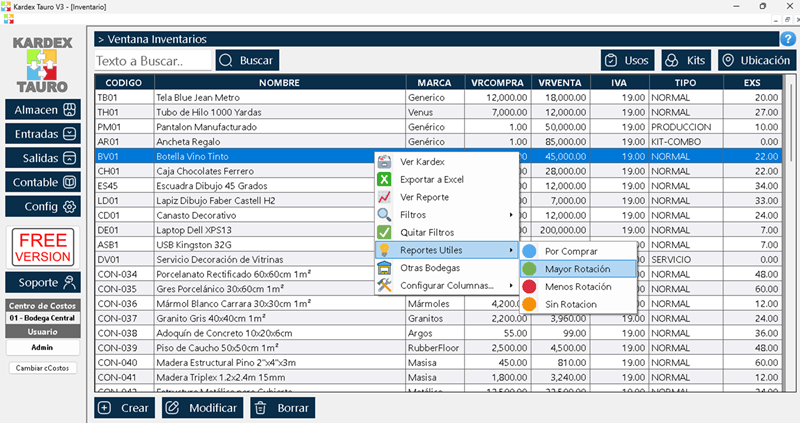
When comparing options, it is wise to examine concrete features before lists of promises. These are the ones a Colombian SME should demand, and programs like Kardex Tauro, designed from the start for small businesses, bring several of them together in a single tool:
Control by warehouse and cost center
A small business rarely keeps everything in one place: there is merchandise in the shop, in the depot, on its way to a branch or set aside for a special order. A good program organizes stock by warehouse or cost center, so that each location's inventory is independent and verifiable. This avoids the mistake of selling a product that is at another site, and you can tell at a glance where each item is.
Sales invoicing that deducts stock
Invoicing and inventory should be a single movement: when a sale is invoiced, stock goes down; when it is cancelled, it comes back up. If the software does not make that deduction automatically, someone has to subtract by hand and the errors return. This feature keeps balances up to date without extra work for whoever sells.
Costs in Colombian pesos
The cost of merchandise defines how much is earned on each sale. A suitable program records purchases and calculates the cost of what is sold in Colombian pesos, so the business knows its real profit instead of discovering at year-end that it sold a lot and earned little. Cost reports also help decide when to buy and from which supplier.
Ready for electronic invoicing
Electronic invoicing is already part of everyday life for many businesses in Colombia and will keep growing. What an SME should look for is software that helps it keep up with that requirement without duplicating work: no typing the same sale twice, once for the inventory and once for the document the customer receives. Every business should confirm with its provider how this point is handled in its case.
Local, close support
When the system raises a question or shows an error, time is money. A Colombian provider that answers quickly, in Spanish and with knowledge of local operations, resolves in minutes what distant support would take days to handle. That closeness also shows in updates, which should respond to the Colombian market and not to that of other countries.
A price designed for the SME
Not every small business can pay for large-corporation systems, and it should not have to. There are affordable programs that cover the needs of a company with few employees, through a license purchase or a reasonable subscription. What matters is that the cost is clear from the start, with no surprise modules or hidden fees.
No dependence on the internet
In many parts of Colombia the connection is unstable or expensive, and a system that freezes when the internet fails leaves the business unable to invoice. The ideal software keeps operating during an outage and syncs the information when the connection returns. Technology should adapt to the business, not the other way around.
Need, feature and benefit in one table
To summarize the points above, this table links the typical need of a Colombian SME with the feature that solves it and the concrete benefit:
| Need of the Colombian SME | Feature that solves it | Benefit |
|---|---|---|
| Knowing what is in each place | Inventory by warehouse or cost center | Only existing products are sold and goods are located without phone calls or trips |
| Sales not throwing stock out of control | Sales invoicing that deducts automatically | The balance always reflects what has been sold |
| Knowing how much the merchandise costs | Cost calculation in Colombian pesos | Prices with a defined margin and real profit at month-end |
| Invoicing electronically without typing twice | Invoicing integrated with inventory | Fewer errors and less administrative time |
| Resolving doubts when the system fails | Close local support | The business does not stop waiting for distant answers |
| Investing without risking cash flow | Affordable price for SMEs | Professional control at a cost that can be sustained |
How to choose the right software
With clear needs, the choice becomes simple. Before deciding, it is worth requesting a demonstration using real products from the business and answering these questions:
- Was the program designed for small businesses, or is it a stripped-down version of a system for large companies?
- Does it let you try it with your real information before buying?
- What does the price include: updates, support, training? Will extra costs appear later?
- Does the business keep control of its data? Can it be exported, backed up and recovered if you switch programs?
- Is it simple enough for someone without technical training after a couple of days of practice?
- Does support respond quickly and at times that are useful for the operation?
A good demonstration shows the program solving everyday situations: a sale that deducts inventory, a purchase that adds to it, a return that corrects it and a transfer between warehouses. If it cannot show that clearly, it will hardly do better in real operation.
Implementation, step by step
Choosing well is half the work; the other half is getting the program running without disrupting operations. A practical order is this:
- Clean up the catalog before migrating: list the products, unify names, define units of measure and remove references that are no longer used.
- Load the opening inventory: use a real physical count cut off at a date, not the figures from the notebook. If the program imports inventory from Excel, the work is reduced to filling in a template.
- Set up users and permissions: define who invoices, who records purchases and who can only view, so every movement is linked to a responsible person.
- Test with real operations: during the first week, invoice and purchase for real, checking that balances match what comes in and goes out.
- Run a first verification count: compare the system with the physical stock; differences are corrected at the start, when they are still few.
- Train the team and set rules: agree on who records each movement and when. With a single way of doing things, the information stays clean.
Conclusion: control as an advantage
Inventory is not just a number at the end of the month: it is the information that tells you what to buy, how much and at what price to sell. With software designed for Colombian SMEs, that figure stops being a guess and becomes the basis for business decisions.
In Colombia there are programs built precisely for this scale. Kardex Tauro, for example, is a Colombian program made for small businesses of up to about fifty employees: it controls inventory with a stock ledger, issues sales invoices that deduct stock, records purchases, handles warehouses or cost centers, manages users with permissions and imports inventory from Excel. Solutions like this exist so that a small business does not manage its merchandise like a large corporation, or with the tools of thirty years ago.
The important thing is not the perfect software, but the one that fits the business, is implemented in an orderly way and is used every day. Choosing with criteria, implementing with method and recording every movement: with those three habits, any Colombian SME turns stock control into a real competitive advantage.
