What Are Inventories in Accounting?
What Are Inventories in Accounting?
When an entrepreneur or the owner of a small business hears the word "inventory," they think of what they see every day: the merchandise on the shelves, the boxes in the back room, the materials ready to use. That picture is correct, but accounting uses the term with a more precise and more useful meaning. In accounting terms, inventories are the goods a company owns with the intention of selling them in the normal course of its operations, or the goods it buys to transform and sell later. That definition includes both the product waiting for a buyer in the display window and the fabric, supplies, and work in progress inside a production workshop.
Understanding this definition is not a theoretical exercise. Many of the control errors in small businesses come from not being clear about what is and what is not inventory, and that shows up at the end of the period: numbers that do not add up, costs calculated wrong, and profits that never appear. That is why, before talking about stock cards, physical counts, or valuation methods, it is worth answering the underlying question calmly: what are inventories in accounting, and why should a small business care?
For accounting, inventory is not simply "what is in the back room"
The general rule is simple: an item is inventory if the company holds it to sell it or to turn it into something it will sell. Office supplies used up in administration, the cashier's computer, or the store shelving are not inventory: they are other kinds of assets or expenses, because they are not meant for the customer. Inventory, by contrast, is the merchandise that will be sold, and that is why accounting treats it differently from the other assets of the business.
It is also not necessary for the goods to be physically inside the premises to count as inventory. What matters is ownership and purpose: if the company already paid for the merchandise and the supplier is shipping it, or if it handed products to a salesperson to show customers, those goods are still the company's inventory until they are actually sold. Thinking about inventory by its purpose rather than only by its location prevents typical mistakes, such as forgetting to record merchandise in transit or products delivered to a customer that have not been invoiced yet.
Inventories are a current asset, not an expense
In accounting, inventory is an asset, and more precisely a current asset. An asset is everything the company owns that represents a future economic benefit; current means it is expected to turn into money in the short term, within the normal cycle of the business. Inventory meets both conditions: it is a good with value, and it is meant to be sold soon, not to stay in the company.
This idea completely changes the way a business is read. When a small company buys merchandise, its money is not lost and does not become an expense: it is transformed. Cash goes down, but inventory goes up by the same amount. The real expense does not happen at the moment of the purchase, but when the sale happens and the goods leave the company. That distinction explains why two businesses that bought the same things during the year can report very different results depending on how they keep track of their inventory.
How inventories are classified
Not all inventory is the same, and accounting needs to distinguish the types because each one behaves differently and is valued at different moments of the commercial or productive process. The most common classifications in a small business are the following:
- Merchandise: products already purchased and ready for sale, typical of retail: shops, distributors, hardware stores, stationery stores, and the like. The company does not transform them: it buys and resells them.
- Raw materials: the inputs that enter the production process and are consumed to make the product, such as fabric in a garment workshop, flour in a bakery, or spare parts in an assembly shop.
- Work in progress: goods halfway through transformation, which have already received labor and some cost, but are not ready to be sold yet.
- Finished goods: the products the company manufactured and that are ready to be delivered to the customer.
- Materials, packaging, and supplies: the items that accompany production or sales, such as bags, labels, lubricants, or shipping boxes.
A pure retail business handles almost only merchandise; a factory, a workshop, or a food business handles several types at once. Knowing which stage each good is in is what allows the inventory to be valued correctly at the close and the real cost of what is sold to be calculated.
| Type of inventory | Accounting definition | Where it is reflected |
|---|---|---|
| Merchandise | Goods purchased ready for sale, with no transformation by the company | In current assets, as inventory, until they are sold |
| Raw materials | Inputs that will be consumed to make the product that will be sold | In current assets, as inventory, until they enter the production process |
| Work in progress | Goods partially finished, already carrying part of their cost | In current assets, as inventory, at the cost accumulated up to that stage |
| Finished goods | Products made by the company and ready for sale | In current assets, as inventory; when sold, their cost moves to the income statement |
Where inventories appear in the financial statements
In the financial statements, inventories are reflected in two places with different roles. On the balance sheet they are presented within current assets, in the inventory account or group of accounts, at the value the company determined at the end of the period. There they show how much money the business has "stored" in goods that it has not sold yet.
When those goods are sold, their cost does not disappear: it leaves the balance sheet and travels to the income statement, where it is compared with the revenue from the sale. That comparison is the gross profit, one of the most watched indicators of any business. Inventory therefore works as a bridge between the two financial statements: what stays in the back room is part of the balance sheet, and what goes out as sales becomes cost of goods sold on the income statement.
The relationship between inventories and the cost of sales
The relationship between inventory and the cost of sales is so close that neither can be explained without the other. In its simplest form, the cost of sales is understood like this: inventory at the beginning of the period, plus purchases during the period, minus inventory at the end of the period. If a business started the year with twenty million in merchandise, bought eighty million, and closed with twenty-five million, it sold merchandise that cost it seventy-five million. That figure is used to calculate the gross profit of the business.
One consequence follows from that formula and is worth remembering: if the ending inventory is valued incorrectly, the cost of sales and the profit are distorted, even when sales were flawless. An inflated ending inventory makes the cost of sales look lower than it really is and the profit higher; an undervalued inventory produces the opposite effect. Neither situation is just a paperwork problem: it is money the business is reporting incorrectly, and decisions made on top of wrong figures.
In addition, poorly controlled inventory hides operational problems: expired or damaged merchandise, losses from theft or misplacement, unrecorded returns, and duplicated purchases. If the business only reviews its inventory once a year, with an emergency physical count, it discovers the shortages when it is already too late to correct them and when it can no longer explain where the difference came from.
Keeping a valued record of movements: what accounting expects from day to day
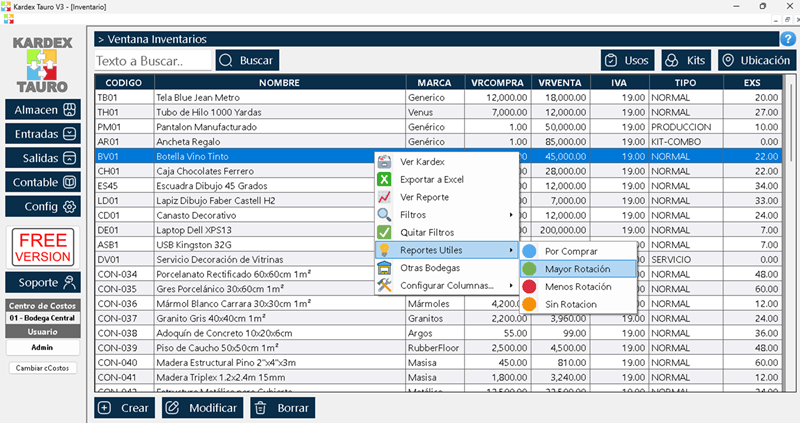
This is where the stock card comes in. Accounting needs to know, at any moment, how much each unit the company holds cost and how much each unit it sells cost. For that, a record of inventory is kept in units and in values, known as a stock card, where every receipt, every issue, and every return is recorded with its cost. When that record is abandoned or kept incompletely, the accounting close becomes a puzzle: nobody knows for certain what is there, what it cost, or what was sold. Tools such as Kardex Tauro help small businesses record valued movements in an orderly way, so that at the end of the period the accounting finds an inventory that is consistent with what is actually in the back room and with what was sold.
The benefit is not only accounting-related. With an up-to-date record, the business owner knows how much money is tied up in merchandise, which products are sitting still, what the real cost of each sale is, and how much profit the operation is actually generating. That information turns decisions that used to be gut feelings, such as what to restock, what to discount, or how much to order, into decisions backed by numbers.
What matters most for a small business
Understanding what inventories are in accounting is the first step toward making the numbers of a small business tell the truth. Inventory is what the company has to sell or to produce what it will sell; it is a current asset and not an expense; it is classified according to the stage each good is in; and it is reflected on the balance sheet as an asset and on the income statement through the cost of sales. With that clear foundation, keeping an orderly, valued record of every movement stops being a tedious obligation and becomes one of the most profitable tools of the business, because it protects the money invested and honestly shows how much is being earned.
