Difference Between Kardex and Inventory Control
Difference Between Kardex and Inventory Control
In the daily routine of a warehouse it is common to hear both expressions used as if they meant the same thing. Someone says the business needs to keep inventory control and the next moment asks where the kardex is, as if carrying out a task were the same as reviewing a document. The confusion is understandable: the kardex is the record where merchandise can be seen, and control is the way of protecting it, and since people usually talk about them together, they end up sounding like synonyms.
For a small business, telling them apart is not an accountant's whim. Knowing what each one is for helps understand why a simple kardex notebook is not enough to protect merchandise and why a control policy without records leaves the owner blind to what happens with the money invested in product. This article explains what each concept is, how they differ, how they complement each other and what the most common mistake is when using them.
What a kardex is
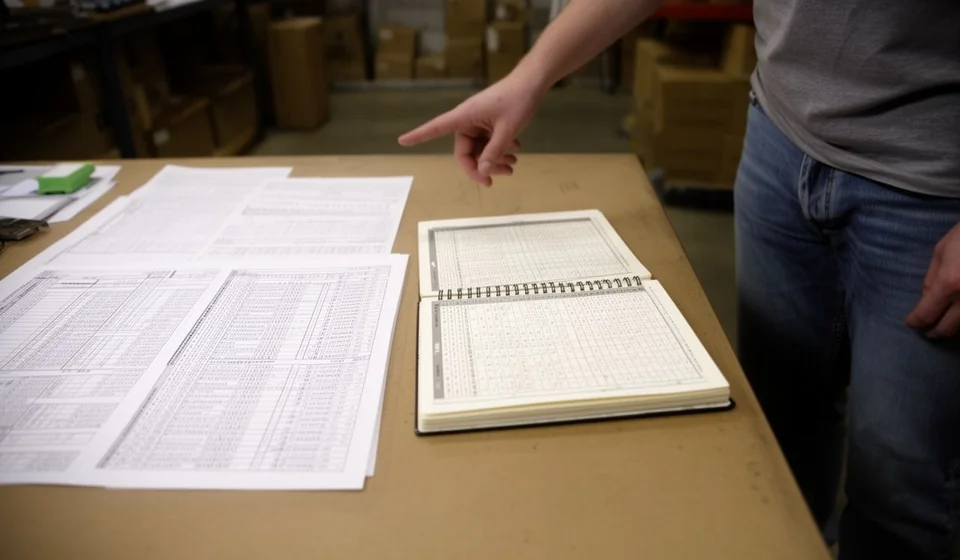
The kardex is a detailed per-product record of entries, exits and balance. For each reference, every movement is noted in chronological order: how much came in through a purchase, how much went out through a sale and how much remains available after each transaction. It is, in essence, the individual memory of each item in the inventory.
A classic kardex record includes at least the following data for each movement:
- Date of the movement.
- Concept or document that causes it: purchase invoice, sales invoice, return or adjustment.
- Entries: the units or value that come into the inventory.
- Exits: the units or value that leave the inventory.
- Balance: the stock remaining after the movement.
A simple example makes it clear. A hardware store that keeps a kardex for the product three-inch screw may have a record like this one:
| Date | Concept | Entry | Exit | Balance |
|---|---|---|---|---|
| March 1 | Opening stock | – | – | 100 |
| March 5 | Purchase from supplier | 200 | – | 300 |
| March 8 | Sales invoice | – | 40 | 260 |
| March 15 | Customer return | 5 | – | 265 |
With that record, at the end of the month the business knows exactly how many screws came in, how many went out and how many should be on the shelf. If the physical count finds 250 units instead of 265, it already knows there is a difference of 15 units that must be investigated. That ability to detect differences is one of the great contributions of the kardex.
What inventory control is
Inventory control is much broader: it is the set of processes, policies and rules that the business uses to take care of its stock. It includes deciding how much and when to buy, where and how to store merchandise, who is authorized to receive and dispatch, how often physical counts are performed, how shrinkage, expirations or damage are recorded, and what to do when the count does not match what is recorded.
In other words, inventory control answers management questions such as these:
- How much merchandise should be ordered and when, so the business neither runs out of product nor fills the warehouse?
- How should the warehouse be organized to find each reference quickly and avoid damage?
- Who is responsible for the stock and what procedure is followed when receiving or dispatching merchandise?
- How often are the items physically verified and how are they compared with the records?
- How are shrinkage, theft and the errors discovered during counts handled?
While the kardex says how much is recorded, inventory control makes sure that figure is real, that the merchandise is well protected and that the business never runs out of what it sells.
Comparison table: Kardex vs. inventory control
| Aspect | Kardex | Inventory control |
|---|---|---|
| What is it? | A detailed per-product record of entries, exits and balance. | The set of processes and rules to protect and manage stock. |
| Scope | Limited to one document or file per reference; it does not define how operations must run. | Covers the whole business: purchases, warehouse, sales, counts, shrinkage and those responsible. |
| Question it answers | How much of this product should there be today? | Is the merchandise truly protected and well managed? |
| Example | The kardex sheet of one product shows that 200 units came in and 40 went out. | The counting policy states that 100 % of the warehouse is physically verified each month and that every shortage or surplus is approved by the manager. |
| If it fails | Nobody knows how much is recorded and differences are not detected in time. | Without clear rules, merchandise is lost even when the kardex is up to date. |
The table summarizes the underlying difference: the kardex is a recording instrument, while inventory control is the complete system of which that instrument is a part.
How they complement each other
The kardex does not compete with inventory control: it is a tool that works inside it. Control needs reliable information to function, knowing how much there is, how much came in and how much went out, and the kardex provides that information. In turn, the kardex alone protects nothing: it can be perfectly up to date and merchandise can still suffer shrinkage if there are no warehouse rules, clear responsibilities and periodic counts to verify what is recorded.
The relationship is like that of a speedometer with safe driving: the speedometer shows the speed, but safe driving includes brakes, mirrors, signs and the driver's decisions. Nobody would say that having a speedometer is the same as driving carefully; neither does it make sense to say that keeping the kardex is the same as controlling the inventory.
In practice, the best approach for a small business is to have both running at the same time and connected. Per-product records are fed by every purchase and every sale, and control activities, such as physical counts, shrinkage handling and warehouse organization, use those records as a point of comparison. Tools like Kardex Tauro do exactly that integrated work: they generate the kardex automatically from purchases and sales invoices, keeping the per-product record always up to date, and at the same time support control with physical counts, shrinkage records and warehouse management inside the same system.
Common mistakes when confusing them
- Using them as synonyms. Calling inventory control the simple act of filling out the kardex makes the business neglect the rules that really protect merchandise, such as counts and warehouse responsibilities.
- Believing the kardex prevents losses on its own. An up-to-date record does not stop theft or shrinkage; it only makes them visible when someone compares the paper with reality.
- Doing control without records. Counting the warehouse and adjusting stock without a reliable kardex is working blind: there is no way to know whether what is missing was lost, sold or never arrived.
- Leaving the kardex outdated. If entries and exits are noted days later, control loses its basis and differences become impossible to explain.
- Relying on memory. Trusting that the person in charge remembers every movement replaces the record and leaves the business depending on a single person.
Conclusion
The kardex and inventory control are neither rivals nor synonyms: they are a record and a system that need each other. The kardex provides detailed information about every product, and inventory control provides the rules, processes and verifications that turn that information into protected merchandise. A small business that wants to protect its investment needs both: a per-product record that is always up to date and clear processes for counting, shrinkage and the warehouse.
The best practical decision is to integrate them into a single tool instead of keeping loose spreadsheets that fall behind. A program like Kardex Tauro saves the business that work: it records every purchase and every sales invoice and generates the product kardex automatically, while supporting control with physical counts, shrinkage and warehouses. That way, the owner stops wondering whether keeping the kardex is the same as controlling the inventory and starts doing both things well.