How to Control Inventory Surpluses

How to Control Inventory Surpluses
When physical count day arrives, most businesses fear shortages: units the system says exist but that do not appear on the shelf. But there is also the opposite problem, the surplus, and it is almost always received with less care than it deserves. An inventory surplus happens when physical stock is greater than recorded stock: the system shows one hundred units of a product and the warehouse count finds one hundred and twenty. Instead of celebrating those twenty "extra" units, it is worth asking where they came from.
In this article we will look at what an inventory surplus is, why it happens in small businesses, how to detect it by comparing physical counts against the system, and what to do when it appears. The goal is not just to make the numbers match, but to understand the cause so the problem does not repeat itself. It is written for shops, warehouses and distributors with up to fifty employees.
What an inventory surplus is and why it matters
The inventory of a business is controlled by two realities that should match: what is physically in the warehouse and what the records say. When the physical amount is less than the recorded amount, there is a shortage; when the physical amount is greater, there is a surplus. They are two information errors in opposite directions, and both cost money.
Why is it a problem that stock is "left over"? Because those units were not in the records, and everything that is not in the records is managed blindly. A surplus can mean that more was purchased because nobody knew stock was available, that a product spent weeks on a shelf without being offered to customers, or that goods entered without the proper control. Units that exist on the shelf but not in the system are called ghost surpluses: they take part in no purchasing or selling decision.
The most common causes of surpluses
A surplus almost never appears by chance: behind it there is always a movement that was recorded wrongly, that was not recorded, or that was recorded twice. These are the most frequent causes in small businesses:
- Receiving errors: fifty boxes arrive from a supplier and only forty-five are recorded in the system, because of hasty entries, not checking the delivery note, or posting the receipt against the wrong document. The boxes that were never recorded become an invisible surplus.
- Unrecorded customer returns: a customer returns a product, the seller receives it and puts it back on the shelf without recording the return. Since the sale already deducted that unit from the system, the unit that came back physically is "extra" for the records.
- Wrongly posted sales: one unit is sold and two are deducted by mistake, or a sale is voided and the goods are not returned to inventory. The system ends up with fewer units than there are in the warehouse, and the surplus shows up at the next count.
- Miscounted units: goods are received or dispatched counting packages instead of units. If the box says it holds twelve units but holds fourteen, every box leaves a surplus of two units that nobody recorded.
- Misplaced or confused products: two similar references get mixed on the same shelf, and when counting, the units of one are added to the other. The result is a surplus in one reference and a shortage in the other, with the same root cause: lack of order.
| Surplus cause | How to detect it | What to do |
|---|---|---|
| Receiving error: fewer units were recorded than actually arrived | Compare the supplier delivery note with the receipt recorded on the same day the goods arrived | Correct the receipt using the supporting document before selling that merchandise |
| Customer return not recorded | Review the sales history and the stock issues of the last few days | Record the return so the unit counts again as available stock |
| Sale wrongly posted or voided without restoring stock | Cross-check the day's sales against the issues recorded by the system | Post the correction movement with the sale receipt at hand |
| Units miscounted when receiving or dispatching | Check the real content of a box or package against what the label says | Count by unit and adjust the presentation on the product record |
| Similar references mixed together in the warehouse | Inspect the shelf and compare codes or labels of similar products | Separate the references, count each one again and correct their stock |
How to detect surpluses: the count against the system
A surplus cannot be seen with the naked eye. A tidy warehouse can hide units the system does not recognize, and only comparing the physical stock with the recorded stock uncovers them. That is why detection follows a clear method: carry out periodic counts and compare them against the system. In each count, every reference must end in one of three states: it matches, it is short, or it is over.
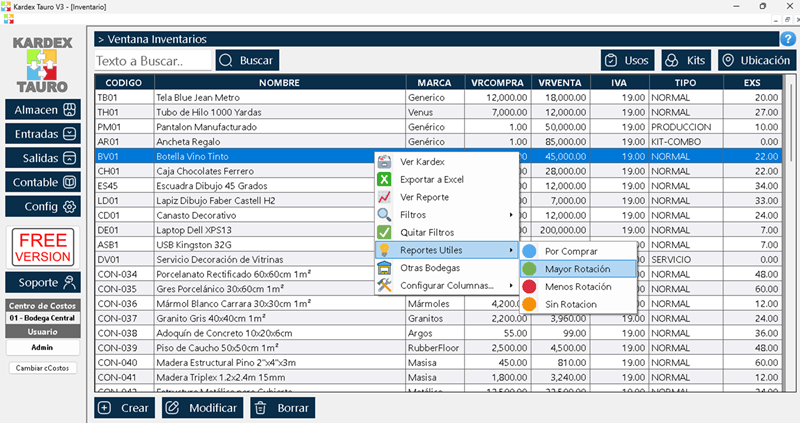
A small business does not need to stop operations for a whole day. Cyclical counts, by product groups or by warehouse zones, work very well: fast-moving products are counted every week or every two weeks, and slow-moving ones once a month. What matters is that the count result is recorded and does not depend on the memory of the person who did it. With a tool such as Kardex Tauro, the physical count can be recorded and compared right away against the stock in the system, so a surplus appears instantly, with the detail of every reference and no loose sheets.
What to do when a surplus appears
When a count shows a surplus, the temptation is to adjust the system right away to make it balance. That is the worst path: an adjustment without investigation turns the difference into a false figure and hides the cause, which will keep producing surpluses in the future.
- Investigate before adjusting. Review the recent movements of the reference: did goods come in during the last few days? Were there customer returns? Was any sale voided? Does the package state the correct quantity? In most cases, the cause shows up when reviewing the last few weeks of movements.
- Record the positive adjustment, documented. If, after investigating, the surplus is real, record a positive adjustment: the units that are physically in the warehouse become recorded in the system. That adjustment must be documented, with date, person in charge and reason, so it is clear that it was not an uncontrolled receipt or a typing error.
- Fix the root cause. If the surplus came from a receiving error, correct the receiving procedure; if it came from unrecorded returns, define who records each return. Adjusting without fixing the cause is paying the same fine twice.
How to prevent surpluses in daily work
Preventing a surplus is cheaper than investigating one. And prevention does not depend on big investments, but on simple habits applied every day:
- Receive goods against the supplier's document and record the receipt the same day, with the real quantities, not the ones that "look right". A single person in charge of receiving reduces errors.
- Record every return. Each return that puts goods back into stock must generate a visible receipt in the system, even if the product goes back to the same shelf it came from.
- Post sales carefully and check cash register closings: a voided sale without a stock return is a surplus in the making.
- Count units, not packages, and check that the presentations match what the label says.
- Do cyclical counts and document them. A count that is not recorded is an opinion, not a fact.
The general rule is simple: everything that comes in, goes out or comes back must leave a movement in the system. When every purchase receipt and every return that restores stock is documented, surpluses stop appearing by surprise. Kardex Tauro applies this rule in practice: every movement is linked to a supporting document, and adjustments and physical counts are recorded with their explanation, so inventory always reflects what happens in the warehouse.
A surplus is neither good news nor a catastrophe: it is information. If it is detected with periodic counts, investigated before adjusting and prevented by recording every movement, the business gains the most valuable thing in inventory management: knowing, without guessing, how much it really has. Controlling surpluses is, in the end, controlling trust in your own numbers.