Inventory Value at Sale Price

Inventory Value at Sale Price
When a merchant looks at the merchandise sitting in the storeroom, he almost always thinks about what he paid for it. That is natural: purchase invoices show how much each batch cost, and memory turns that total into the value of the inventory. But that is only one of the two ways of valuing what is on hand. The other one means looking at the same inventory from the storefront: not what it cost to buy, but what the business expects to receive when it sells.
That second figure, the inventory value at sale price, answers a concrete and very useful question: how much money the merchandise on hand today could generate. It does not replace the cost value, and it does not try to. It is a complementary tool that helps you make commercial decisions, size up risks and speak the same language as the people who think about the business in terms of sales: the owner, a partner, an insurer or a potential buyer of the business.
Two Ways to Value the Same Merchandise
Every item of merchandise has at least two numbers attached to it, and they should not be confused. The first is what it cost to acquire: the amount paid to the supplier so that the unit would reach the storeroom. It is a number backed by invoices and receipts, which is why it is the one recorded on the stock card when merchandise comes in. The second is what the business expects to receive for it on the day it is sold: the sale price set for that product.
- Cost value. The result of multiplying the units on hand by what each unit cost. It looks backward: it sums up how much money left the business to have that merchandise available.
- Sale price value. The result of multiplying those same units by their unit sale price. It looks forward: it estimates how much money could come in if all the merchandise on hand is sold at that price.
When It Makes Sense to Look at the Inventory at Sale Price
- Insurance and business protection. When you think about insuring the merchandise, what is at stake is not only what it cost but what its loss would mean for the business: the sales that stop happening and the difficulty of replacing the assortment. That is why, to size up a possible total loss, the value at sale price gives a far more realistic idea than the mere purchase cost.
- Liquidation decisions. If the business is going to close, change owners or sell off merchandise, the question stops being how much was paid and becomes how much can be received. In those scenarios the inventory is thought of as money coming back into the cash register, and the sale price is the natural reference.
- Retail and commercial decisions. In a store, inventory and sales are connected by the sale price: it is the bridge between what is in the back room and what comes through the register. Product goals, sales budgets and promotions are all calculated on sale prices, and expressing the inventory in that same unit lets you compare what you have with what you expect to sell.
How to Calculate the Value of Inventory at Sale Price
The calculation is simple, but it requires two reliable pieces of data: the exact quantity of units of each product and the unit sale price of each one. With those two figures, the procedure has three steps:
- List each product with the quantity on hand today.
- Multiply that quantity by the unit sale price of the product.
- Add up the results of all the products to obtain the total value of the inventory at sale price.
An example with four products from a personal care store makes it clear:
| Product | Units on hand | Unit sale price | Value at sale price |
|---|---|---|---|
| Handmade soap | 120 | $6,000 | $720,000 |
| Moisturizing cream | 45 | $12,500 | $562,500 |
| Body oil | 30 | $15,000 | $450,000 |
| Scented candles | 80 | $8,000 | $640,000 |
| Total inventory value at sale price | $2,372,500 | ||
Two refinements make the result more useful. The first is to use the regular sale price of the product, not a temporary promotion price: the goal is to measure the normal ability of the inventory to generate income, not an exceptional scenario. The second is to review the quantities when there is damaged, expired or very slow-moving merchandise: if a product is not in a condition to be sold at its normal price, including it at full value inflates the figure and moves it away from reality.
Differences Between Cost Value and Sale Price Value
- The basis is different. Cost value rests on what was paid to the supplier; sale price value rests on what the business charges the customer.
- The distance between them is potential margin. The difference between the sale price value and the cost value of the same inventory roughly indicates the gross margin that is still waiting to be realized in the merchandise. It is a very revealing figure: a large inventory at cost with a small margin can be commercially less valuable than a medium one with a good margin.
- The use is different. Cost value is the basis for the records of the business; sale price value is a tool for analysis and commercial decisions. Confusing the roles leads to wrong conclusions.
The Accounting Warning: Inventory Is Carried at Cost
The fact that the value at sale price is useful for decisions does not mean it should replace cost in the records of the business. In accounting terms, inventory is recorded and reported at cost, that is, at what it cost to acquire it and get it ready for sale. The reason is common sense: cost is a fact that can be proven with invoices, while the future sale price is an expectation that may never come true if the product does not sell or ends up being sold at a discount.
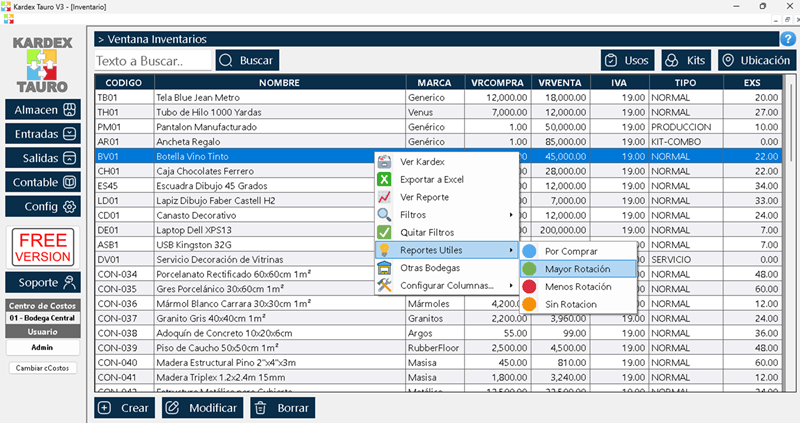
Each country has its own accounting rules, and every business must follow the ones that apply to it, with the support of its accountant. The practical recommendation is not to change the records but to keep both numbers separate and use them where they belong: cost for the accounting of the business and sale price for commercial decisions. Tools like Kardex Tauro make that separation easier, because the stock card records entries and exits at cost and keeps the inventory value at cost always up to date, while the sale price is defined in the product file, so the calculation at sale price can be done in minutes whenever it is needed.
What This Figure Is For in Practice
- Knowing how much money is sitting still. Inventory is the asset where the most money gets trapped in a small business. Expressed at sale price, that amount can be compared with the reality of the cash register and helps decide whether it is worth pushing the sale of certain products, running promotions or simply buying less than before.
- Sizing up real risks. A fire, a theft or massive damage to the merchandise does not destroy what the inventory cost but what it would have generated. Having that figure calculated before something happens allows you to react with numbers instead of assumptions.
- Planning liquidations, closures or transfers. When the time comes to turn merchandise into money, the sale price marks the starting point: how much could be recovered in the best scenario and where to start negotiating discounts.
- Comparing inventory with sales. One of the most useful readings is expressing the inventory in months of sales: if the value at sale price equals four months of sales, too much capital is sitting in the back room; if it equals two weeks, you are probably losing sales for lack of assortment. That comparison is only possible when both numbers speak the same language, the language of the sale price.
So the point is not to choose between cost and sale price as if they were rivals: good inventory control keeps both in sight and knows which one to use in each moment. With a stock card tool such as Kardex Tauro, the cost value is updated with every entry and exit, and with the sale price defined in the product file, the business is ready to answer at any moment how much its inventory is worth and, more importantly, how much it could generate.