How to Reduce Errors in a Warehouse

How to Reduce Errors in a Warehouse
In a small warehouse almost every mistake looks the same: more boxes arrive than the invoice says, the wrong size gets shipped, a movement is recorded two days later, or one reference is mixed up with another that looks almost identical. Each failure seems minor at the moment, but it leaves a mark: the inventory stops matching reality, a customer receives something they did not order, and at the end of the month someone has to answer for the shortage.
The good news is that most of these errors do not come from careless people, but from the absence of a method. When there is no clear receiving procedure, when every worker records things their own way, and when boxes are not identified, a mistake is a matter of time, not bad luck. This article reviews the most common operational errors in a warehouse and the practical measures to reduce them, designed for small businesses that do not have a large inventory control department but do need their stock records to tell the truth.
Why errors happen in the warehouse
Most operational errors share a single origin: the warehouse works on memory and trust. People trust that the quantity shipped is the quantity ordered, they trust that the supplier invoice is correct, and they trust that the data will be recorded later. That trust works while volumes are small and the owner handles everything; when sales, orders and references grow, memory starts to fail and discrepancies appear.
There are also conditions that invite mistakes. Similar references, identical packaging, end-of-month rush, missing labels and the habit of recording movements at the end of the day are the perfect breeding ground. Understanding how each error is produced helps design the exact measure to prevent it, instead of applying generic remedies that rarely work.
The most common errors and how to avoid them
These are the errors that repeat most often in the warehouses of small businesses, together with how they happen and the concrete measure to prevent each one:
| Warehouse error | How it happens | Measure to prevent it |
|---|---|---|
| Receiving wrong quantities | Boxes are counted without opening them, or the invoice is signed without checking against the order | Apply the receiving procedure: count item by item against the purchase order before signing |
| Sending the wrong product | The worker picks the reference that is closest at hand or the one they believe was ordered | Double checking: the person who picks is not the person who ships, and both compare against the dispatch note |
| Recording movements too late | The entry or exit is left for the end of the day, with data that is no longer remembered well | Record every movement at the moment it happens, before starting another task |
| Mixing similar references | Two products look alike in name or packaging and are stored or shipped as if they were one | Use your own codes, visible labels and separate locations for similar references |
| Not checking documents | Goods are received or shipped without comparing them against the invoice, dispatch note or order | Require a document check at every receiving and every shipping process |
As you can see, each error has a different origin and therefore a different solution. Each measure is explained below, in the order in which it makes sense to implement them.
How to reduce errors step by step
1. Define a receiving procedure
Receiving well is half of inventory control, because a miscounted receipt contaminates every later balance. The procedure does not have to be complex, but it must always be followed, even in a rush. At minimum:
- Check that the supplier document matches the order that was placed: same reference, same quantity and same conditions.
- Count the goods item by item, not by closed boxes. If everything cannot be opened at once, mark the pending boxes and verify them before storing.
- Inspect the condition of the products: damaged, expired or opened items must be set aside and noted as a finding before signing.
- Sign the document only when the quantity received matches the real one, and note any difference with the supplier present.
When an invoice is signed without verification, the difference is recorded as if the full order had arrived, and the inventory is overstated from day one.
2. Apply double checking when shipping
The wrong shipment is the error that hurts customer relationships the most, because it is discovered when the goods are already in the customer's hands. The most effective and cheapest measure is double checking: one person picks the order and another reviews it before it leaves, comparing the goods against the dispatch note or sales invoice.
In very small businesses where only one person works in the warehouse, double checking can be done differently: pick the order in a first pass, leave the goods in the dispatch area, and review them against the list before packing. Simply separating picking from reviewing greatly reduces crossed references.
3. Identify everything with codes and labels
Many errors happen because people rely on how the package looks, and packaging is misleading. The solution is to let the code make the decision: every reference should have its own code, and the box or shelf should carry the matching label.
For similar references, the label is essential. Two products with almost identical names or similar packaging colors should be kept apart in the warehouse, with their code visible and, if possible, a short photo or description at the workstation. When barcodes are used, the scanner prevents the eye from being fooled: if the code does not match the order, the system warns before the mistake leaves the warehouse.
4. Assign fixed locations
An organized warehouse is not a cosmetic luxury: it is a tool against error. When every reference has a fixed location, whoever looks for a product goes straight to the right place instead of searching through dozens of similar boxes, and whoever stores goods knows exactly where to put them.
A fixed location is described simply: aisle, shelf or rack, level and position, for example A-3-2. That location reference is recorded next to the product in the stock record, so the location list works as a guide for storing, picking and counting. When a product has no defined place, it ends up wherever there is space, and wherever there is free space the wrong reference always ends up.
5. Record at the moment
Recording later is the silent cause of most discrepancies. A worker receives ten units at nine in the morning, handles three orders, ships two, and at six in the evening tries to reconstruct what happened. The result is an approximate record that does not match reality.
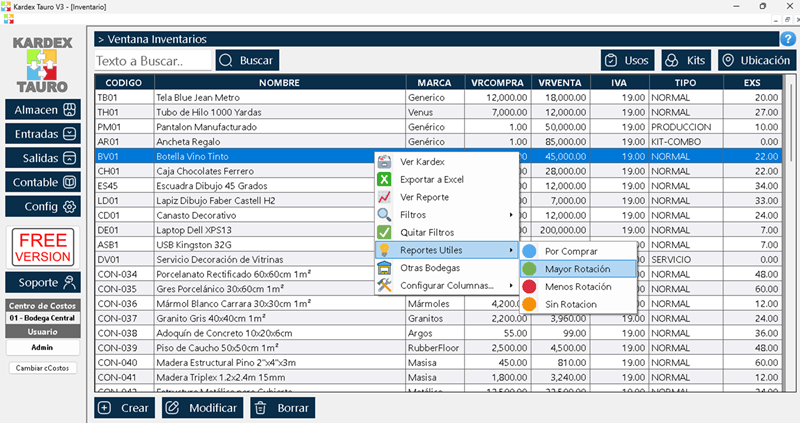
The simple rule is: the movement and its recording are a single task. The receipt is recorded when goods arrive, the exit is recorded when goods are shipped, and the supporting document is filed together with the movement. In Kardex Tauro every entry and exit is recorded with its supporting document: purchases, sales, transfers and shrinkage. So when a question arises about a quantity, it can be traced back to the document that supports it and resolved in minutes, instead of guessing.
6. Run control counts
However good the procedures are, it always pays to verify periodically that the stock record and the warehouse agree. Control counts are quick reviews of some references, without stopping the whole operation:
- Count every week the references with the highest turnover, which are the ones that fail most.
- Count before and after a large receipt or a full inventory.
- Investigate any difference as soon as it appears: if you wait until month end, nobody remembers what happened.
- Record the cause of each difference (receiving error, crossed shipment, late recording) to fix the process, not just the number.
A small discrepancy detected in time is solved in minutes. The same discrepancy detected three months later forces you to review dozens of movements and, often, it is never explained.
The warehouse is controlled with method
Reducing errors in the warehouse does not require expensive equipment or extra staff: it requires order, simple procedures and the discipline to follow them. Receiving against the document, shipping with double checking, identifying with codes, storing in fixed locations and recording every movement at the moment eliminates most of the discrepancies that today are blamed on poor memory.
The recording tool supports that method: Kardex Tauro supports product locations in the warehouse and working with barcodes, so the data that is entered matches the product that is actually moved. When the process is clear and the record is faithful, the warehouse stops being a place where things get lost and becomes the reliable foundation for business decisions.