How to Control Construction Materials Inventory

How to Control Construction Materials Inventory
In a construction hardware store or a building materials depot, merchandise does not behave like it does in a clothing store or a supermarket. Cement arrives in heavy bags that harden if they get wet, rebar is sold both per unit and per kilogram, blocks and bricks take up meters of warehouse space and crack with every handling, and paints and finishes have lots and dates that demand rotation. Keeping control of that inventory is not optional: it is what separates a business that knows what it has from one that discovers shortages when it is already too late.
Controlling construction materials inventory means three things at once: knowing exactly how many units and quantities are in the warehouse, recording every entry and exit the moment they happen, and keeping the warehouse organized so that what the record says matches what the shelves show. When those three elements work, the business buys better, dispatches faster and loses less money to damaged or misplaced merchandise.
Why Construction Materials Are Hard to Control
Each material family brings its own problems, and the record has to recognize them. Cement and adhesives are sold by the bag, but a bag that gets wet or is stored for too long becomes unusable and has to be written off. Rebar and steel can be sold per unit, per quintal or per kilogram depending on the customer, and that forces the business to handle more than one unit of measure for the same product. Blocks, bricks and roof tiles are fragile: they break while being loaded, transported and stacked, and those losses are known as handling shrinkage. Paints, sealants and finishes arrive in lots and colors that must be rotated so the business does not end up with old containers or expired products.
On top of that come dust and moisture, which dirty labels and damage packaging, and the weights, which make a full warehouse count take hours and discourage anyone from doing it often. The typical result is the same in almost every business: the person in charge believes there are twenty bags of cement left, but only twelve are found at dispatch time, and the difference is discovered after the sale has already been committed.
The following table summarizes the basic care and controls by material type:
| Material type | How to store it | Recommended control |
|---|---|---|
| Cement and adhesives | Bags on pallets, away from the floor and the walls, in a dry, ventilated area | Record per bag and per lot; dispatch the oldest stock first |
| Rebar and steel | Laid flat or supported on racks, away from moisture and sorted by diameter | Record the main unit (piece or kilogram) and keep the secondary measure |
| Blocks, bricks and roof tiles | Stacked on stable pallets, without exceeding unsafe heights | Count per unit and note breakage losses when removing stock |
| Paints and finishes | Closed containers, lid up, on shelves, grouped by color and lot | Rotate by arrival date and control per container or per gallon |
| Aggregates (sand, gravel) | In yards or marked areas, kept separate from each other | Estimate per trip or volume and compare with recorded exits |
Organize the Warehouse by Material Families
The first step toward control is physical: organizing the depot by product families and giving each one a fixed place. Cement and adhesives in their dry area, rebar sorted by diameter, blocks on their pallet, paints by color on the metal shelves and finishes apart. When each material has a defined place, counting becomes faster, dispatches take less time and differences jump out: if a box of rollers shows up in the paint area, someone put it there, and that is already a sign of disorder.
Within each family it is wise to apply a simple rotation rule: what arrived first is dispatched first. It is the same logic as the FIFO method applied to the warehouse, and it is especially important with cement, paints and finishes, where storage time deteriorates the product.
Register Every Material with a Code and a Group
Physical order is not enough if the record does not recognize each product individually. In the inventory system every material must have its code, and codes must be grouped by family: one group for cement and adhesives, another for steel, another for blocks, another for paints and another for finishes. With that structure, the stock report can be read by group and by product, making it effortless to answer how much exists in the paint family as a whole and which code belongs to the product that is running out.
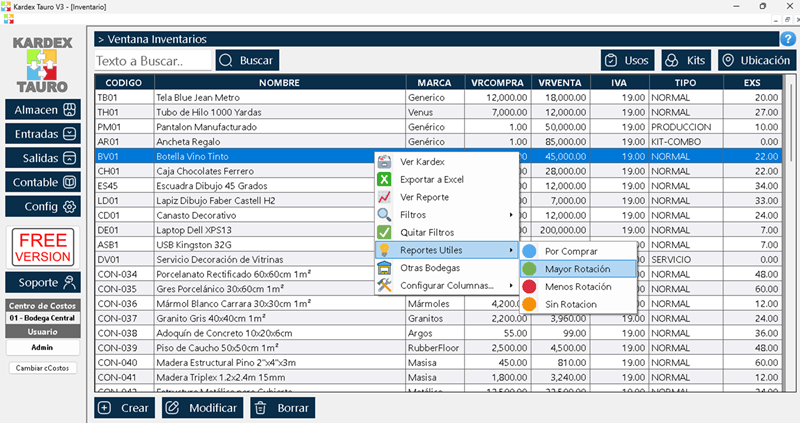
This is where software like Kardex Tauro makes the hardware store owner's work easier: it lets you create products with code and group, so the digital warehouse mirrors the physical one. It also keeps a per-product stock ledger, that is, an orderly history of every entry and exit with its date and balance. That history is the memory of the business: with it you can know when a lot arrived, what it cost, how much has been sold and how much should remain.
Control Entries: Purchases and Receiving
Every entry must be recorded, without exception. When a supplier order arrives, the right thing is to check the merchandise against the invoice or delivery note. The recommended process is as follows:
- Count the physical merchandise: the cement bags, the block loads, the rebar bundles and the paint cans or boxes.
- Check that each material matches what was ordered: rebar diameter, cement type, and paint color and lot.
- Note any difference, damage or shortage on the delivery note itself before signing the receipt.
- Record the entry in the stock ledger with the date and the lot, and place the merchandise in its area.
If the material arrives damaged or incomplete and the business receives it without noting it, that shortage will be charged to the inventory as if it existed. When the purchase is recorded, the inventory must increase by the quantities actually received, not by what the invoice says if there were differences.
Control Exits: Sales and On-Site Uses
Exits from a materials depot come in two kinds. The first is the sale to the end customer: the foreman who buys ten bags of cement or the construction company that takes a full order. The second is internal use or dispatch to the company's own site, when the business itself consumes material for a project and no sale is involved. Both must subtract from inventory, because if only sales are deducted, materials used on site stay counted as stock that is no longer there.
For sales, the ideal record subtracts inventory at the very moment of invoicing. A sales invoice that automatically subtracts the balance avoids the classic mistake of selling at the counter and forgetting to update the stock ledger. For on-site uses, it is best to issue a consumption or transfer exit, noting which material, how much and for which project it was intended. At the end of the day, the sum of sales and consumption must match the total decrease in inventory.
Dispatch by Units and Measures
One of the biggest sources of error in hardware stores is dispatching in one measure and recording in another. Rebar can be sold per piece, per bundle or per kilogram; paint per container or per gallon; wire per roll or per kilogram. Each product must have its main handling unit defined in the stock ledger, and when the customer asks in another measure, the conversion must use a clear factor that is applied consistently. Otherwise, the balance ends up in mixed units that mean nothing.
It is also wise to define how fractions are handled. If a product is sold by the kilogram, dispatching three-quarters of a kilogram must subtract that exact quantity, not round it. Precision at dispatch is what allows the month-end physical count to match the system balance.
Measure Shrinkage and Count Periodically
Shrinkage exists, and denying it only makes the problem worse. Bags that tear while being loaded, blocks that crack at dispatch, paint damaged by a leak or material that expires on the shelf: all of that must leave inventory with a shrinkage record, not stay counted as available stock. Kardex Tauro lets you control that shrinkage with adjustment or loss exits, so the balance always reflects what can actually be sold and the business knows how much it is losing to handling or storage.
With records up to date, the periodic count becomes a quick check instead of a surprise. Choosing one day a month to count the most critical families (cement, paints and steel) and comparing against the stock ledger makes it possible to detect theft, dispatch errors or poorly recorded receipts in time. If a difference appears, it is investigated before it grows; if it does not appear, the control is working.
Controlling construction materials inventory does not require expensive tools or complicated processes. It requires order in the warehouse, a record with code and group per product, entries and exits noted the moment they happen, and an invoice that subtracts on its own. With that, the hardware store owner stops guessing how much stock there is and starts making decisions with real figures.
