What Inventory Software Does a Store Need?
What Inventory Software Does a Store Need?
Behind almost every small store there is the same scene: the owner serves customers, sells, receives merchandise and writes things down in a notebook, but when someone asks how many units of a product are left, he hesitates, walks to the shelf to count them one by one, and is still not sure about the number. That doubt repeats every day and costs money: too much stock is bought or the store runs out, products are promised that are not there, and at the end of the month the shortage has no explanation. This article answers the question that arises in that moment: what inventory software does a store need to stop running blind?
The short answer is that a retail store does not need a manufacturing system or industrial modules: it needs a simple program that connects invoicing with inventory and quickly answers the questions of everyday life, how much is on hand, how much was sold and how much is owed. The following sections review the essential functions, the unnecessary ones and the criteria for choosing according to the size of the business.
Invoicing and deducting stock at the same time
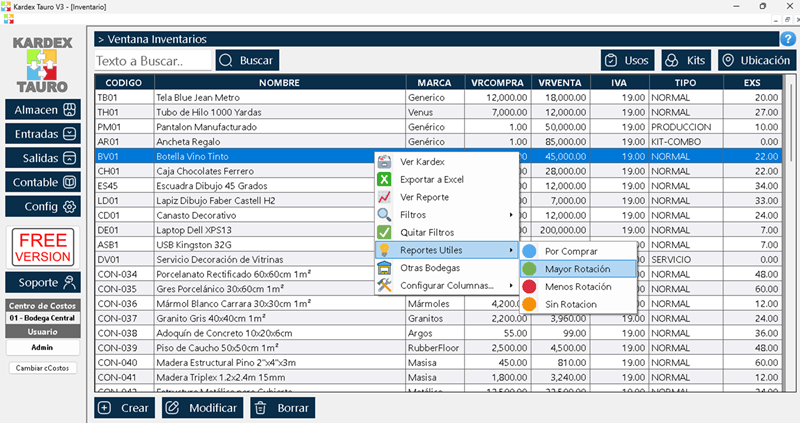
The most important function for a store is that the sale and the stock movement happen in a single step. When the cashier charges the customer at the point of sale, the program must immediately subtract each sold unit from the product stock, without anyone having to record the movement later. If the invoice and the inventory are fed separately, discrepancies are a matter of time: a forgotten sale, a movement recorded twice and a balance that stops meaning anything. Kardex Tauro invoices the sale and deducts stock automatically, generating the product stock record, the stock ledger, at the same moment. The person at the cash register does not think about inventory, but the inventory is updated anyway; that integration, which looks like a small detail, is the difference between a reliable record and a notebook kept twice.
A product catalog with codes
For the deduction to be correct, each product must exist only once in the system, identified by its own code. The catalog removes the dependence on memory and on similar names, such as two almost identical references that differ only in their packaging, and lets the cashier find an item in seconds by typing part of its code or name. With organized codes, physical counting also becomes much faster, because the same order is followed in the system and on the shelf, and every counted unit is marked without ambiguity.
Knowing how much is left of each product
The second everyday question is how much is left. Good inventory software shows the available units of any reference on screen at the exact moment they are needed: before placing an order with a supplier, when promising merchandise to a customer or when deciding whether to restock a shelf. Behind that figure there must be a complete stock record, with all entries, exits and adjustments sorted by date, so that any number can be explained. Kardex Tauro handles coded products and lets the store organize stock by warehouse, something a shop appreciates as soon as it starts keeping merchandise in more than one place or separates the storage room from the sales floor.
Physical counts to correct reality
No matter how tidy the record is, reality and the system drift apart: a unit gets damaged, another is lost between boxes and one more is sold without an invoice. That is why the store needs to count. The software must allow recording the physical count of one product or of the whole store, comparing it with what the system says and applying the corresponding adjustment, leaving a record of who did it and when. Without that function, any error stays frozen in the inventory and reappears every time a balance is checked.
Cash control and accounts receivable
In a store, money also goes out of balance, and not only because of inventory. The cashier must record in the same sale whether the customer pays in cash or on credit, and the program must track both sides: what goes into the cash register on one hand and what remains as an account receivable on the other. That way, at the end of the day, the cash close matches the sales of the day and the store knows exactly who owes and how much. For a store that sells on credit, that up-to-date list of debts is worth as much as the inventory itself, because a credit sale that is not tracked is a sale that can be lost.
Speed at the counter
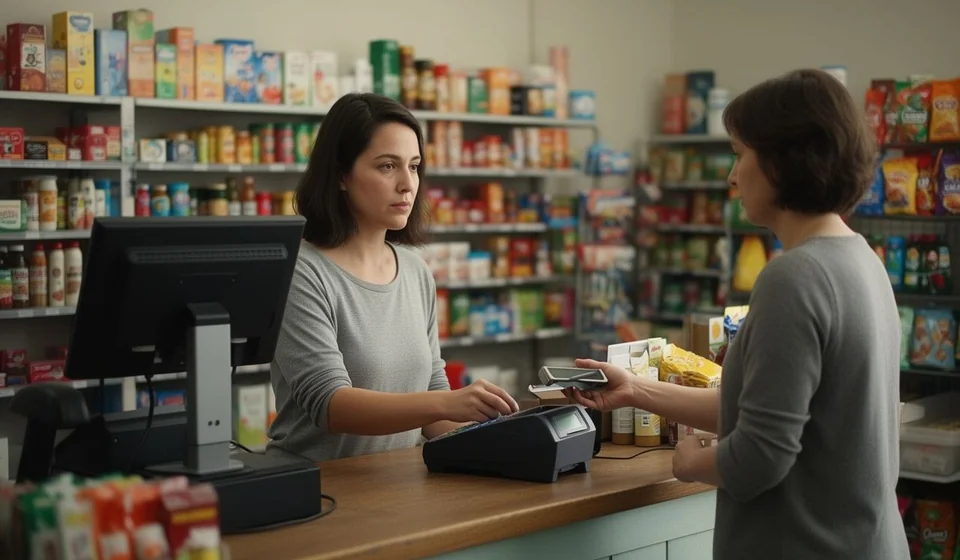
A store lives on turnover: when there is a line, every second counts. The point of sale must print the receipt instantly, with a ticket or invoice printer, and the whole cycle of finding the product, charging and printing should not take more than a minute. Kardex Tauro includes a POS or ticket printer, designed so that the counter does not become a bottleneck and the customer leaves with the document in hand, without waiting and without handwritten notes.
What the store needs at a glance
The following table summarizes the real needs of a retail store and the exact software function that solves each one.
| Store need | Software function | Benefit |
|---|---|---|
| Invoicing at the counter | The sale deducts stock and generates the stock record movement | Nobody writes things down twice and the balance is always up to date |
| Identifying each product | Catalog with its own codes | The item is found in seconds |
| Knowing how much is left | Stock inquiry by product and by warehouse | The store buys just enough and never runs out |
| Correcting differences | Physical counts with recorded adjustments | Inventory matches reality again |
| Controlling money | Cash or accounts receivable recorded on each sale | The daily close balances and debts are known |
| Serving customers fast | Ticket or invoice printing from the point of sale | Short lines and returning customers |
What a store does NOT need
Choosing software also means knowing what to discard. A store buys, stores and sells; it does not transform raw materials or run industrial processes, and buying a program designed for a factory only adds noise. These are the functions that are almost always unnecessary:
- Production modules, manufacturing orders and raw material control that nobody in the store will use.
- Batch costing, formulas or recipes, typical of businesses that make products.
- Industrial traceability functions or quality control by production batch.
- Advanced accounting reports that nobody reads and that only clutter the screen.
That kind of option is not used, it makes training longer and ends up pushing the person in charge to abandon the program and go back to the notebook. A program with a thousand features is not better than one with twenty that are easy to understand: before paying for an option, it is worth asking who will use it and on which day of the week; if nobody is going to touch it, it is noise.
How to choose according to store size
Not every store needs the same thing, and the difference is set by sales volume and by how many people run the business. A practical guide by size is this:
- Small store with a single counter: a point of sale that deducts stock, a simple catalog and a balance inquiry are enough; daily control is done with the system own sales report.
- Store with several salespeople or several points of sale: it needs organized product codes, cash control per shift, periodic counts and, if merchandise is kept elsewhere, warehouse management.
- Growing business with a storage room or delivery service: it requires stock separated by warehouse and a stock record per product showing the movements of each location.
The practical rule is the same in every case: software is chosen for the tasks that repeat every day, not for the ones that sound impressive. It is also worth choosing a provider that offers support and training, because a program that nobody learns to use ends up abandoned.
Software tailored to the store
In the end, the best inventory software for a store is not the most advertised or the cheapest, but the one that is used every day without friction. The right criterion is simple: the program must leave inventory updated after every sale, identify every amount of money as cash or as debt and answer any question about stock in seconds. With just the right features, clear screens and a provider that offers support, an invoicing program with integrated inventory turns the counter into the most reliable source of data in the business. The store that solves this decision well stops guessing and starts deciding with numbers.