How to Connect Purchases and Inventory
How to Connect Purchases and Inventory
In a small business, buying merchandise and keeping inventory usually look like two separate tasks: one happens over the phone with the supplier and the other happens in the stockroom or on the computer. In reality they are two sides of the same movement. Every time you buy something, it enters the inventory; and every time something enters or leaves the inventory, there is a reason that should be traceable to a document. When purchases and stock do not talk to each other, the business ends up paying twice for the same mismatch: once on the shelf and once in the records.
This article explains how purchases and inventory connect in daily operations: which documents take part, in what order, why buying without control throws stock out of balance, and what a small company gains when it integrates both processes into a single system.
The bridge between purchasing and inventory
Inventory is the memory of what enters and leaves the business. Purchases are the main source of entries: almost everything that reaches the stockroom was once a purchase order. That is why purchasing and stock are not separate areas but two moments of the same cycle: you buy to have stock, and stock is only replenished by buying.
That cycle touches three concrete points. The first is the order: when the business commits to a supplier to buy a certain quantity. The second is the receipt: when the merchandise arrives and becomes physically available. The third is the record: when the business notes how much arrived, at what cost, and how much it owes the supplier. If the three points are recorded consistently, at any moment a single look can answer how much merchandise there is, what it cost, and how much is still unpaid.
What a purchase order is and why it matters
The purchase order is the document that formalizes the request before the merchandise arrives. It records the supplier, the product, the requested quantity, the expected delivery date and the agreed terms. Many micro-businesses buy over the phone and rely on memory; the purchase order forces the business to decide first and record afterwards, which is the right order.
Having an order for every purchase gives three simple and powerful things:
- What is expected. It is written down which product and how many units the business ordered, without relying on what the supplier remembers.
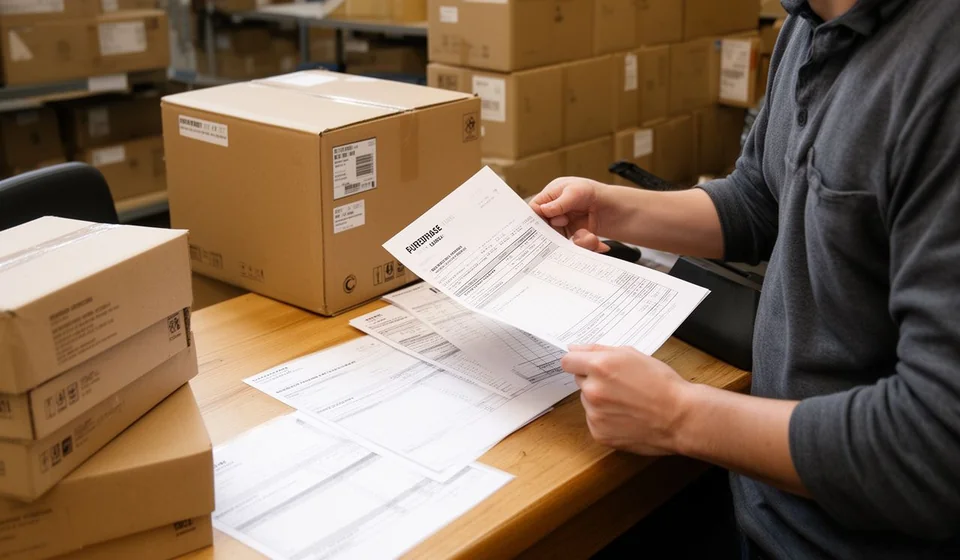
- Something to compare against. When the merchandise arrives, the receipt is checked against the order: if fewer units arrived or a different product came, it shows up right away.
- The basis for the record. The order later explains the inventory entry and the account payable; no movement is left without an origin.
Why buying without control throws inventory off balance
When a purchase is not linked to inventory, every order becomes an isolated event and the mismatch appears through several paths at once:
- Merchandise that arrives and is never recorded. The box enters the stockroom, products sell for days, and only then someone records the entry. Meanwhile the system says the product is not there, even though the shelf is full.
- Costs that stay out of date. If the entry is not recorded at the real cost on the invoice, the average cost goes stale and every later calculation starts from a wrong number.
- Quantities that are never verified. Without a purchase order there is no way to know whether the supplier shipped what was ordered: the business pays for what the invoice says, not for what it actually received.
- Debts with no support. The account payable lives in the owner's memory and gets paid when "something says it is owed," with the risk of overpaying or paying twice.
- Physical inventory that differs from the books. At the end of the period, what is in the stockroom does not match what the records say, and nobody knows exactly where the chain broke.
The underlying problem is simple: inventory can only be right if every entry has a known origin. Buying without leaving a trace is the fastest way to lose that origin.
The complete flow: from need to payment
Linking purchases and inventory is not complicated if the business follows a fixed flow. Each step produces a record and leaves a trace that the next step uses:
- Detect the need. A product reaches its minimum level and the business decides to replenish it.
- Create the purchase order. The order is recorded with the supplier, the product and the quantity.
- Receive and verify the merchandise. On arrival, it is checked against the order: quantities, product and condition.
- Record the inventory entry. The merchandise enters the stock card at the real cost on the invoice.
- Pay the supplier. The account payable is settled on the agreed date and the payment is recorded.
The following table summarizes what is recorded at each step and what effect it has on the inventory:
| Purchase process step | What is recorded | Effect on inventory |
|---|---|---|
| Detect the need | Nothing yet; only the balance is observed | None: the current level becomes the reference for deciding how much to order |
| Create the purchase order | The order with supplier, product and quantity | None: stock does not change until the merchandise arrives |
| Receive and verify | The receipt checked against the order | Shortages or overages are detected before anything is recorded |
| Record the inventory entry | The stock-card entry at the invoice cost | The balance goes up and the average cost is updated |
| Pay the supplier | The account payable and the payment | None on stock: the debt changes; the cost was already recorded on the card |
An example of the complete flow
A corner grocery has fifteen units of a cooking oil that sells well, and its supplier takes a week to deliver. The owner decides not to run out and creates a purchase order for forty units. The order is recorded, but the inventory does not change: nothing has arrived yet.
Six days later the merchandise arrives. While receiving it, the person in charge compares it with the order and finds that thirty-eight units came instead of forty; two are damaged. Instead of recording forty and sorting it out later, they record the real receipt. The inventory entry is then made for the thirty-eight good units at their real cost, and the product's average cost is recalculated with that figure. The account payable is created for the invoice value, and the supplier is paid on the agreed date.
If the same order had been handled without an order document, without verification and without an inventory entry, the grocery would have ended up with more stock than its records showed, an outdated cost and no way to claim the two damaged units. The orderly flow did not solve the supplier's problem: it made it visible in time, which is almost the same.
How Kardex Tauro connects purchases with inventory
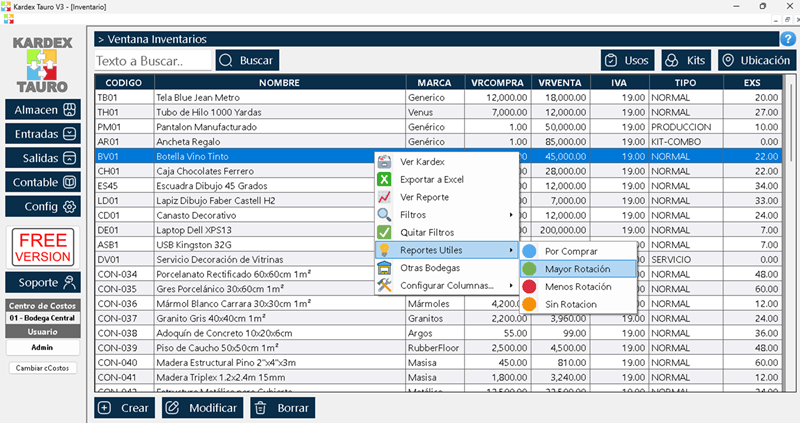
Kardex Tauro is designed so that this flow happens in a single place. The business records the purchase order to the supplier and, when the merchandise arrives, the receipt automatically generates the inventory entry: the movement is recorded on the stock card at its cost, the product's average cost is updated at that same moment, and the account payable to the supplier is registered. There is no need to write everything twice or to remember later what came in.
That integration turns the purchase into a single movement with three visible effects: stock goes up, the cost is corrected and the debt appears in the accounts payable book. Inventory stops being a separate world and becomes the natural consequence of purchasing decisions.
Benefits of linking purchases and inventory
- Inventory that is always explained. Every unit in stock has an origin: an order, a receipt, a recorded entry.
- Real costs. The average cost is updated with every purchase and profitability calculations start from true data.
- Fewer shortages and fewer surpluses. Purchases respond to real stock levels instead of gut feelings.
- Controlled payments. Every account payable is born from a verified receipt and has a date and a supporting document.
- Fast reconciliations. When the physical count and the records do not match, the exact point where the chain broke can be traced.
Buying and counting: one single process
For a small company, the difference between a healthy inventory and an unbalanced one is almost never in the ability to count: it is in the way it buys. If every order is born from a detected need, formalized in a purchase order, verified on receipt and entered into inventory at its real cost, stock control stops depending on memory. With tools such as Kardex Tauro, that cycle becomes automatic and the business can focus on selling, knowing that what it bought, what it has and what it owes always go hand in hand.