Difference between accounting inventory and physical inventory

Difference between accounting inventory and physical inventory
In a small business, two inventories exist at the same time: the one shown by the records and the one that is actually in the warehouse. For weeks both figures can look identical, until the day of the count arrives and differences nobody expected appear. Understanding the difference between accounting inventory and physical inventory is the first step toward making those surprises stop repeating and toward reporting figures you can actually trust.
The good news is that this is not a technical problem, nor one that only large companies face. It is a matter of order: knowing what each figure represents, why they drift apart, and what to do when that happens. In this article we explain the two sides of inventory, the most common causes of differences, and a practical procedure to reconcile them in a small business.
What accounting inventory is
Accounting inventory is the quantity of merchandise that, according to the business records, should exist at a given moment. It is built by adding purchases and subtracting sales and other outflows, movement by movement, on top of an opening balance. If the company had one hundred units of a product at the start of the month, bought forty and sold thirty, the records will say there are one hundred and ten units, no matter what happens in reality.
That is why it is also called theoretical inventory: it is a calculation, not a photograph. Its value depends entirely on every entry and every exit having been recorded correctly and on time. A sale registered with two fewer units than the real ones, a purchase typed with one extra digit, or a return that never entered the system is enough to make the book balance stop reflecting the truth. Management systems help reduce those errors, because they record each movement at the moment it happens and keep the balance updated automatically, but no system can fix a record that never arrived or arrived wrong.
What physical inventory is
Physical inventory is what actually exists: the units that can be counted, weighed or measured on the shelves, in the warehouse, at the point of sale or in transit inside the business. It does not depend on any record or any screen. It depends on what a person finds when checking the product one by one, and that is why it is the only way to confirm that paperwork and reality match.
Doing a physical count is not simply looking at the shelves. It requires a procedure: stopping or controlling entries and exits during the count, assigning zones and responsible people, counting in pairs to validate the results, and writing the quantities on a single form. In a small company this can be done in an afternoon or a weekend, but it must be done methodically, because a careless count produces a physical inventory as wrong as a bad record.
Why differences appear between accounting and physical inventory
When the physical count does not match the system balance, the difference almost never has a single explanation. The most frequent causes in small businesses are the following:
- Theft and shrinkage: merchandise that leaves without an invoice or a record reduces the physical stock without touching the accounting balance.
- Natural shrinkage and losses: expired, broken, spilled or damaged products, or items lost through mishandling, that were never registered as an outflow.
- Recording errors: quantities typed wrongly in purchases or sales, products swapped for similar-looking ones, or movements entered twice.
- Unregistered returns: customers returning merchandise that goes back to the warehouse with no entry, or returns to suppliers that leave without being deducted.
- Misplaced merchandise: units that are in the business but in another spot, or that were sent to a customer but not yet invoiced.
- Incomplete or surplus receipts: receiving fewer or more units than the supplier shipped, when the difference was not checked on arrival.
These causes usually combine. That is why, when a difference appears, the sensible approach is not to guess the reason but to review the product's movements to find it. A one-off difference may be a typing error; one that repeats on the same items usually reveals a deeper control problem, such as an unsupervised area or a receiving process without verification.
Comparison table: accounting inventory vs. physical inventory
| Aspect | Accounting inventory | Physical inventory |
|---|---|---|
| What it is | The stock shown by the records and the system, based on recorded movements | The real stock found by counting the merchandise in the business |
| Where the figure comes from | From purchases, sales, shrinkage and adjustments recorded in the stock card or the system | From directly counting units, weights or measures in the warehouse and at the point of sale |
| When it is done | It is updated permanently with every movement that is recorded | It is determined during scheduled counting sessions, with operations cut off |
| Who determines it | The system or the person in charge of recording movements | The staff who count, ideally supervised and verified in pairs |
| What happens if it does not match | It cannot detect the difference on its own | It is the tool that reveals the difference against the records |
| Its usefulness | Knowing stock, costs and values without going out to count | Validating how reliable the records are and detecting real losses |
Both figures are useful, but they play different roles: accounting inventory serves to run the day-to-day operations and to value the merchandise in the financial statements, while physical inventory serves to prove that this information is true. A small business accounting system is only as reliable as its latest count.
How to reconcile accounting inventory with physical inventory
Reconciling inventories does not mean forcing the figures to match: it means finding the origin of each difference, correcting what can be corrected, and leaving a record of the rest. An orderly procedure has these steps:
- Prepare the count: choose the date, notify the team, organize the warehouse and define zones and people in charge.
- Cut operations: stop or isolate entries and exits so nothing moves while counting, and the record stays frozen at the same moment.
- Count and record: capture the real quantities and load them into the system using the physical counts window, so what was counted is compared against the recorded balance product by product.
- Investigate the differences: review the product's movements, purchase and sale documents and warehouse transfers before adjusting anything.
- Adjust with support: correct in the system only what is justified and documented, identifying the reason for every adjustment.
- Record shrinkage: when the count shows fewer units than registered and there is no other explanation, the negative difference is recognized as shrinkage and removed from inventory.
- Analyze the results: review which products concentrate the differences and fix the process that is causing them.
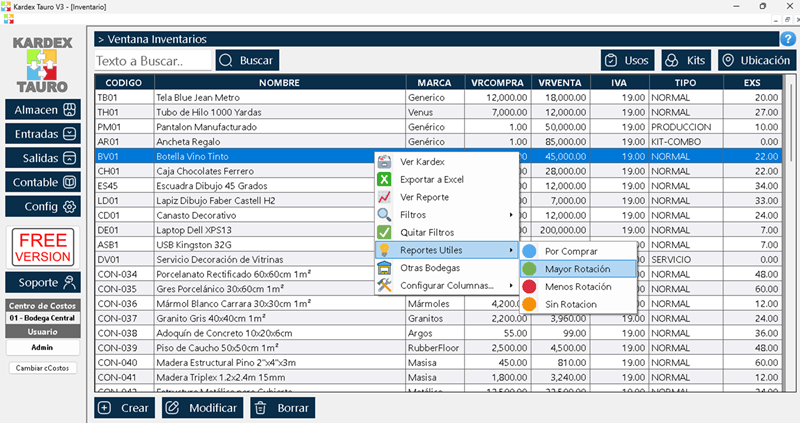
A management program makes a real difference at this point. Kardex Tauro records every inventory movement —purchases, sales, shrinkage and adjustments— so the accounting balance is always up to date, and its physical counts window lets you load what was counted and compare it against the record without loose spreadsheets or improvised Excel work. That turns a procedure usually done in a hurry into an orderly control with full traceability.
The accounting adjustment must always be documented: who made it, why, on what date and against what evidence. An adjustment without support fixes that day's difference but hides the real problem, which will show up again in the next count.
How often you should do the physical count
The ideal frequency depends on the size of the business, the value of the merchandise and how fast it turns. As a practical rule, we recommend:
- Monthly or bimonthly counts of the highest-value or fastest-moving products, which concentrate most of the money and most of the risk.
- A general count at least twice a year, ideally with operations cut off on a closing date, to leave the balances ready for financial reporting.
- Extraordinary counts when there is a change of warehouse manager, suspicion of losses, or right after a system implementation or migration.
The golden rule is simple: the count is not an expense, it is an investment in information. Every counting session reveals leaks, errors and improvement opportunities that would otherwise stay invisible until they hit the cash register or the tax return.
Conclusion
The difference between accounting inventory and physical inventory is not an error to hide: it is a signal. When the records say one thing and the warehouse shows another, the business is telling you that something in its operation needs attention, whether it is a weak receiving process, a wrongly recorded sale, or shrinkage that was never controlled. Keeping both inventories up to date, counting them methodically and reconciling them with documented adjustments lets accounting information serve as a basis for confident decisions. In a small business, inventory is not just one more number: it is the X-ray of what the company really has to sell.