What Is Committed Inventory?

What Is Committed Inventory?
A customer calls in the morning and asks for twenty units of a product that always sells well. The stock ledger says there are thirty in the warehouse. The answer seems easy: yes, there is enough. But before confirming, it is worth asking a second question: of those thirty units, how many are actually free? It may happen that fifteen are already set aside for an order that ships tomorrow, or that a customer ordered them and will pick them up in the afternoon. The merchandise is there and nobody stole it, but it can no longer be offered. That is committed inventory.
This article explains what committed inventory is, how it differs from available inventory, how it originates in small businesses, why it matters to know about it before promising stock to a customer, and how to keep track of it in practice in a company with up to fifty employees. The topic is not theoretical: understanding the difference between what is on hand and what is free avoids double sales, upset customers and wrong purchases.
What it means for merchandise to be committed
Committed inventory is merchandise that already has a commitment: it was set aside for an order, reserved for a customer, or promised in a sale that has not been shipped yet. It is still physically in the warehouse or in the store and it still counts as stock, but it is no longer available to be sold to someone else. It already has an owner even though it has not gone out the door.
Commitments usually take two forms. The first is the confirmed order: the customer ordered, the sale was accepted, and the units are waiting to be dispatched or delivered. The second is the layaway or reservation: the customer ordered the product without paying for it in full, or asked to have it held while they get the money or come to pick it up. In both cases the units are committed, and selling them again would mean promising the same thing twice.
It helps to distinguish the states in which the same unit can be found, because each one allows a different answer:
| State of the merchandise | What it means | Can it be sold? |
|---|---|---|
| Available or free | It has no commitment and can be offered to any customer. | Yes, with no restrictions. |
| Set aside for an order | Reserved for a confirmed order waiting to be dispatched or delivered. | No: it already has an owner. |
| Held as layaway or advance order | The customer ordered it and will pick it up on an agreed date. | No, until the reservation is released. |
| Being prepared for dispatch | It left the shelf to assemble an order and is ready for delivery. | No: it is in the process of leaving. |
The table sums up the golden rule: committed merchandise is not promised twice. If a reservation expires or an order is cancelled, the merchandise becomes available again and can be offered once more; until then, it belongs to the person who reserved it.
Available versus committed: two different numbers
Many businesses work with a single number: the total amount of stock. But in practice it is better to handle two. Physical stock is the units that are in the warehouse, counted or recorded. Available inventory is what can truly be promised today: physical stock minus what is already committed.
Let us go back to the opening example. Thirty units in the warehouse with fifteen committed leave fifteen available. If the salesperson promises based on thirty, at some point fifteen units will be missing to fulfill what was promised. If they promise based on the fifteen free units, they can deliver what they say. The difference between one number and the other is exactly the committed inventory, and hiding it is the cause of a good share of customer conflicts in small businesses.
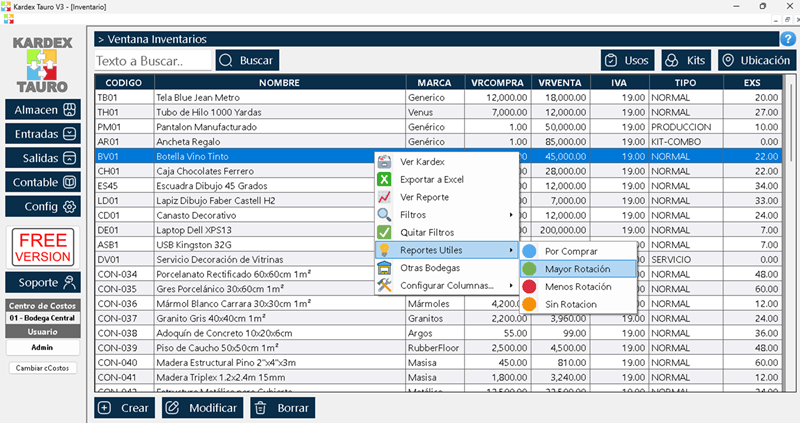
This is where the stock ledger and the commitments register come in. The stock ledger, such as the one offered by Kardex Tauro, shows physical stock: how much came in, how much went out and how much remains. But the stock ledger does not say by itself which of those units are already set aside; that lives in the record of pending orders and sales. To know how much can be sold, you have to look at both: what the stock ledger shows minus what the commitments list shows.
How committed inventory originates
Committed inventory does not appear on its own: it is always born from a promise made to a customer or from an internal decision to hold merchandise. In a small business the most common situations are:
- Advance orders: a customer orders a product before it arrives or before picking it up, and the units are reserved as soon as they are available.
- Layaways: the customer asks to keep the merchandise while they get the payment or stop by the store; a common practice in clothing shops, hardware stores and neighborhood businesses.
- Sales being prepared for dispatch: the sale is already recorded, but the units are still in the warehouse while the delivery or shipment is being arranged.
- Commitments made over the phone or by message: a verbal promise counts as a commitment even if no sales document exists yet.
- Internal reservations: merchandise meant for a contracted installation, an event or a job at a customer's home, which should not be sold at the counter.
When the order is dispatched and the exit is recorded, the commitment becomes a fulfilled sale and the merchandise stops counting as stock. If the customer does not hold up their end, the commitment is released and the units return to the available inventory. What matters is that each of those transitions is written down.
Why it pays to know how much inventory is committed
Knowing your committed inventory protects three things: sales, purchases and customer trust.
The first thing it protects is the sale itself. The most expensive mistake is promising merchandise that is already set aside: two customers end up waiting for the same units, one of them is left without their order, and the business loses the trust of both. Whoever knows their commitments offers realistic dates and only promises what they can deliver.
It also protects purchases. If committed merchandise is not deducted, the business believes it has less than it really does and buys too much, or believes it has more than it really does and runs out of stock when dispatch time comes. Knowing how much is committed allows you to calmly decide whether you need to restock and how much to order from the supplier.
Finally, it protects the mood of the store. When two salespeople serve the same counter and neither of them writes down the layaways, the first customer who walks in takes the reserved unit and the owner ends up in the middle of the complaint. Knowing your commitments avoids internal arguments, returns and misunderstandings that employees and owners end up paying for.
How to track commitments in a small business
Tracking committed inventory does not require expensive technology: it requires a method and consistency. These are the practical steps for a small business:
- Define a single place to write down commitments. It can be a notebook, a spreadsheet or the pending orders record, but it must be one and known to everyone: product, quantity, customer, promised date and delivery date.
- Separate the committed merchandise physically. A box or an area marked as reserved, with a note saying who it is for and until when, keeps someone from selling it by mistake. What is mixed in with free stock gets sold, sooner or later.
- Check before promising. Before telling a customer there is stock, review the record of pending orders and sales. The practical rule is: what is available is what the stock ledger shows minus what is listed as committed; Kardex Tauro helps you with the first part and your pending record with the second.
- Record when commitments are fulfilled. When the order is dispatched or the customer picks up their layaway, write it down the same day: the merchandise leaves the commitments record and, if it was not shipped, becomes available again.
- Release reservations that expire. Set a reasonable holding period and a clear rule: if the customer does not come within that time, the units go back to the counter. A layaway forgotten for weeks is frozen inventory.
- Assign one person in charge of reviewing the list. It does not matter whether the business has two or forty employees: someone must be able to answer at any moment how much is free.
Why memory is not enough
In a small business, everything seems to fit in the owner's head, and for a while it does. But commitments are exactly the kind of information memory handles worst: there are many of them, they change every day, they depend on promises made by different people, and they leave no trace when someone makes a mistake.
The busiest sales day of the month is also the day when layaways are forgotten the most. Two customers ask for the same product, a new employee did not know some units were reserved, and the owner, who keeps the numbers in their head, discovers the clash when it is already too late. From memory you also cannot answer a simple question in the morning: how many units of this product can I promise today? The answer requires subtracting something that nobody wrote down.
Memory does not help with the physical count either: if reserved units were counted as normal stock, the inventory seems complete when in reality part of it can no longer be sold, or it seems incomplete when the units are in the reserved box. Without a record, even the best stock ledger tells only half the story.
Committed inventory, then, is not a textbook concept: it is the difference between promising and delivering. An orderly stock ledger tells you how much merchandise there is; the record of pending orders and sales tells you how much of that merchandise already has an owner. Whoever keeps both numbers up to date can serve customers with confidence, buy with good judgment, and rest easy knowing they did not promise what was already committed.