How to Calculate Your Inventory Service Level

How to Calculate Your Inventory Service Level
For a small business, few numbers say as much about how you operate as your inventory service level. It answers a simple question: out of every hundred orders your company receives, how many do you manage to deliver complete and on time? The answer can be a source of pride or a warning, because behind every poorly filled order there is a customer who waited too long, a sale that was lost or a promise that was broken.
Unlike other indicators that feel distant, this one is calculated with information your business already produces every day: the orders that arrive, the ones that are shipped and the ones that stay pending. This article explains what service level means, how to calculate it with a simple formula, a practical month-by-month example, what level is considered healthy and why raising it almost always means carrying more inventory.
What is the inventory service level
The inventory service level is the percentage of your customers' orders that you manage to fill completely and within the agreed time frame. It works like a grade your customers silently give you every month: if a customer orders five products and receives four, that order does not count as fulfilled, even though you shipped eighty percent of the units. The requirement is double: complete quantity and on-time delivery.
That is why service level does not measure how much merchandise you sell, but how well you respond to what customers ask for. Two businesses can sell the same amount and have very different service levels: the one that fills orders better keeps its customers even when its price is not the lowest. In markets where a buyer can switch suppliers with a single phone call, the confidence of receiving the complete order becomes a concrete advantage.
It is also worth telling it apart from similar terms. Inventory accuracy tells you whether what your stock records show matches what is actually in the warehouse; service level tells you whether the customer was satisfied with the shipment. The two are connected: if your records say there are ten units and only six are on the shelf, sooner or later an order will go out incomplete and the indicator will drop. Measuring service level is therefore also an indirect way to detect problems in recording, purchasing and dispatch.
The formula to calculate it
The formula is straightforward and fits in one line: divide the orders you filled completely and on time by the total orders received during the period, then multiply by one hundred.
Service level (%) = (Orders filled completely and on time ÷ Orders received) × 100
To make the number reliable, define three rules before you start counting. First, what counts as an order received: every order confirmed by the customer, regardless of its size. Second, what counts as complete: every line and every unit of the order must leave in the shipment, with no shortages promised for later. Third, what counts as on time: the order must leave within the agreed deadline, not whenever the merchandise finally showed up. With these rules agreed with your team, everyone will count the same way and the result will not depend on who calculates it.
A month-by-month calculation example
To see it in practice, let us take a small cleaning and pantry products distributor that serves neighborhood stores. Every month it records how many orders it receives and how many it ships complete and on the agreed date, and with those two figures it calculates the percentage. The following table summarizes six months of operation:
| Month | Orders received | Orders filled completely | % service level |
|---|---|---|---|
| January | 120 | 117 | 97.5% |
| February | 135 | 126 | 93.3% |
| March | 110 | 108 | 98.2% |
| April | 140 | 130 | 92.9% |
| May | 125 | 121 | 96.8% |
| June | 150 | 144 | 96.0% |
| Total | 780 | 746 | 95.6% |
In January the calculation was (117 ÷ 120) × 100 = 97.5%. February and April were the weakest months, at 93.3% and 92.9%: in February a fast-moving reference was missing for two weeks, and in April pending orders piled up because of a poorly assembled shipment. In March, on the other hand, the business reached 98.2%, its best result of the semester.
To get the semester figure you do not average the monthly percentages: you add the complete orders (746) and divide them by the orders received (780), that is, (746 ÷ 780) × 100 = 95.6%. Averaging the months would give 95.8%, a similar number but less accurate, because each month weighs differently depending on its order volume. The practical rule is to always calculate with the period totals.
What service level is healthy
What is a good level? The temptation is to answer one hundred percent, but perfection is expensive. Filling absolutely every order forces you to carry inventory for the worst-case scenario of every reference, which means more money tied up and a higher risk of ending up with old merchandise. That is why each business has a healthy level depending on what it promises and what it sells.
As a reference, many small distributors and wholesalers operate between 93% and 97%, and setting the target at 95% is common. That means that out of every hundred orders, five arrive incomplete or late: those are still unsatisfied customers, but the cost of climbing to 99% is usually disproportionate for a small business.
To decide your target, keep three things in mind:
- What you promise: if you sell with 24-hour delivery, your service level is measured against that promise, not against a catalog ideal.
- The value of the customer: for your most important customers it is worth sustaining a higher level, even if it demands more inventory.
- The type of product: running out of a reference that sells daily hurts more than running out of an item that moves once a month.
More service level means more inventory
Here appears the relationship every business owner must understand: asking for more service level means carrying more inventory. Customer demand is never exact; some days they order more and others less. To fill every order you need an extra cushion of stock, the so-called safety stock, that absorbs those peaks without running out.
The relationship is not proportional but curved. Moving from a level of 90% to 95% requires a moderate increase in stock, but climbing from 97% to 99% can demand almost twice the safety stock for the same reference, because you are trying to cover the extreme demand cases that almost never happen. The extra money tied up in that last improvement is often not recovered by the sales it prevents you from losing.
The practical recommendation is to assign stock according to the importance of each product: a high service level for the references that sell the most and that customers wait for the most, and a more moderate level for slow-moving items. That way you concentrate capital where it really protects the relationship with the customer, instead of spreading it across thousands of units that barely move.
How to improve your service level
Improving service level does not require a new warehouse or a huge investment; it requires method and consistency. These are the steps that work best in small businesses:
- Record everything daily: every order received, every sale and every warehouse movement must be recorded the same day. When records are kept from memory, shortages appear without warning.
- Measure by parts: besides the overall percentage, calculate the level by reference and by customer. An overall 95% can hide the fact that your star product fails 15% of the time.
- Investigate every incomplete order: write down the cause, because not buying in time is not the same as recording the stock wrongly or assembling the shipment badly. Each cause has a different remedy.
- Put safety stock where it matters: define extra units for critical references, based on what you sold in recent months and not on gut feeling.
- Review what you promise: if the offered deadline is not met because of a lack of staff or delivery routes, it is better to promise one more day and keep it than to promise 24 hours and fail.
- Review the indicator every month: compare the result with the target, celebrate the improvement and attack the cause of the weakest month.
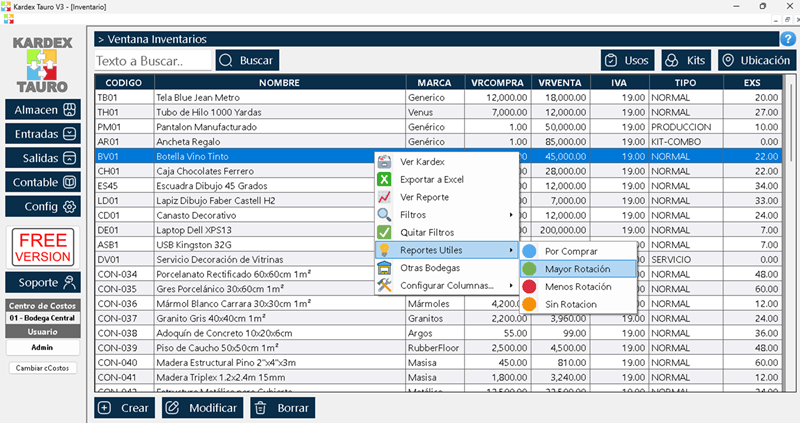
Service level becomes actionable when it rests on organized data. With Kardex Tauro, by recording orders, sales and stock in an organized way, you have the information to calculate your service level every month, spot the references that fail and decide with good judgment how much extra inventory is worth carrying. The indicator is not paperwork: it is your customers' voice turned into a number.