Supermarket inventory
Supermarket inventory
Running a supermarket or a small neighborhood grocery looks simple: customers walk in, grab what they need, pay, and leave. Behind that five-minute purchase, however, there is an operation that very few small businesses manage to master: keeping control of thousands of different products, each with its own sales pace, packaging, supplier and, in many cases, its own expiration date. For a small food-retail company, inventory is not a form to review once a month; it is the difference between selling with a healthy margin and losing money without realizing it. Taming that organized chaos is possible, and the key is to treat inventory for what it really is: a living record that changes every time a customer passes through the checkout.
Why a supermarket is a special case
No other business combines so many different categories under one roof. A clothing store handles sizes and styles; a hardware store manages a few dozen product lines; but a supermarket brings dry goods, cleaning supplies, chilled foods, beverages, fruits and vegetables together at a single point of sale. That mix multiplies the risk of mistakes: what overflows in one aisle is missing in another, and the owner usually finds out when a customer asks for a product that is no longer on the shelf.
The operation is also fast by nature. At peak hours dozens of people pass through the checkout, each carrying several items, and no cashier can stop to write in a notebook what was just sold. If the record is not made at the exact moment of the sale, it simply never happens, and the inventory starts living a life of its own, detached from the reality of the store. That is why the same typical mistakes repeat in almost every small grocery:
- Invisible stockouts: the best-selling product runs out and nobody saw it coming.
- Costly surpluses: whole boxes of merchandise arrive in excess and take up space without selling.
- Expired items on the shelf: units pass their date because nobody checks them on time.
- Counts that never match: what the paper says does not agree with what is actually on the shelf.
Control inventory by sections
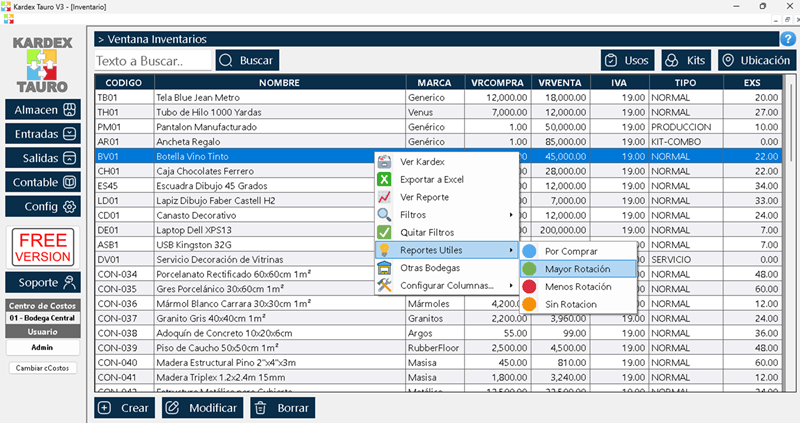
No supermarket can control thousands of items one by one from day one. The trick is to group them: each section of the store (dry goods, cleaning, chilled foods, produce, beverages) works as its own mini inventory with its own rules. A management tool supports this way of working by giving every product a code and placing it inside a group, so the owner can check the state of a whole section without reviewing each item individually.
Defining sections brings three immediate benefits. First, it makes purchasing easier: checking the dry-goods group shows what needs restocking without walking the whole aisle. Second, it distributes responsibility: the employee in charge of the cold section answers for its expirations and its order. Third, it makes data comparable: knowing how much each section sells reveals which ones sustain the business and which ones barely pay for their shelf space.
| Supermarket section | Typical control challenge | Practical solution |
|---|---|---|
| Dry goods and groceries | Similar-looking items that get confused | Own code per product and a fixed location |
| Cleaning and household | Heavy boxes that move and break the count | Record receipts and sales by unit |
| Chilled and refrigerated | Near expiration dates and constant restocking | Batch control with expiration date |
| Fruits and vegetables | Loss from ripening and handling | Short orders and daily shrinkage record |
| Beverages and candy | Seasonal sales peaks | Frequent counts around promotions |
Perishables: expiration dates rule
In a supermarket, merchandise is not only sold; it also expires. Milk, dairy products, cold cuts and refrigerated foods have a deadline, and that deadline turns inventory into a race against the clock. An expired product on the shelf is not a simple paperwork error: it is a disappointed customer, a health risk, and money lost twice, because the unit is thrown away and the shopper's trust disappears with it.
The right way to control perishables is by batch. Every batch that arrives from the supplier carries its own expiration date, even when the product is the same: the inventory must tell which batch arrived first so that what expires sooner is sold first. Kardex Tauro lets you register each product with its code and its group, and store expiration dates by batch, so checking a reference shows at once which units are closest to expiring and need to be rotated, discounted, or removed from the sales floor. That simple daily check prevents most of the expired goods that end up in the trash.
Shrinkage is not hidden: it is measured
Every supermarket loses merchandise, even the best managed. A package gets damaged, a jar falls, three yogurts go past their date, a box of tomatoes spoils, and the gap between what was bought and what was sold grows in silence. If that loss is not recorded, the business believes it sold what it actually lost, and the numbers show a profit that does not exist. Shrinkage is one more expense, and like any expense, it can only be controlled once it is measured.
The recommended practice is to record shrinkage the moment it is detected. When an expired or damaged product is removed, the exit is noted as shrinkage and not as a sale, together with its reason: expiration, spoilage, damage or loss. That way the records keep showing true stock levels, and month after month the owner can see which causes repeat and where the losses concentrate. Recording shrinkage also protects the team's work: what gets measured gets discussed, and what gets discussed gets improved. Armed with that information, purchasing becomes more careful: smaller quantities of perishables are ordered, batches with longer shelf life are negotiated, and products at risk are removed on time.
A fast checkout that truly discounts stock
The most delicate moment for inventory is the sale itself, because it happens fast and in the middle of a busy store. If the invoicing system is slow or complicated, cashiers take shortcuts: they leave products unregistered, reuse the same code for everything, or charge from memory. Every shortcut is a silent leak in the inventory. The solution is a fast sales invoice that is issued in seconds and automatically discounts every sold unit from stock.
When the invoice is generated with Kardex Tauro, the program reduces the stock of each product at the exact moment of the sale, with no extra steps and no later notes. That means inventory always reflects what actually went out the door. The difference compared with the notebook method is enormous: instead of balancing at the end of the day against a list that was already outdated by mid-morning, the owner can check the stock record at any time and know exactly how much of each item remains, even while the store keeps serving customers.
Physical counts: reality always wins
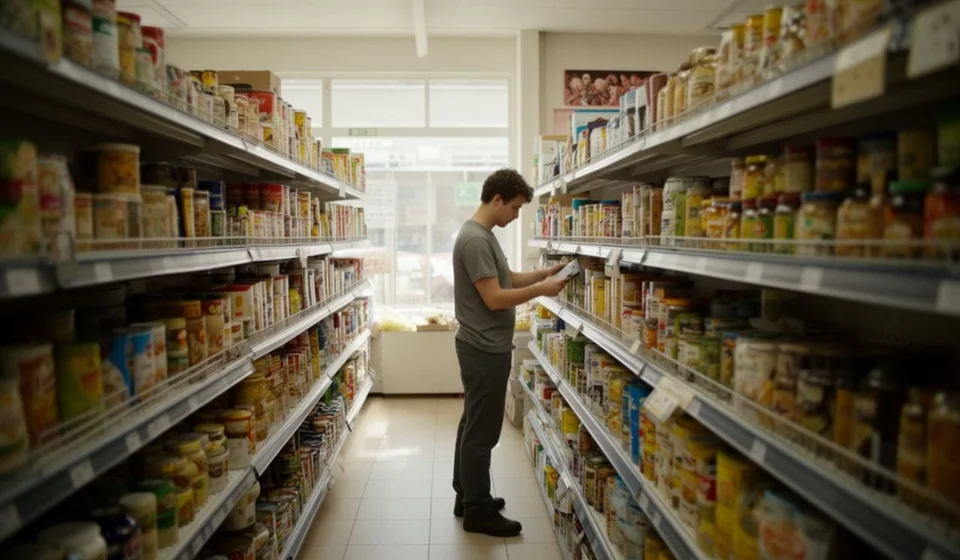
No matter how good the records are, the physical inventory is the final judge. A well-done count detects petty losses, checkout mistakes, code confusions and misplaced products that no report will point out on its own. For a supermarket, the recommendation is to combine two rhythms: a periodic full count and cycle counts by section, so the whole business does not have to stop.
- Choose the section: each week a different area is counted; this week the cold section, next week dry goods.
- Count on paper or device: record what physically exists, unit by unit, without trusting memory.
- Compare with the system: match what was counted against the registered stock and note every difference.
- Investigate and adjust: find the cause of each difference and correct the balance so the record tells the truth again.
Cycle counts spread the work over time: there is no need to close the store for a whole day to know how the inventory is doing. Because each section is counted more often, errors are detected early, when their cause can still be found. Over time the business accumulates valuable data: it learns which sections drift the most, in which months shrinkage rises, and which products need more careful purchasing.
An inventory that survives the daily grind
Supermarket inventory is not mastered with a heroic end-of-month effort, but with well-supported daily routines: defined sections, perishables controlled by batch, measured shrinkage, invoicing that discounts stock on the spot, and constant counting. When those five routines work together, the owner recovers the most valuable thing of all: knowing at any moment what he has, what he is missing, and what each loss costs. In a business with margins as thin as a supermarket's, that clarity is not an administrative luxury; it is the foundation for deciding what to buy, how much to order, and at what price to sell without guessing.