QR Code vs. Barcode for Inventory
QR Code vs. Barcode for Inventory
If you run a small business, you have probably noticed that coded labels are everywhere: on the boxes that arrive from suppliers, on the products you sell and on the shipping documents. What may not be so clear is why some labels have vertical lines and others have little squares. That difference is not decorative: it defines how much information travels on each label, how quickly an inbound or outbound movement can be recorded and how much it costs to get the whole system running. Choosing between a barcode and a QR code for the inventory of a small or medium-sized business is, above all, an operational decision.
Before comparing them, it is worth clearing up one idea: neither format organizes the inventory on its own. The label and the reader are only the bridge between the physical merchandise and the digital record that the inventory software updates.
What a barcode is and what a QR code is
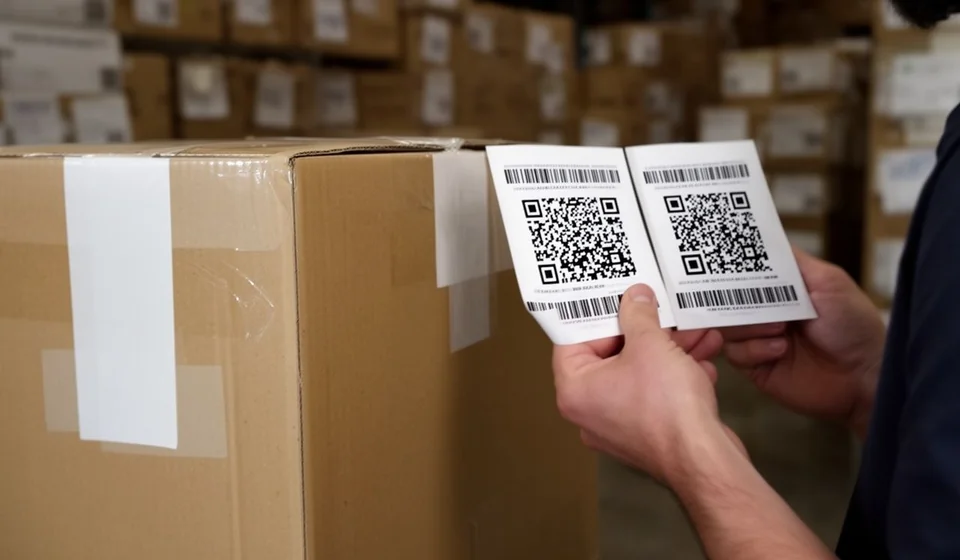
The classic barcode, also called linear or one-dimensional, is a sequence of vertical lines and spaces of varying width that encode a number. That number, on its own, says little: it works like a key that opens a record in the database, where the product name, price, supplier, unit of measure and other details live. A typical barcode stores between 12 and 25 characters: enough space to identify a product, but not to describe it or carry additional information.
A QR code, by contrast, is a two-dimensional code: a square matrix made up of small modules that store data in two directions, horizontal and vertical. Thanks to that, it can hold hundreds or even thousands of characters in the space of a single label. Instead of storing only a search key, it can store the full data: batch number, expiry date, serial number or the location where the item should be stored. It also builds in redundancy: if part of the code is damaged or dirty, the remaining information can rebuild it and keep it readable.
Technical differences that matter on a daily basis
Storage capacity is the most quoted difference, but for someone working in a warehouse there are others that matter just as much. The first is reading orientation. A barcode is read in a single direction: the reader beam must cross the lines at the right angle, and if the label is folded, rotated or partially covered, the read becomes slow or fails. A QR code can be read from any angle because it includes positioning patterns that let the reader orient it automatically.
The second difference is tolerance to damage. Because a barcode is a continuous code, if a section is erased the whole code becomes unreadable. A QR code is designed to resist: depending on the error-correction level, it can keep being read even after losing a significant part of its surface.
The third difference lies in the reading equipment. Barcode readers, whether pen or laser type, are very fast, read from a distance and work well at the checkout and at goods receiving. QR codes are read with cameras, such as those on a phone or tablet, or with imager readers that capture the full picture of the code.
This table sums up the key differences:
| Criterion | Barcode | QR code |
|---|---|---|
| Structure | Vertical lines in a single direction | Square matrix in two directions |
| Data capacity | Low: between 12 and 25 characters | High: hundreds or thousands of characters |
| Reading orientation | One position in front of the reader | Readable from any angle |
| Damage resistance | An erased section blocks reading | Corrects errors and tolerates partial damage |
| Reading equipment | Inexpensive pen or laser reader | Phone or tablet camera, or imager reader |
| What the label holds | The product reference | The reference plus extra data: batch, expiry, serial, location |
| Speed at the counter | Very high, even from a distance | High, but the code must be framed |
What works best for a small business inventory
If the goal is to run the daily control of a business with fewer than fifty employees, with inbound and outbound movements, invoicing and periodic counts, the barcode is usually the most balanced choice. It is the cheapest technology to implement: the readers are inexpensive, sturdy and fast in repetitive checkout and receiving operations. Since the product information lives in the system rather than on the label, the code only needs to identify the item; that is enough to update stock, calculate costs and generate reports.
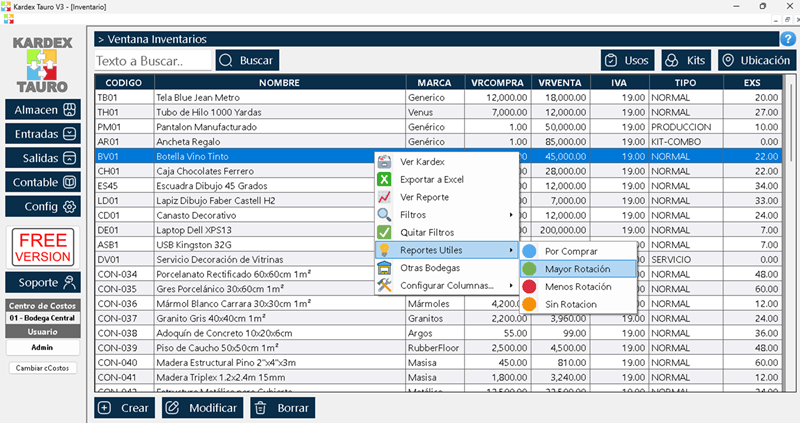
This is where a good inventory program comes in. A tool like Kardex Tauro, built for stock control in small businesses, is compatible with barcode readers for recording inbound movements, outbound movements and invoicing: the operator passes the reader over the code and the system does the rest, with no manual typing and no reliance on anyone's memory. The barcode stops being a decoration and becomes the daily shortcut that keeps the stock record up to date.
The QR code gains the advantage when the label has to carry information that is not always available when you look up the system. That is the case with products that have an expiry date: food, beverages, medicines and controlled supplies, where recording the batch when the merchandise arrives and again when it is shipped can mean the difference between tracing a problem or not. It is also useful for items with serial numbers and for businesses that manage several warehouse locations.
When to use each one
There is no absolute winner here. Experience shows that both formats can coexist in the same business without any trouble. A barcode is more convenient when:
- the operation has high volume: point of sale, checkout counters and goods receiving;
- products arrive with the barcode already printed by the factory, as happens with most consumer goods;
- you want the lowest possible cost for readers and labels;
- the inventory consists of standard items: clothing, hardware, stationery, groceries and general retail.
A QR code is more useful when:
- the product requires traceability by batch or expiry date, such as food, beverages and pharmaceutical items;
- you manage serial numbers or warranties, for example appliances, tools, spare parts and equipment;
- the label must carry the full data so that nobody has to look it up later in the system;
- you want to record the location of each item inside the warehouse or the destination of every unit shipped.
In many cases the answer is not one or the other, but both: barcodes for the fast daily operation and a complementary QR code on the items or processes that need more information. Modern image readers scan both formats without switching equipment.
Costs and compatible readers
When it comes to costs, the main difference is not in label printing, which has a similar cost for both formats on a common thermal printer, but in the reading equipment. Barcode readers are the cheapest and most widespread, and most businesses start there. Reading QR codes with a phone or tablet requires no additional readers, although for continuous operations an imager reader is a better fit: it costs more than a pen or laser reader, but it reads both types of code.
Before buying any equipment there is one rule that always applies: the reader must be compatible with the software that keeps the inventory. An excellent reader is useless if the program does not understand the information it sends. The practical approach is to choose the management system first and then the reader that the system supports; with Kardex Tauro, barcode-reader compatibility covers inbound movements, outbound movements and invoicing for the whole business.
The practical decision
To sum up: the barcode is still the best entry point for a small business inventory because it is fast, inexpensive and enough to identify products and keep daily operations up to date. The QR code is worth it when the label must tell a fuller story: batches, expiry dates, serial numbers or locations. Most businesses do not need to choose between one and the other, but rather to combine both according to the product and the process.
Start simple: give every item a code, use a reader that is compatible with your inventory system and record every inbound and outbound movement without exceptions. With that foundation, adding QR codes later is a natural and low-risk step. What matters is not the code format, but the discipline of recording every movement so that the stock in the system always matches what is actually in the warehouse.