Cloud Inventory Software

Cloud Inventory Software
More and more owners of small businesses are being offered "cloud software" to manage their inventory: you pay a monthly fee, you log in from a browser or from your phone, and your data "lives on the internet." It sounds practical, and in many cases it is. But it is also a decision with nuances: managing the stock of a store with a single computer and a good connection is not the same as managing a business with several employees, two locations, and an owner who spends much of the day away.
This article explains what cloud inventory software really is, its advantages and drawbacks for a small business, what kind of business it suits best, and what to check before signing up.
What it means for software to be "in the cloud"
When an inventory program is installed on the business computer, everything stays on that machine: the program, the database, and the backups. When the software is in the cloud, the program and your information live on the servers of the company providing the service, and the business only reaches them over the internet, usually through a browser or a phone app. What appears on screen is the same kind of system: products, stock cards, entries, exits, and balance queries. The difference is not in what you do, but in where you do it and who takes care of the data.
That difference changes several practical things: who keeps the information, which devices you can work from, what happens if the business computer breaks, and what happens if the internet goes down. It is worth understanding them before deciding, because each one works for or against you depending on the case.
Advantages of keeping inventory in the cloud
For a small company, the cloud solves several concrete everyday problems well:
- Access from multiple devices. Inventory stops depending on a single computer. Two cashiers, the manager, and the owner can look at the same numbers at the same time, and what one person records is reflected immediately on the other screens. The classic "I saw there were five left, but the other computer said three" is gone.
- Backups that do not depend on memory. The provider keeps automatic backup copies on its own servers. If the computer is damaged, stolen, or burns, the information is not lost with the machine: you just log in from another device.
- Nothing to install or update. The program already runs on the provider's server, so there are no new versions to install on each computer and no maintenance to pay for. You always use the latest version, from any browser.
- Work from anywhere. With a connection you can check stock, review the day's sales, or record an entry from home, a trip, or a temporary sales point. For an owner who is always moving, it means carrying the warehouse in your pocket.
Drawbacks worth knowing before you decide
No technology is all benefits, and the cloud is no exception. These are the trade-offs that small businesses feel the most:
- Dependence on the internet. Without a connection you cannot check or record anything. In areas with weak signal or frequent outages, operations stop exactly at the peak hours of sales or when urgent merchandise arrives.
- A cost that never ends. The cloud is paid for as long as you use it, month after month. A business that keeps the service for years ends up paying several times the value of a program bought once. It is a permanent operating expense.
- Data stays outside the business. Information about customers, suppliers, costs, and sales lives on a third party's servers. It is worth knowing who can access it, what happens if the provider closes or raises prices, and whether you can take all your data out in a common format if you want to switch systems.
- Speed depends on the connection. Every query travels over the internet. With several users and a slow connection, screens lag at the busiest moments.
Cloud software versus installed software
To choose well, it helps to compare both options using the same criteria. The table below summarizes the differences that matter most in a small business:
| Criterion | Cloud software | Installed software |
|---|---|---|
| Where the data lives | On the provider's servers | On the business computer |
| Installation | None: you log in over the internet | Installed on each computer |
| Access from multiple devices | Simultaneous, from any device with internet | From the business computers, depending on the program |
| Works without internet | No, it does not work offline | It works normally |
| Data backup | Automatic, handled by the provider | Manual or scheduled by the business |
| Payment model | Monthly fee or permanent subscription | One-time license payment |
| Control of the information | Depends on the contract with the provider | The owner decides where and how data is stored and backed up |
Neither option wins at everything: each one is strong exactly where the other gives ground. The right question is not "which one is better?" but "which one fits my business better?"
What kind of business suits the cloud
The cloud makes the most sense when inventory is used from several places or handled by several people who do not share the same desk:
- Businesses with two or more locations or sales points that need to behave as a single inventory.
- Owners or managers who spend time away from the premises and need to check stock and sales from their phone.
- Teams where several employees record sales, purchases, or entries at the same time.
- Businesses with no one in charge of making backups or keeping the program updated.
- Shops that do not want to invest in servers or powerful computers: a browser is enough.
On the other hand, an installed program makes more sense when there is a single location and a single work team, the connection is unstable or expensive, the owner prefers to pay once without depending on a subscription, or keeping information under your own control matters a lot. For that profile, the cloud would add costs and risks without offering a real advantage.
What to check before choosing cloud software
If the cloud seems like the right option, the decision does not end with "I liked the screen." Before signing up, it is worth verifying at least these five points:
- Security. Ask how access is protected: a username and password for each employee, permission levels, encryption, and who at the provider company can see the data. A serious provider answers clearly and without hesitation.
- Backups. Ask how often backups are made, how many places they are stored in, and whether you can request a restoration test. A backup that has never been restored is not a backup: it is a promise.
- Data exit. Check that you can export all your information —products, movements, stock cards, history— in common formats such as Excel. That guarantees the business is never held hostage by the service.
- Support. Confirm what hours support is available, through which channels, and in what language. For a small business, an unanswered question can mean a day without being able to invoice.
- Total cost. Add the base monthly fee, the price of each additional user, and the extra charges. That monthly total, multiplied over the years, is the real price of the decision.
These five checks can be done in one conversation with the provider or during a free trial. If something is not answered clearly, it is better to keep looking.
The local alternative is still valid
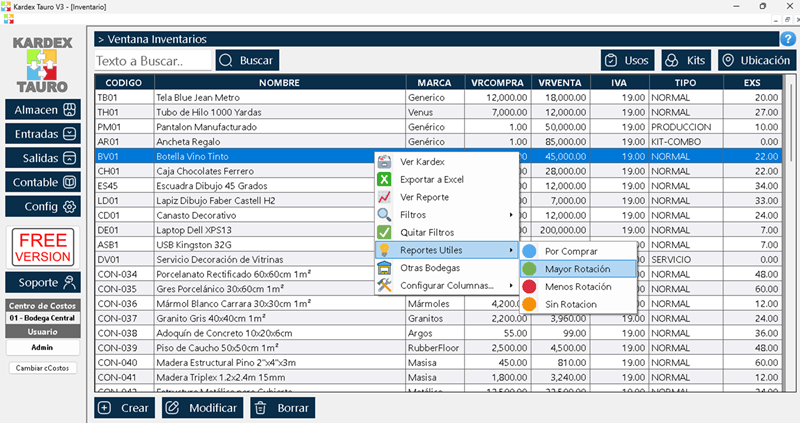
The fact that the cloud exists does not make installed software obsolete. A program that lives on the business computer works without the internet, is paid for once, and keeps the data under the owner's control. For a small business with a fixed location and a small team, it remains a sensible and often cheaper option. Kardex Tauro is an example of that philosophy: it is an installed program designed for small businesses that does not depend on a permanent connection and includes its own backup section, with which the owner creates complete backup copies of the database in the location of their choice and can restore them if something goes wrong. It is the local path, but with the backup security that the cloud promises.
The cloud is an option, not an obligation
Cloud inventory software solves real cases very well: businesses with several work points, owners who are always on the move, teams that do not want to manage servers or updates. But it is not automatically better than an installed program: it depends on the internet, it is paid for as long as it is used, and it hands your data to a third party. The right decision comes from looking at your own business: how many computers use the system, how stable the connection is, how much you can pay each month, and how important it is to keep your information under your own key. Inventory can be managed well in the cloud and it can be managed well with a local program; what no system forgives is a lack of order and backups, no matter where the information lives.