How to Calculate the Cost of Ingredients
How to Calculate the Cost of Ingredients
In a restaurant or any food business, the best-selling dish can also be the least profitable without anyone noticing. The reason is almost always the same: the owner knows what the groceries cost, but not what each plate leaving the kitchen really costs. Calculating the cost of ingredients turns that purchase of bags, kilos and bottles into a clear figure per portion, and that figure is the foundation for setting prices, measuring margins and building a menu on data instead of guesses.
This article explains, with a step-by-step example, how to cost a recipe by adding up its ingredients, how to get the cost per portion, how to set a selling price with a healthy margin, and how to watch two factors that quickly make any calculation outdated: yield loss during preparation and changes in the price of supplies.
Costing a dish is an addition, not a guess
Costing a recipe means adding up the value of every ingredient that goes into it: multiply the amount used of each one by its cost per unit and add the results. If the recipe produces several portions, divide the total by the number of portions to get the cost of each one.
Although the idea is simple, almost every mistake happens in two places: using different units without converting them (grams versus kilos, millilitres versus litres) and forgetting the small ingredients that still cost money, such as salt, oil or spices. Reliable costing demands the same discipline as a good recipe: exact amounts, clear units and no ingredient left out.
It is worth distinguishing two levels of cost. The first is the theoretical cost: the one that comes from the recipe exactly as written, with the ingredients in the state in which they are bought. The second is the real cost: what the kitchen truly consumes, including yield loss, wrongly served portions or ingredients that go to waste. Good cost control calculates both separately and compares them; the difference between the two is where money leaks out of the operation.
Step by step: how to cost a recipe
- Write the recipe with exact amounts. The standardized recipe is the basis of costing: every ingredient with the amount actually used, for example 180 grams of chicken breast or 15 millilitres of oil.
- Identify how you buy each ingredient and at what cost. Ingredients are bought in market units: the kilo, the litre, the piece or the bag. Record the cost paid for that purchase unit.
- Convert the amount used into the purchase unit. If the recipe uses grams and you buy by the kilo, express everything in the same unit: one kilo is 1,000 grams and one litre is 1,000 millilitres.
- Multiply the amount by the cost per unit. For example, if a kilo of tomatoes costs $3,200 and the recipe uses 70 grams, the cost of the tomatoes is 3,200 × 0.07, or $224.
- Add up every ingredient. The result is the cost of the whole recipe. If it yields several portions, divide that total by the number of portions.
Repeating this process with paper and a calculator works, but it becomes hard to keep up with when the menu grows or prices change. Later we will see how an inventory system helps you always have the cost of each ingredient at hand.
Example: the cost of a dish, number by number
Let us take a simple dish from a small kitchen: stewed chicken with rice, a single portion. The table below shows the complete costing. The cost per unit is expressed in the unit in which the ingredient is bought, and the cost per dish is the result of multiplying the amount used by that unit cost.
| Ingredient | Amount used | Cost per unit | Cost per dish |
|---|---|---|---|
| Chicken breast | 180 g | $16,000 per kilo | $2,880 |
| White rice | 90 g | $4,800 per kilo | $432 |
| Tomato | 70 g | $3,200 per kilo | $224 |
| Onion | 40 g | $2,600 per kilo | $104 |
| Vegetable oil | 15 ml | $9,000 per litre | $135 |
| Salt and spices | 1 portion | $60 per portion | $60 |
Adding the last column, the ingredient cost of this dish is $3,835. If the same recipe yields ten portions, multiply every amount by ten and the total cost becomes $38,350; the cost per portion stays at $3,835 as long as the amounts remain proportional and the prices do not change.
From the cost of the dish to the selling price
The ingredient cost is not the selling price: it is only one part of it. The price must also cover labour, rent, utilities, packaging and profit. The usual practice in restaurants is to define a target ingredient cost percentage: the share of the selling price left to pay for the food itself. A common range is between 25 % and 35 %; very elaborate dishes or dishes with expensive ingredients can approach 40 % only if sales volume allows it.
With that percentage, the price is calculated by dividing the cost of the dish by the target percentage. If the dish in the example costs $3,835 and you want the ingredients to represent 30 % of the price, the calculation is 3,835 ÷ 0.30 = $12,783, which rounds to a commercial price of $12,800.
The gross margin is the difference between the price and the ingredient cost: 12,800 − 3,835 = $8,965. That margin must be enough to pay the other expenses of the business and still leave a profit. If it is not enough, there are two paths: raise the price carefully, watching what the competition does, or lower the cost of the dish by reviewing portions, suppliers and ingredients.
Yield loss: when the real cost is higher than the theoretical one
No recipe turns into a finished dish without losses: peeling an onion, boning a chicken breast, trimming fat or dropping a little product leaves less usable ingredient than the amount purchased. That difference between what was bought and what can actually be used is the yield loss, and if it is not included in the costing, every dish is sold at a lower cost than the real one.
The way to measure it is the yield factor: divide the initial weight of the ingredient by the usable weight left after cleaning. If you buy one kilo of bone-in chicken breast for $16,000 and, after boning it, 700 grams are usable, the cost per usable kilo is no longer $16,000 but 16,000 ÷ 0.7 = $22,857. Costing with the purchase price and ignoring yield loss underestimates the cost of the dish and can turn a plate that looks profitable into a silent loss.
The recommendation is to measure the real yield of the ingredients you use most: weigh them before and after cleaning over several working days and use the average to adjust the unit cost in the recipes. Yield loss is reduced with good technique and good handling, but it must always be represented in the cost.
How to control changes in the price of supplies
Food prices change with the seasons, the weather, the suppliers' availability and the wholesale market. A costing done in January can be outdated by March, and the ingredients that weigh the most in the cost of a dish — almost always the protein — are the ones that make the numbers outdated fastest.
To stay in control, it is worth doing three things. First, review the cost of the dishes every time an important supplier price list changes; do not wait until the end of the month. Second, identify the ingredients that represent the largest share of the cost of each dish and watch them closely: a 10 % increase in chicken affects the margin far more than a 10 % increase in salt. Third, recalculate the whole menu periodically, even when there are no visible changes, because small adjustments add up.
When an ingredient goes up in price, the options are always the same: adjust the price of the dish, change suppliers, reformulate the recipe with an ingredient of similar cost or slightly reduce the portion. No decision is made well without knowing how much the cost of the dish really changed, and that can only be known if the costing is kept up to date.
How an inventory system supports costing
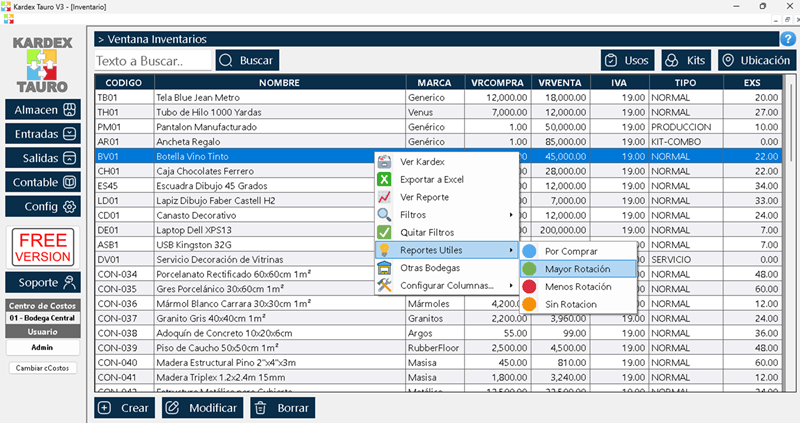
All of this work rests on one basic piece of data: the cost at which the supplies enter the storeroom. Kardex Tauro records each product with its cost and, when you finalize a purchase, it automatically updates the average cost of the ingredient. That way, when you cost a recipe you always start from a reliable, current value instead of a price you remember or wrote down on a loose piece of paper.
The second piece is structure. Kardex Tauro handles composite products through the Kits function, which is nothing more than a list of components with their quantities. A recipe is exactly that: the list of ingredients of a dish with the amount of each one. What is more, kits can contain other kits as components, like a base preparation inside a finished dish; that makes it possible to represent recipes that use other recipes, just like a sauce that is prepared only once and used in several dishes on the menu.
Costing is not a distant accounting exercise: it is the way to know, dish by dish, whether the food business is winning or losing. With standardized recipes, measured yield loss and up-to-date ingredient costs, setting prices stops being a gut feeling and becomes a decision backed by numbers.