Perpetual Inventory vs Periodic Inventory

Perpetual Inventory vs Periodic Inventory
Every business that sells merchandise needs to know how much it has and what it cost. Two methods of handling inventory meet that need: the perpetual system and the periodic system. They are not accounting fashions, but two ways of recording and valuing merchandise, and choosing well changes the way a business knows its own truth.
Both systems are valid, but they answer different questions. The perpetual system answers "how much do I have right now?"; the periodic one answers "how much did I have during this period?". Here we explain what each system consists of, how they work, their advantages and disadvantages, and which one suits a small business like yours.
What is perpetual inventory
The perpetual inventory system, also called the continuous or running inventory system, keeps the merchandise record up to date at all times. Every inflow and every outflow is recorded when it happens: a purchase increases the stock and its cost; a sale decreases it and calculates the cost of what was sold. In this way, the balance in the stock ledger or in the software reflects what is in the warehouse at any given moment.
Its central feature is the continuous record, transaction by transaction and product by product. Nobody has to wait for the month-end closing to know how much is left of an item or what the goods sold cost: that information is available on the very day of the operation. Physical counting does not disappear, but it stops being the only source of truth: it exists to confirm that the records are correct.
What is periodic inventory
The periodic inventory system works the other way around: during the period — a month, a quarter — the business does not keep a detailed, up-to-date record of its stock. Purchases are recorded, but in separate accounts, and sales do not deduct the balance of each product unit by unit. The actual stock is known only through a physical count at the closing of the period, and that result is used to adjust the inventory and to calculate the cost of what was sold.
In accounting terms, the cost of the merchandise sold comes from a simple formula: beginning inventory plus purchases minus ending inventory, where the ending figure is the one the count produced. Between one count and the next, the company operates without knowing its actual stock: it knows what it bought, but not what it has left, and any loss, theft or mistake ends up mixed into the period's cost. It is simpler to run, but it delivers information late.
How each system works in practice
The difference is easiest to see in day-to-day operations. In the perpetual system, the flow is continuous:
- Purchases are recorded when the goods arrive: the merchandise enters, the stock goes up and the cost is added to the inventory.
- Sales are recorded immediately: the merchandise leaves, the stock goes down and the cost of what was sold is calculated.
- Returns, shrinkage and adjustments are recorded when they happen, so the balance reflects the real movements.
- At any moment the business can check how much is left of each product and at what cost, without waiting for closings or counts.
In the periodic system, the flow is concentrated at the ends of the period:
- During the period purchases are recorded, without deducting each sale from the balance of each product.
- At the closing the merchandise is counted and the real ending inventory is determined.
- With that result the accounting balance is adjusted and the cost of sales for the period is calculated.
- Between closings, the stock of each product is estimated or simply unknown until the next count.
Comparison table: perpetual inventory vs periodic inventory
| Criterion | Perpetual inventory | Periodic inventory |
|---|---|---|
| How the stock is known | From the up-to-date record, updated with every movement | From the physical count done at the closing of the period |
| When outflows are recorded | At the moment of each sale | Globally at the closing, according to the count |
| Cost of goods sold | Calculated with each sale, according to the cost in the stock ledger | Calculated at the closing: beginning plus purchases minus ending |
| Information available | Stock and cost of each product at any moment | Stock known only on count dates |
| Daily recording effort | Higher: every movement is recorded per product | Lower during the period; the effort is concentrated in the count |
| Role of the physical count | To validate and correct the record | To be the basis of the ending balance and the cost |
| Loss and mistake detection | Fast: differences show up when record and reality are compared | Late: they stay hidden until the closing count |
| Best fit | Many products, frequent sales and cost control needs | Very few products and few sales per day |
Advantages and disadvantages of perpetual inventory
Its main advantages:
- Up-to-date information: the business knows how much is left of each product and at what cost, at any moment.
- Stricter control: losses, theft and mistakes are detected earlier, product by product.
- More reliable reports: the value of the inventory and the cost of sales are known without depending on a late count.
- Faster decisions: buying or filling orders relies on current figures.
Its downsides:
- It demands recording every movement: if inflows and outflows are not recorded on time, the balance stops being useful.
- It requires discipline: the system is only as reliable as the people who feed it every day.
- It is heavy on paper: manual stock ledger cards consume time; technology solves this.
Advantages and disadvantages of periodic inventory
Its advantages:
- Less daily recording: there is no need to write down every sale against the balance of every product.
- Simple to understand: the physical count is an activity every business knows.
- Useful with few products: with ten or twenty items, counting at the closing is quick and cheap.
Its disadvantages:
- Outdated information: between counts, the business does not know for sure how much it has of each product.
- Hidden losses: theft, shrinkage and mistakes are mixed into the period's cost of sales and are not identified.
- Heavy counts at the closing: they require stopping operations, assigning staff and racing against the clock.
- Hard to scale: with more products, the general count becomes more expensive and more prone to errors.
Which one suits a small business
There is no single answer: the decision depends on the number of products, how often the business sells and its ability to record movements. A micro-business with few products and few sales per day works well with the periodic system: the monthly count is quick and cheap. But when products, sales and the value of the merchandise grow, the periodic system becomes expensive in the worst sense: not because of what it costs to run, but because of what it costs not to know.
The breaking point arrives sooner than it seems. When a business cannot say how much it has of a product without going out to count it, it loses sales for lack of stock it thought it had, buys too much out of fear of running out, or discovers at the closing losses that happened months earlier. For a small business that sells every day, perpetual inventory is not a luxury: it is how information supports decisions instead of springing surprises. Even so, the physical count is still necessary from time to time, but as a check on the record, not as the only source of truth.
The stock ledger and perpetual inventory
The stock ledger is the natural tool of perpetual inventory. One card per product, where inflows, outflows, balances and costs are recorded, makes it possible to follow the history of each item and to know its balance at any moment. On paper it is possible, but it becomes heavy as the business grows: every sale must be written by hand, mistakes pile up and the balance ends up outdated.
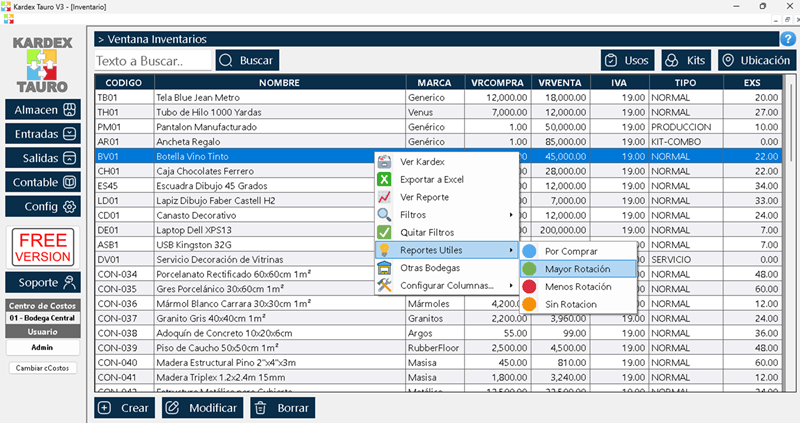
This is where a management program changes the rules. Kardex Tauro keeps the stock ledger up to date: every purchase updates the stock and the cost of the product, every sale deducts the merchandise and leaves the cost of what was sold calculated, and adjustments and shrinkage are recorded when they happen. With Kardex Tauro, adopting the perpetual system does not mean more work, but less: the stock ledger is updated automatically with each invoice, purchase or movement, and any query shows the stock of each product in seconds. The business operates, without noticing, under the perpetual inventory system: balances are always current, and the physical count serves to validate, not to start from zero.
For a small business used to surprise counts, moving to an up-to-date inventory is a change toward peace of mind: the information that used to appear only at the closing is now available every day.
Conclusion
Perpetual and periodic inventory represent two philosophies: keeping the stock up to date with continuous records, or determining it with counts at the closing. The first demands daily discipline, but delivers permanent information and control; the second is simpler, but hides losses and delays decisions. For a small business that sells every day and handles several products, the perpetual system is usually the best investment, and a well-kept stock ledger is the piece that makes it possible: the question is not whether the business can afford to know how much it has every day, but whether it can afford not to know.