Inventory Accuracy Indicator

Inventory Accuracy Indicator
The inventory accuracy indicator is a measure that answers a question every business owner should be able to answer: how much of what the system says actually exists in the warehouse? If the system shows forty units of a product, does the shelf show forty? If the answer is almost always yes, the inventory is accurate. If it is almost always no, no report, no matter how polished, is useful for making decisions. This indicator puts a number on that trust: the percentage of items, units or value recorded that matches what a physical count actually finds.
For a small or medium business, accuracy is not an auditing luxury but the foundation for buying, selling and calculating profit. Whoever does not know how much they have ends up buying more of what they already have in surplus and running out of what sells best. The indicator does not measure the warehouse worker's effort: it measures how well the recording process, the organization of the warehouse and the discipline of counting work together. When those three elements fail, the number drops and the business feels it first in its wallet.
What Inventory Accuracy Is
Inventory accuracy is the degree of agreement between the stock recorded in the control system and the actual stock physically present at the storage location. A product is said to be accurate when the balance shown in the record, after reviewing entries, exits and returns, equals the result of the physical count. If the system says there are twenty-five units and only twenty-two are on the shelf, that product is not accurate, and the difference of three units is a shortage that was at some point sold, damaged, misplaced or recorded incorrectly.
Differences are not rare: a delivery that was never recorded, a purchase received without being entered, an expired product thrown away and never written off, a typing error in the quantity of an invoice, or simply misplaced merchandise that the counter never found. Each of those situations is small, but they add up. That is why accuracy is never taken for granted: it is measured with periodic counts and expressed as a percentage, so the business knows whether it is winning or losing the battle against invisible errors.
The Formula for the Accuracy Indicator
The most common way to calculate the indicator compares the number of items counted with no difference at all against the total number of items counted. The item-based formula is:
% accuracy = (items with no difference ÷ total items counted) × 100
If, in a count of fifty different products, forty-eight match the system exactly, the result is (48 ÷ 50) × 100 = 96%. This version is fast and useful when what matters is knowing how many references can be trusted.
There is also the unit-based or value-based version, which measures the size of the errors and not only their quantity. It is calculated as follows:
% accuracy = (1 − (units with differences ÷ total units in system)) × 100
This second formula is more sensitive: a shortage of fifty units in a single product weighs more than ten differences of one unit each. Many businesses use both, the first one to detect how many references have problems and the second one to know how serious those problems are.
Step-by-Step Calculation Example
A grocery store decides to count five references in its warehouse and compare them against the system balance. For each product, the person in charge writes down the stock shown in the record, the result of the physical count and the difference between both. The accuracy percentage per product is calculated as the physical count divided by the system stock, expressed as a percentage. The table summarizes the exercise:
| Product | Stock in system | Physical count | Difference | % accuracy |
|---|---|---|---|---|
| Rice per pound | 120 | 120 | 0 | 100% |
| Cooking oil per liter | 85 | 85 | 0 | 100% |
| Coffee 250 grams | 60 | 57 | −3 | 95% |
| Lentils per pound | 40 | 40 | 0 | 100% |
| Sugar per pound | 75 | 71 | −4 | 94.7% |
| Total | 380 | 373 | −7 | 98.2% |
Of the five references counted, three matched the system exactly, so item-based accuracy is (3 ÷ 5) × 100 = 60%. By units, however, the result is much better: 380 units were expected and 373 were found, which means 98.2% accuracy. The difference between both results is normal and complementary: the first figure warns that two references need review, while the second indicates that, in total volume, the error is small. The coffee and the sugar show shortages of 3 and 4 units that must be investigated against the sales record and the shrinkage log before adjusting the balance.
What Percentage Is Considered Healthy
There is no universal target, but there is a widely used benchmark in inventory management: accuracy of 95% or higher is considered acceptable, and businesses with disciplined processes usually operate between 97% and 99%. Below 95%, shortages and surpluses are already large enough to distort purchases, sales and financial statements, so it is worth attacking the causes before continuing to count.
The target should be set by product type: expensive references, fast-moving ones and those that require batches or expiration dates deserve a stricter target, close to 99%, because an error in them costs more. For the rest of the assortment, 95% may be enough. The important thing is not to chase 100% forever, but to know the point at which errors stop being noise and start costing money.
Why Accuracy Matters for Buying and Selling Well
Buying well requires knowing what is there and what is missing. With accurate inventory, the replenishment order is calculated on real shortages: no money is spent on product that is already in the warehouse, and the business does not fail to buy what is truly running out. When the system is inflated, the business buys less than it needs and loses sales; when it is deflated, it buys too much, accumulates dormant capital on the shelves and ends up discounting old merchandise. In both cases, the money lost is the direct consequence of a low indicator.
Selling well is also impossible with a dishonest record. A seller who promises fifty units and only finds forty disappoints the customer, loses the sale or ships a partial order and creates returns. Accuracy also protects financial information: if the closing balance of the period is not real, the cost of sales, the profit and even taxes are calculated on the wrong basis. That is why inventory accuracy is not a warehouse issue: it is a matter of cash, customers and decisions.
How to Improve Inventory Accuracy
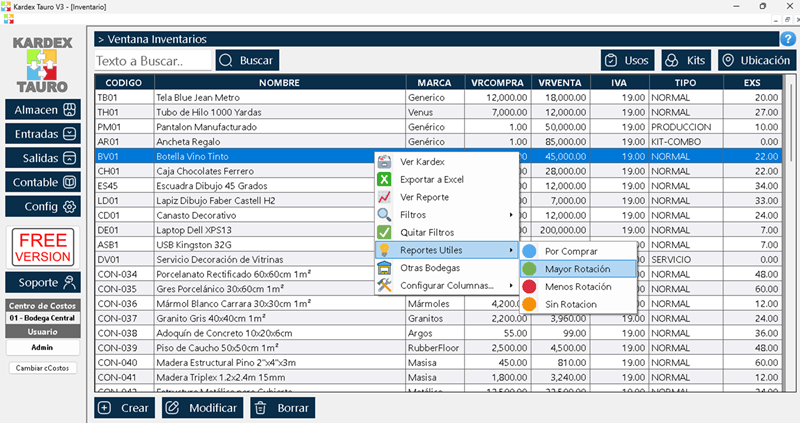
Improving the indicator does not depend on a single action but on three fronts that reinforce each other: clear processes, periodic counts and recording at the moment. A system like Kardex Tauro records every inbound and outbound movement, so the balance always reflects the latest operation; but the system is only accurate if the operation is recorded when it happens and if counts periodically confirm that nothing escaped it.
Record Every Movement at the Moment
The most common mistake in small warehouses is postponing the record: goods are dispatched today and recorded tomorrow, or merchandise is received and entered three days later. In that gap, any sale, return or exchange stays out of the record and a shortage is born that nobody can explain. The rule is simple: no product enters, leaves, is returned, is damaged or expires without that movement being recorded the same day, ideally at the moment. With Kardex Tauro, every entry and exit is recorded instantly, which keeps the balance live and reduces memory errors and loose-paper mistakes.
Run Cycle Counts, Not Only the Annual Count
Waiting for the year-end general count to discover the errors is too late: the business spent twelve months making decisions with wrong numbers. The cycle count spreads the work: each week or each month, a small group of references is counted, preferably those with the highest turnover or the highest value, and compared against the system. When a count finds a difference, the cause is investigated, the balance is corrected and the lesson is written down. In this way, instead of one big surprise a year, there are small corrections all year round.
Order, Responsible Staff and Documented Adjustments
Besides recording and counting, accuracy needs minimum conditions. Keeping the warehouse organized and labeled prevents merchandise from disappearing from sight and similar products from being confused. Assigning a clear person in charge of receiving, storing and dispatching prevents everyone from recording in their own way. And when a count shows a difference, the balance must always be adjusted with a supporting document that explains why, never by fixing the number from memory. With these practices, the accuracy indicator rises, and with it rises the confidence to buy, sell and plan.
Measuring inventory accuracy is, at its core, measuring the health of the business: a high percentage means that what is known is what is owned, and that certainty is what allows a business to grow without tripping over the merchandise that is missing or the merchandise that is left over.
