Inventory carrying cost: what it includes and how to reduce it

Inventory carrying cost: what it includes and how to reduce it
Buying merchandise is not the last expense your inventory will cause you. From the moment a product enters your warehouse until the day it is sold, that product consumes money every single day: it takes up space, it needs to be insured, it demands time from the people who receive it, count it and look after it, and it runs the risk of being damaged, expiring or becoming obsolete. On top of that, it keeps the capital you invested in it tied up. Together, all of this is what is known as inventory carrying cost, or holding cost, and in practice it represents between 20% and 30% of the value of your stock every year.
The fact that this cost does not show up on a single invoice does not mean it does not exist: it means it hides in the warehouse rent, in insurance premiums, in shrinkage and in the cash that is missing when you need to buy the items that actually turn. This article explains what carrying cost includes, why excess stock costs money even after it has been paid for, and what concrete steps a small business can take to reduce it without running out of merchandise.
What inventory carrying cost is
Inventory carrying cost is the total expense generated by holding merchandise in storage over a period, usually calculated per year. It does not include the purchase price of the merchandise: that money already left your cash register when you paid the supplier. It includes everything that happens afterwards, while the merchandise waits to be sold.
It is expressed as an annual percentage of the average inventory value. The logic is straightforward: if you hold $100,000 worth of merchandise on average all year and your carrying cost rate is 25%, keeping that inventory costs you around $25,000 per year, no matter how much you sold.
It is worth separating it from two other costs it gets confused with. Ordering cost is what each purchase costs: the buyer's time, freight, paperwork and receiving. Stockout cost is the lost sales when merchandise is missing. Buying in small lots reduces carrying cost but raises the other two; buying in large volumes does the opposite. Much of the craft of inventory management is finding the middle ground between the three.
What makes up the carrying cost: the typical line items
Carrying cost is not a single item on a budget: it is the sum of several components, and it pays to know them separately so you know where to act. The typical ones are:
- Tied-up capital. The money invested in merchandise that does not turn is not working for you. Its cost is the opportunity cost: what that money would cost you if it were borrowed, or what it would earn if it were invested somewhere else. It is the heaviest item and usually represents between 8% and 15% per year.
- Physical space. The warehouse or the part of the store, the shelving, and the share of utilities the merchandise consumes: electricity, refrigeration, security and cleaning. It is calculated on the area the inventory occupies and usually runs between 2% and 5% per year.
- Insurance. The premiums paid to protect the merchandise against fire, theft or damage. They depend on the risk of the business and typically sit between 1% and 3% per year.
- Shrinkage and damage. Product that gets spoiled, expired, broken, lost or misplaced in daily operations. In food, medicine and cosmetics this item weighs more; in general it ranges from 1% to 5%.
- Obsolescence. Merchandise that loses value over time because of fashion, technology, seasons or supplier packaging changes. It can mean 1% to 3% per year, or much more in fast-moving categories.
- Labor and administration. The paid time of the people who receive, store, count and control the merchandise. It does not look like it, but it also grows with inventory size: more stock demands more counting, more space and more control.
The practical rule: between 20% and 30% per year
The benchmark most quoted in finance and operations management says that holding inventory costs between 20% and 30% of its value every year. It is an industry average, not an exact law: a business with expensive warehousing or costly credit can exceed 30%, and one with stable raw materials can be closer to 15%. The important thing is to use it as a smoke test: if your average inventory is $100,000, you should be paying at least $20,000 a year just to keep it stored.
Many small business owners do the math backwards: they celebrate a full warehouse because the money is there. But money sitting on shelves does not pay payroll, does not pay suppliers and does not take advantage of early-payment discounts. When the business needs cash, slow merchandise is sold at a discount or expensive debt is taken on, and that is where the loss doubles.
Worked example: what it costs to hold $100,000 in inventory
To bring the concept down to earth, assume an average inventory of $100,000 held for a year, with typical rates for a trading business. The breakdown would look approximately like this:
| Line item | Annual rate | Annual cost on $100,000 |
|---|---|---|
| Tied-up capital (opportunity cost of money) | 12% | $12,000 |
| Physical space: warehouse, shelving and utilities | 4% | $4,000 |
| Merchandise insurance | 2% | $2,000 |
| Shrinkage, damage and losses | 3% | $3,000 |
| Obsolescence and write-downs | 2% | $2,000 |
| Warehouse labor and inventory administration | 2% | $2,000 |
| Typical total | 25% | $25,000 |
Read the table carefully: that $25,000 is paid for merchandise that has not been sold yet. If your average gross margin is 30%, the business needs to generate around $83,000 in additional sales just to cover the cost of keeping that full warehouse. And if the average inventory rises to $150,000 because there was spare cash, the annual cost climbs to $37,500: excess stock is not free, it finances itself.
Also notice that about half of the cost usually sits in tied-up capital. That is the first lever: any decision that lowers the average inventory, such as buying less or turning faster, hits the largest item directly.
Why excess stock costs money even after it is paid for
The most dangerous sentence in a business with a warehouse is that merchandise is already paid for, so keeping it costs me nothing. It is paid for, true, but the money already left the cash register, and what stayed behind is not a saving: it is an asset that keeps generating costs and risks while it sleeps on the shelves.
Think about tied-up capital in concrete terms. If you paid cash, that money is no longer available to pay off a debt that costs you 2% a month, to take a supplier discount, or simply to have liquidity the day sales drop. If you bought on credit, you are paying interest on merchandise that may not turn. In both cases, excess stock has a real and measurable financial cost.
Risk also grows with time. The more days a unit spends in the warehouse, the more likely it is to be damaged, lost, expired or left obsolete when the supplier launches the new version or the season changes. Shrinkage is not an accident: it is the natural result of holding more merchandise than the business can move in a reasonable time.
This does not mean an empty warehouse is the goal. Running out of stock also costs money: customers who leave, lost sales and poorly negotiated emergency purchases. The goal is balance: carrying the merchandise that turns, in the right quantity to serve demand, and nothing more than that.
How it connects to how much you buy: the logic of the economic order quantity
Carrying cost is the flip side of the coin of order size. The economic order quantity theory, known as EOQ, says something every owner understands: every time you order merchandise you pay ordering costs, such as time and freight, and while that merchandise sits in storage you pay carrying costs. The ideal lot is the one that balances the two.
The key point is that average inventory depends on lot size: if you order once a year everything you sell in a year, your average inventory is around half of that giant order. If you order every month, the average shrinks to a fraction. Buying large quantities because freight is cheaper or because the supplier gives a discount almost always looks like a saving on the purchase invoice and turns into a loss in the warehouse, once the 20-30% annual carrying cost eats the discount within a few months.
A small business does not need complex formulas. It is enough to ask the right question before every large purchase: how long will this sit in my warehouse and what does it cost me to keep it there meanwhile? If the answer is more than a few months, the volume discount probably does not pay off.
How to reduce inventory carrying cost
The good news is that carrying cost can be attacked on several fronts, almost all within reach of a small business. The most effective measures are:
- Lower the average inventory. Buying more often and in smaller quantities is the highest-impact measure: it reduces tied-up capital, space, shrinkage and insurance all at once. It demands discipline: define a reorder point and respect it.
- Negotiate deliveries with suppliers. Many suppliers accept delivering a large order in several partial shipments, keeping the volume price, or running more frequent delivery routes. It is also worth asking about consignment for expensive or slow-moving items.
- Improve rotation. Classify products by their share of sales with an ABC analysis and focus purchases on what turns fast. Slow inventory is not fixed by simply buying less of it: it is fixed by stopping purchases until what you have runs out.
- Sell off slow and obsolete stock. Promotions, bundles with products that do turn, returns negotiated with the supplier, or sales at cost. Selling a slow unit at 60% of its value is usually a better deal than paying 25% a year to keep it.
- Review insurance and space. Adjust coverage to the real value of the merchandise, renegotiate the warehouse rent and compact the shelving to free up area. Every square meter returned or subleased is carrying cost that disappears.
- Calibrate safety stock. Keeping a just-in-case cushion of everything is extremely expensive. The buffer is only justified for products with variable demand or unreliable suppliers; for the rest, overstock is a luxury the business pays for every month.
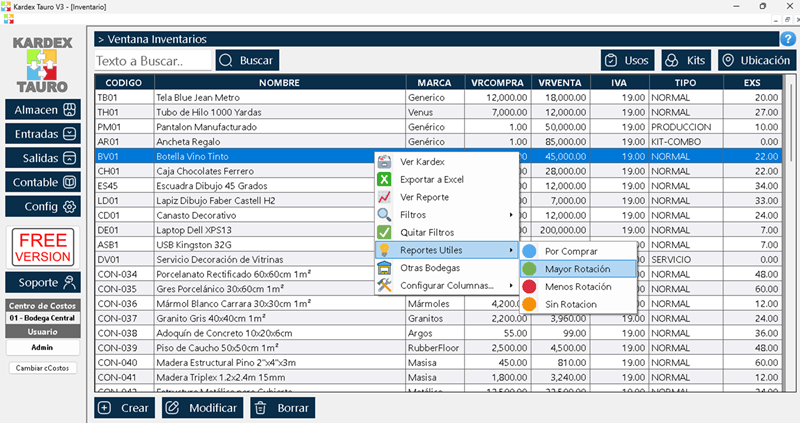
- Measure before you act. Without knowing your average inventory and how fast each product turns, every decision is a leap in the dark. With an orderly record of ins and outs like the one kept by Kardex Tauro, those figures stop being an estimate and become the starting point of every purchase.
Conclusion: the most expensive inventory is the one that does not turn
Inventory carrying cost is real, it is paid every day and it is almost always underestimated. The 20-30% annual rule is a good starting point to size it: tied-up capital, space, insurance, shrinkage, obsolescence and labor eat around a quarter of the value of the warehouse every year, even though no invoice says so by that name.
Reducing it does not require magic recipes: buy in smaller and more frequent quantities, negotiate deliveries, turn faster, liquidate slow stock and adjust insurance and space. All of that starts with knowing your real stock and its movement, and that is what an orderly stock ledger is for: recording every entry and exit and checking balances and rotation with reliable data is the basis for deciding how much to buy. Tools like Kardex Tauro handle that record so the owner can focus on what matters: having the right merchandise, in the right quantity, for the shortest possible time.