Units and packaging: buy by the case, sell by the unit without losing control

Units and packaging: buy by the case, sell by the unit without losing control
You buy a case with twelve bottles and sell them one at a time all week. On Sunday you do the count and you no longer know if a bottle is missing, if the case is complete, or if somebody got the price wrong. That scene repeats every day in thousands of shops, minimarkets, hardware stores and warehouses: the supplier delivers in large packs (cases of twelve, 50 kg bags, dozens, thousands), but the customer buys by the unit, by the kilo or by the fraction. When the unit you buy in does not match the unit you sell in, your inventory falls out of balance because of conversion, not because of theft or mysterious losses.
The good news is that this problem has a solution and it does not require a sophisticated warehouse system. You only need to decide on a base unit for each product, write down the conversion factor of each package, and work out costs and prices before the goods reach the shelf. In this article we go through it step by step with real store examples: the case of 12 bought at $24,000 and sold one by one, the 50 kg bag sold by the kilo or in fractions, and the famous packages that end up half open.
The root problem: mixing units without rules
A stock card counts physical inventory: goods come in, goods go out, and the balance should match what is on the shelf. That works as long as everything is counted in the same unit. The trouble starts when you record the incoming goods in one unit and the outgoing goods in another, with no bridge between the two. A typical example: you receive a case of 12 and write it down as one unit because your notebook only says case. Then you sell five units, you record them as five, and the system or the notebook tells you that you are now four units in the negative. Nothing is missing: you just mixed apples with oranges.
- You record purchases by the case and sales by the unit: the balance stops meaning anything.
- You sell eleven units out of a case of twelve, and the last one stays recorded as if the whole case were still available.
- You buy in 50 kg bags and sell by the kilo, but you never convert the bag into kilos when you receive it.
- You set the selling price on the package cost instead of the unit cost, so your real margin is different from what you think.
The risks are not theoretical: you do not know what you really have left, the cost of sales comes out wrong, prices end up below your break-even point, and fraction losses pile up without anyone noticing. Every open case that sells eleven of its twelve units leaves one orphan unit that nobody records as such.
Step 1: define the base unit of control
Before recording any movement you have to answer one question: in what unit is this product counted? That unit is called the base unit, and it should be the smallest unit you sell or the one that allows fractions without ambiguity: unit, kilo, gram, meter, liter, centimeter. Do not pick the case or the bag as the base unit just because that is how you buy. Pick the unit you count with, sell with and do the physical inventory in.
- Oil that arrives in cases of 12 bottles and is sold by the bottle: the base unit is the bottle.
- Rice that arrives in 50 kg bags and is sold by the kilo or by the half kilo: the base unit is the kilo.
- Bags that arrive by the thousand and are sold in packs of 20: the base unit is the bag, and the pack is defined as a package of 20 units.
The practical rule is simple: the base unit is the one you use to sell and to count in physical stock. Everything else, the case, the bag, the dozen, the thousand, the pack, is defined as a package equal to an exact number of base units. With that decision made, recording no longer depends on the memory of whoever types the numbers in.
Step 2: record the conversion factor
The conversion factor is the equivalence between the package and the base unit: one case equals 12 units, one bag equals 50 kilos, one dozen equals 12, one thousand equals 1,000. It sounds obvious, but if the factor is not written down and visible at the moment of recording the purchase, sooner or later someone enters a case as if it were one unit, or twelve units as if they were twelve cases. Conversion errors are not made by careless people: anyone makes them when the information is not organized.
The product record should have a single place showing the base unit, the alternative packages with their factor, and the cost of each presentation. That way, when the supplier invoice arrives, recording the purchase becomes mechanical: two cases of oil come in, the system or the notebook knows that means 24 units, and the unit cost is calculated by dividing the package cost by its factor.
Practical example: the case of 12 sold by the unit
Let us look at a concrete case in a neighborhood store. Cooking oil is bought in cases of 12 one-liter bottles at $24,000 per case. On the shelf it sells by the bottle at $3,000. Some customers also ask for the whole case, and they get a 10% discount off the list price. Here is the complete picture:
| Item | Value |
|---|---|
| Purchase presentation | Case with 12 one-liter bottles |
| Cost of the case (supplier purchase) | $24,000 |
| Conversion factor | 1 case = 12 units |
| Cost per unit | $24,000 divided by 12 = $2,000 |
| Selling price per unit | $3,000 |
| Margin per unit | ($3,000 minus $2,000) over $2,000 = 50% |
| Full case at list price | 12 x $3,000 = $36,000 |
| Full case with a 10% discount | $32,400 |
| Margin on the discounted case | ($32,400 minus $24,000) over $24,000 = 35% |
| Per-unit equivalent in the case sale | $32,400 divided by 12 = $2,700 |
Notice two things. First, even though the discounted case has a lower percentage margin (35% versus 50%), it moves twelve units at once and frees up space and cash, so it can still be worthwhile. Second, the cost that matters when pricing the loose bottle is the unit cost, $2,000, not the case cost. If you set prices looking only at the case, you end up selling the bottle at a price that does not cover what you actually paid for it.
The leftover unit: fraction losses and half-open packages
The case that causes most imbalances is the incomplete package. You sold eleven bottles out of the case of twelve and the last one stayed on the shelf. If the record says the whole case is still available, the physical count will never match, because there is no case on the shelf: there is a single loose bottle. That gap between what the paper says and what exists in physical stock is what we call fraction loss. It is not theft and it is not damage: it is simply a package that was split into unit sales.
- A case of 12 that sold 11 leaves one loose unit that must be counted as a unit, not as a case.
- A 50 kg bag of rice sold by the kilo keeps turning into fractions until the package disappears.
- A dozen eggs with one broken during handling is no longer a complete sellable dozen.
- A pack of 20 bags opened to sell in fives leaves an incomplete package that nobody ever counts again.
The organized way to handle it is to unpack: the moment a case is opened to sell by the unit, the record must stop showing the case as a whole and show the loose units that remain. If your system lets you convert a package into loose units, do it when you open the case, not at the end of the month. If you keep a notebook, write on the same line of the purchase that the case was opened and how many units come out of it, and do a short physical count of the package every time you touch it.
Half-open packages must be identified in the store: a piece of colored tape, a label with the opening date, or a fixed area of the warehouse. What matters is that the record and the shelf say the same thing at all times. An unidentified incomplete package is the number one source of inventory differences in small stores, ahead of shoplifting.
The full package: its own product or just a purchase presentation?
When you sell the whole package as well as the unit, you have two ways to model it, and you should choose with a criterion in mind.
- Package only as a purchase unit: the product is always managed in the base unit and the case is just the presentation it arrives in from the supplier. This is the right choice when almost everything sells by the unit, the case is always opened, and whole-case orders are rare.
- Package as a separate product: the sealed case has its own code, its own price and its own stock control, separate from the loose unit. This is the right choice when customers regularly order sealed cases, you offer volume discounts, and you need to know how many unopened cases you have left.
There is no universal answer: it depends on how your business sells. A useful trick is to ask how often the sealed package is sold. If it is less than once a month, duplicating the record is not worth it and the conversion factor is enough. If it is a weekly sale or you have wholesale customers, treat it as a separate product, with its cost calculated from the package cost and its own discounted price.
In either model, the cost of the full package must never be a made-up number: it comes from the same purchase invoice and is converted into units when needed. What you cannot do is manage the same product sometimes by the case and sometimes by the unit with no fixed rule, because that is the direct road to imbalance.
From the package cost to the unit cost
There is only one formula: unit cost equals package cost divided by the conversion factor. If the case of 12 costs $24,000, each bottle costs $2,000. But the package cost is not only the invoice price: freight, insurance and taxes paid on the purchase are also part of the cost and must be spread across the units. A case that costs $24,000 but arrives with $1,000 of freight actually costs $25,000, or about $2,083 per bottle, and the selling price should take that number into account.
Let us apply the same principle to a product sold by weight. A 50 kg bag of rice is bought for $150,000 and the freight to the store costs $5,000:
| Item | Value |
|---|---|
| Cost of the 50 kg bag | $150,000 |
| Freight and unloading | $5,000 |
| Total cost of the bag | $155,000 |
| Cost per kilo | $155,000 divided by 50 = $3,100 |
| Selling price per kilo | $4,200 |
| Margin per kilo | ($4,200 minus $3,100) over $3,100 = 35% |
| Half-kilo sale (500 g) | Cost $1,550, price $2,100 |
Watch out for two details that escape with fractions. First: if the case of 12 arrived with one damaged or expired bottle that you cannot sell, the real cost per sellable unit rises from $2,000 to $2,182 (24,000 divided by 11). Your selling price should cover that cost if this loss is common. Second: rounding. If you sell 250 grams at a rounded price for convenience, check from time to time that the margin on the fraction is still positive; small fractions rounded down month after month end up eating the profit of whole kilos.
Other common conversions: dozens, thousands, reams and packs
The logic of the case of 12 applies to any presentation. A dozen eggs or buns equals 12 units; a thousand bags or hangers equals 1,000; a ream of paper holds 500 sheets; a gross holds 144; a pack of towels may hold 20. In every case the procedure is the same:
- Define the base unit: the sheet, the bag, the egg, the single unit.
- Write the conversion factor of the package on the product record.
- Calculate the unit cost by dividing the package cost by the factor.
- Set the selling price per unit and, if you sell the full package, a price of its own with its discount.
- Unpack in the record as soon as you open the presentation to sell fractions.
Products sold by weight or by measure also face the challenge of fraction sales with a scale or a tape measure. There the base unit must be the unit of measure (kilo, gram, meter), and the purchase package is converted with its real weight or length, not the theoretical one: a rice bag that says 50 kilos can arrive at 49.8 or 50.3 depending on the packing and the humidity. If you sell on the theoretical weight, the difference piles up against you.
Control routines that prevent imbalance
With the rules above in place, day-to-day work becomes simple if you keep a few minimum routines:
- Unpack when you open: the moment a case or a bag is opened to sell by the unit, update the record.
- Do short, frequent physical counts of open packages: five minutes at closing time prevents end-of-month surprises.
- Have one person responsible for conversions, or one written rule, so there are not two criteria.
- Check the unit cost every time an invoice arrives with a price change: a more expensive package changes the cost of all its units.
- Reconcile what was sold by the unit against the package outputs: if you sold eleven bottles, the record must show eleven outputs and one loose bottle.
- Always mark incomplete packages with the opening date, so you know which one to sell or rotate first.
These routines do not take time away: they give it back. Whoever applies them stops chasing inventory differences and starts trusting what the record says, which is the foundation for buying well, charging well and never running out of stock at the peak of the selling season.
The role of the stock card in units and packaging
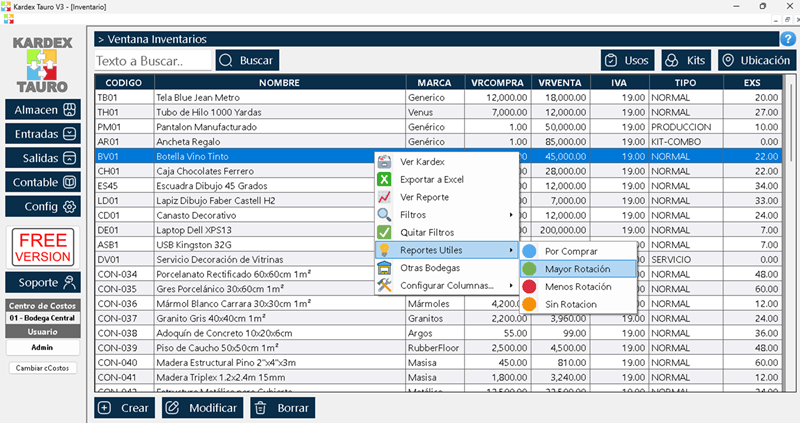
Everything above can be done in a notebook, but it holds up better when the product record has a fixed place for the base unit and its conversions. If you keep a manual stock card or an inventory system like Kardex Tauro, what matters is the discipline of whoever records: the tool keeps what you tell it in an orderly way, and the order starts by choosing the base unit before typing the first entry.
When a purchase arrives, always record the presentation you received and note its conversion factor, so the unit cost and the unit sales do not depend on memory. And when a case is opened, let the record know the same day. A good stock card, the classic notebook or a program like Kardex Tauro, does not replace the decision to manage units properly: it makes that decision visible and organized, which is exactly what an inventory needs to balance every month.
The golden rule is short: decide the unit you count each product in, write down how many units each package holds, and never record a case as if it were one unit or one unit as if it were a case. With that, buying by the case and selling by the unit stops being a headache and goes back to being what it always was: an ordinary everyday business.
