FEFO: ship what expires first (and when to use FIFO instead)

FEFO: ship what expires first (and when to use FIFO instead)
If your business sells products with an expiry date, you race against the clock every single day. Food, drinks, medicines, vaccines, chemicals, cosmetics: every unit that reaches your warehouse carries two dates you must never confuse: the date it arrived and the date it stops being usable. The first one depends on your supplier and your purchasing decisions; the second one is set by the product itself and does not negotiate. Many businesses organize their outbound stock by looking only at the first date: they ship whatever arrived first and barely check when each batch expires. That habit, which looks sensible, is a silent cause of most expiry-related losses. In this article we will look at what the FEFO method is, how it differs from the classic FIFO, when to use each one, and how to set up your warehouse so that whatever expires first goes out first, almost by itself.
What FEFO is and how it differs from FIFO
FEFO stands for First Expired, First Out: ship what expires first. The rule fits in one sentence: out of all the batches of a product you have in stock, ship first the one with the nearest expiry date, whether or not it was the first to enter the warehouse. The goal is not to clear out the oldest stock; it is to make sure that no unit stays stored long enough to expire on your own shelves.
FIFO, on the other hand, stands for First In, First Out: ship what came in first. It is probably the most widespread inventory rotation rule in the world, and it works like this: ship first the batch that has been in the warehouse the longest, the one that arrived first, without stopping to check its expiry date. FIFO was designed for products that do not spoil over time, and it is still a very good rule in plenty of businesses.
The confusion is understandable: the names look alike and both rules organize merchandise, but they answer different questions. FIFO answers this one: which batch arrived first? FEFO answers this other one: which batch expires first? When your stock has no expiry date, both questions lead to the same result and it does not matter which rule you apply. When products do expire, the answers can move apart, and that is exactly where FIFO alone falls short.
Why FIFO is not enough when expiry dates exist
In theory, if batches always arrived in expiry order, the soonest first and the latest last, FIFO and FEFO would produce exactly the same result. In practice that condition almost never holds. A supplier delivers mixed batches, a bargain purchase arrives with a short shelf life, a container gets held up in customs, a returned batch goes back into stock. The reality of the warehouse is that arrival dates and expiry dates easily get out of order, and the order in which goods arrived stops being a reliable clue about which product needs to move urgently.
Here is a case that repeats every day. In May batch A arrives; it expires in March next year, with plenty of shelf life ahead. In June batch B arrives; it expires in October, only a few months away. A business that applies FIFO blindly will ship batch A first, because it arrived first, and leave batch B waiting its turn. The result? When batch B finally goes out, it may already be expired or close to it, and the customer receives it with a date that inspires no confidence, or simply returns it. The batch that arrived first was not the one that needed to move; the urgent one was the batch expiring sooner.
That is why people say that, with perishable goods, FIFO sorts by the wrong date: it sorts by how long stock has been in the building, not by how urgent the expiry is. FIFO assumes that what came in first aged first, and that is only true when the product does not expire or when the supplier always delivers in order. FEFO corrects that assumption: it looks directly at the date that puts the merchandise at risk. In practice you can think of FEFO as FIFO that also respects expiry dates, which is why many food and pharmacy companies adopt it as their official shipping rule.
A practical example: four batches of the same product
Imagine that today is September 2026 and your warehouse holds four batches of the same product, with the dates shown in the table. The column on the right shows the correct shipping order under the FEFO method.
| Batch | Received | Expiry date | Units | Shipping order |
|---|---|---|---|---|
| L-103 | 12 May 2026 | 10 Mar 2027 | 180 | 4th |
| L-104 | 15 Jun 2026 | 15 Oct 2026 | 120 | 1st |
| L-105 | 02 Jul 2026 | 30 Nov 2026 | 200 | 2nd |
| L-106 | 20 Aug 2026 | 20 Jan 2027 | 150 | 3rd |
Look at the detail that changes everything: batch L-103 is the oldest stock in the warehouse, it arrived in May, but it is also the one that expires last, in March 2027. Batch L-104 arrived later, in June, and yet it expires within a few weeks, in October 2026. A FIFO shipment would move L-103 first because it is the oldest; a FEFO shipment moves L-104 first because it expires first. The table shows the correct order under FEFO: L-104, then L-105, then L-106, and finally L-103, which is precisely the one with the most time ahead of it.
Now imagine an order for 150 units. Under FEFO the shipment comes out like this: the 120 units of batch L-104 plus 30 units of batch L-105, which is left with 170 units. In a single move the business removed the most urgent batch from the warehouse and never touched the one with eight months of shelf life ahead. That is the spirit of the method: outbound movements are decided batch by batch, looking at each one's expiry date, and every movement stays clear for whoever records the inventory.
When to use FEFO
FEFO is the right method whenever a product deteriorates or loses value over time and has a date limit for use. The clearest cases are:
- Food and beverages: dairy, meat, bakery, juices, canned goods and any product with an expiration or best-before date.
- Medicines and pharmaceuticals: here the date is not a commercial detail but a safety matter; an expired drug can be ineffective or harmful.
- Vaccines and biological products: they demand strict date control and, in many cases, cold chain control as well.
- Chemicals, agrochemicals and paints: they lose effectiveness over time and some become dangerous as they break down.
- Cosmetics and personal care products: they have a shelf life and, in many countries, expiry is regulated there too.
- Dietary supplements, pet food, laboratory reagents and other products with a date printed on the package.
In these lines of business FEFO is not an efficiency luxury: it is part of service quality and, in several cases, a health regulation obligation. Customers should not have to check the date of what they buy to feel safe; that check happens in the warehouse, before the order ships. Product rotation by expiry date is, at heart, a promise the business makes to the people who buy from it.
When FIFO is enough
If your products have no expiry date, FEFO loses its meaning: there is nothing that expires. In warehouses of clothing, footwear, hardware, stationery, packaging, spare parts or tools, the rule that matters is still FIFO, or more precisely, rotating the oldest stock first so that no product is left behind or becomes obsolete for lack of movement.
FIFO is still useful even when expiry dates exist, in two situations. First, when expiry is so far away that it never constrains sales: a product that expires in three years and turns over in weeks, for example. Second, when the supplier guarantees delivery in expiry order and the warehouse keeps that order when putting goods away. In those cases FEFO and FIFO produce the same result and the difference is only a matter of naming.
The practical decision for a business owner is simple: if any part of your inventory expires, apply FEFO to that part, even if the rest of the business keeps working with FIFO. Many mixed warehouses live with both rules: FIFO for what does not expire and FEFO for what does. What matters is that the rule is defined, that everyone on the team knows it, and that nobody decides the shipping order out of pure habit.
How to set up the warehouse so FEFO happens by itself
The best shipping method is the one that still gets followed on the busiest day, and that depends less on the memory of whoever runs the warehouse than on physical order. If the merchandise is arranged by dates, FEFO happens almost by itself. These practices help you get there:
- Make expiry dates visible. Keep the date readable at a glance on every box or unit, with a marker or a large label; if you have to turn the package around to read it, a mistake is already waiting to happen.
- Put what expires first at the front. On the shelf, the stock closest to expiry goes at the front or in the easiest place to reach, and what expires later stays behind. Whoever picks orders gets used to taking the first thing they find, and the first thing they find is the right one.
- Review dates on a schedule. Once a week or once a month, depending on the business, walk the warehouse and confirm that the order is still right; move whatever is getting close to expiry toward the front.
- Check dates on receiving. When goods arrive, check batch expiry dates before putting them away; if a batch arrives with little shelf life left, decide consciously whether to accept it and where it should go.
- Do not mix batches in the same spot. When a new batch goes on top of or in front of a more urgent one, the order is lost; finish one batch before opening the next.
- Train whoever ships orders. The rule fits in one sentence: what expires first goes out first. If the person picking orders understands it and applies it, nobody needs to memorize dates.
Notice that almost all of these practices are about physical order and routine, not paperwork. A warehouse arranged by dates turns FEFO into the easiest option, and the easiest option is the one done right every day, even when the end-of-month rush arrives.
What happens when FEFO is not applied
When outbound stock ignores expiry dates, the consequences show up quickly and all of them translate into money. The first one is expiry loss: units that never went out and end up in the trash or in a write-off for deterioration. The cost is not just the product's value: it is also the space it occupied in the warehouse, the money paid for it and the margin of a sale that never happened.
The second consequence is returns and complaints. A customer who receives an expired or about-to-expire product does not come back, and if they return it, the business pays the refund and also loses the freight and the trust. In food and beverages, a single delivery with a short date can cost an entire institutional account: a restaurant or a store that buys every week.
The third one is the most serious: the health and legal risk. Selling expired medicines, food or chemicals is not just a commercial mistake; in most countries it is an offense that health authorities punish with fines, suspensions or closures, and in pharmacy and food it can put people's health at risk. No amount of saved loss justifies that risk, and no business should find out its control was insufficient through an inspection.
The good news is that expiry loss is one of the most preventable losses in inventory, because it is avoided with information and order, not with luck. Whoever knows which batches they hold, when each one expires and ships in that order turns a chronic problem into an indicator that stays close to zero.
Expiry control is done by batch
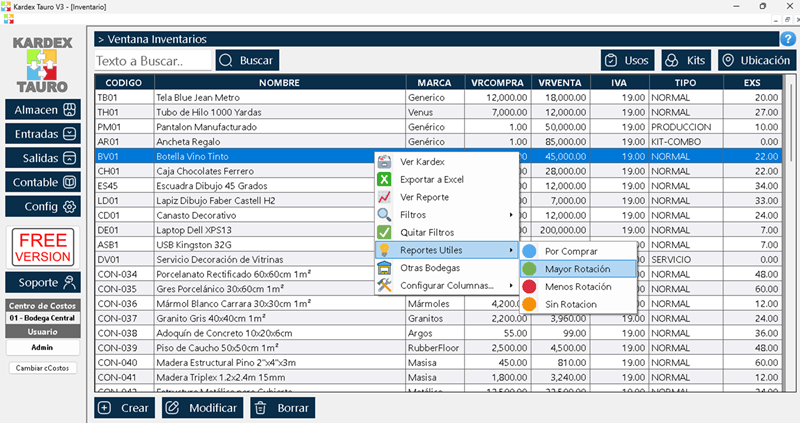
FEFO only works if the business knows which batches it holds and how many units are left in each one, and that information does not live in someone's head or in a notebook updated whenever there is time. Every receipt should be recorded with its batch and expiry date, and every shipment should say which batch it came from. With that record, knowing when each batch expires and how much of it is left becomes a query, not a memory. This is where an inventory system like Kardex Tauro helps: it lets you record the batch and expiry date of each product and group stock by batch, so the warehouse always knows how many units of each batch are available.
The other side of control is the loss that, even with FEFO applied well, will still show up from time to time: a damaged package, a returned batch, a product that expired at the point of sale. That loss must also be recorded, with its cause, so the business knows how much it loses to expiry every month and can fix the root cause. Modern inventory management tools, such as Kardex Tauro, allow these write-offs to be recorded as losses with the reason stated, and with that information the business can attack the problem at its source instead of repeating it month after month.
The conclusion is simple: in an inventory with expiry dates, the shipping rule is not chosen by habit but by product type. If what you sell expires, apply FEFO; if it does not, FIFO is enough. Arrange the warehouse by dates, record batches and expiry dates on every receipt and shipment, review regularly, and expiry loss will stop being an accepted monthly expense and become a number you watch and keep under control.
