Cycle counting: which products to count first (ABC counting plan)

Cycle counting: which products to count first (ABC counting plan)
Every year the same date arrives and the warehouse turns into chaos: sales stop, shipments are suspended, and the whole staff spends a day or two counting thousands of items against endless lists. At the end of the exercise, the annual physical count reveals differences that have been piling up for months, but nobody can say for sure when they happened, in which movement, or why. The result is a massive adjustment that fixes the numbers on paper and leaves the cause of the error untouched. Cycle counting proposes exactly the opposite: instead of counting everything once a year, you count a portion of the inventory every week, all year long, following a plan that prioritizes what hurts your business most when it goes wrong.
This article explains what cycle counting is, how to build a counting plan with ABC analysis, how to organize the calendar so operations never stop, and what to do with the differences you find. By the end you will have a concrete method to keep inventory accuracy above 95 percent without living through the full-count week ever again.
What cycle counting is and why it pays off
Cycle counting means physically counting a subset of the inventory on a continuous, scheduled basis, so that every item is reviewed once or several times a year depending on how important it is. Instead of a single annual event that interrupts everything, it becomes a weekly routine built into the operation: while the warehouse works normally, one person or a small team walks a zone, counts the items assigned for that week, and compares the result against what the system shows.
The logic is simple: an inventory error is not caught because it is big, but because it is looked for. If an item is only counted in December, a shortage that started in March can grow for nine months: the system keeps showing stock, sales are promised, purchase orders are not generated, and replenishment arrives late. With continuous counting, that same shortage is discovered two or three weeks after it happened, when recent movements can still be traced and the cause found. Cycle counting turns error correction into a small, frequent, inexpensive process instead of a big, late, painful adjustment.
ABC analysis: which products to count first
Not every item deserves the same attention, and counting them at different frequencies is not a whim: it is a cost decision. ABC analysis, based on the Pareto principle, classifies inventory into three groups by impact. Group A normally holds about 20 percent of the items that concentrate close to 80 percent of sales value or inventory value; these are the expensive products, the fastest movers, or the ones critical to operations. Group B groups the next segment, roughly 30 percent of the items, with a moderate contribution. Group C, usually half of the items, contributes the smallest share of value or turns slowly.
If a Group C item is off by five units, the impact is small and can wait months. If a Group A item is off by five units, the impact can be a lost sale, an unnecessary purchase, or a major accounting difference. That is why counting frequency follows the same curve: A products are counted every month, B products every quarter, and C products every six months or once a year. Counting effort is concentrated where it protects the most value, and every item is reviewed as often as its importance justifies.
Example: ABC plan for a store with 1,200 items
Take a typical business with 1,200 active items. First, sort all items by last year's sales value or by inventory value, accumulate the percentage, and define the cutoffs: Group A up to 80 percent of accumulated value, Group B up to 95 percent, and the rest as Group C. With that classification, the counting plan looks like this:
| Group | Classification criteria | Items | Counting frequency | Counts per week (approx.) |
|---|---|---|---|---|
| A | 20 percent of items holding 80 percent of value: high turnover and high cost | 240 | Every month (12 times a year) | 55 |
| B | Next 30 percent in value and turnover, up to 95 percent accumulated | 360 | Every quarter (4 times a year) | 28 |
| C | Remaining 50 percent: lower value, lower turnover | 600 | Every six months (2 times a year) | 23 |
| Total | All active items | 1,200 | 5,520 counts per year | 106 |
The math is straightforward: 240 Group A items multiplied by 12 annual counts give 2,880 reviews per year, spread over 52 weeks that is about 55 per week. Group B adds 1,440 annual counts, about 28 weekly, and Group C another 1,200 annual counts, about 23 weekly. In total, the plan demands about 106 items counted each week, roughly 21 per working day: a task easily handled by one person dedicating one or two hours daily, without closing the warehouse or stopping shipments.
The monthly counting calendar
Once the frequency is defined, the next step is turning it into a concrete calendar. The practical rule is to divide the items of each group into zones or ranges and assign one zone per week, so that Group A is complete by the end of the month and Group B by the end of the quarter. A typical month would look like this:
| Week of the month | Group A (55 per week) | Group B (28 per week) | Group C |
|---|---|---|---|
| Week 1 | Zone A1: 55 items | Zone B1: 28 items | Not scheduled |
| Week 2 | Zone A2: 55 items | Zone B2: 28 items | Not scheduled |
| Week 3 | Zone A3: 55 items | Zone B3: 28 items | Not scheduled |
| Week 4 | Zone A4: 55 items | Zone B4: 28 items | In March and September: 150 items |
| Monthly total | 220 items | 112 items | 150 in C-cycle months |
Group C, counted twice a year, is split between March and September: 300 items per cycle, 150 per month, using the fourth week when movement is lighter. The calendar is printed or checked in the system, and every week you know exactly which items must be counted, who counts them, and in which zone. Nothing needs to be decided on the fly, and that is precisely what keeps the routine alive.
How to count without stopping operations
Cycle counting works because it is designed to live alongside operations. To make it work, follow some practical rules:
- Count by zone and during low-traffic hours: early morning, after closing, or during the quietest shifts, when fewer receipts and shipments interfere with the count.
- Assign a stable person per zone. Whoever counts the same shelves every month ends up knowing their products, locations, and oddities better than anyone.
- Count one complete item at a time: verify location, unit of measure, and packaging. A classic mistake is counting boxes while the system records units, or mixing different presentations of the same product.
- Do not just write down the total: record the count on the week's sheet and mark it on the list as soon as it is done, so you never count the same item twice or leave a zone half finished.
- If you find a messy aisle or misplaced merchandise, write it down. Counting also detects housekeeping problems no report can show.
- If operations do not allow finishing the zone on the planned day, reschedule within the same week; never skip to the next zone without closing the previous one.
Consistency beats speed: half an hour a day, well used, sustains the whole plan, while two mass-counting days a year are not enough to correct anything on time.
What to do with the differences you find
When the count does not match the system, the immediate temptation is to adjust the number and move on. That is the most expensive mistake in cycle counting. A difference is a clue, not paperwork: before touching the inventory, you must understand it. The recommended procedure has four steps:
- Recount the item on the spot. A significant share of differences disappears in the second count, because someone counted wrong or the merchandise was in another location.
- Investigate possible causes before adjusting: review recent movements of that item, the day's shipments, returns, unregistered purchases, or damaged merchandise that was never reported. Always ask whether the error comes from the count, the record, or the process.
- Record the adjustment with its cause. When the difference is real, adjust the stock and document the reason in the movement's reference: a shortage is registered as an outbound movement for shrinkage or adjustment, and an overage as an inbound adjustment, with date, zone, and person responsible.
- Analyze repeated causes. If the same item fails twice in a row, it is not bad luck: it is a broken process. Three shortages in the same zone point to storage or picking problems; three overages, to poorly recorded purchases or returns. Use cycle counting to find those patterns and fix the process, not just the number.
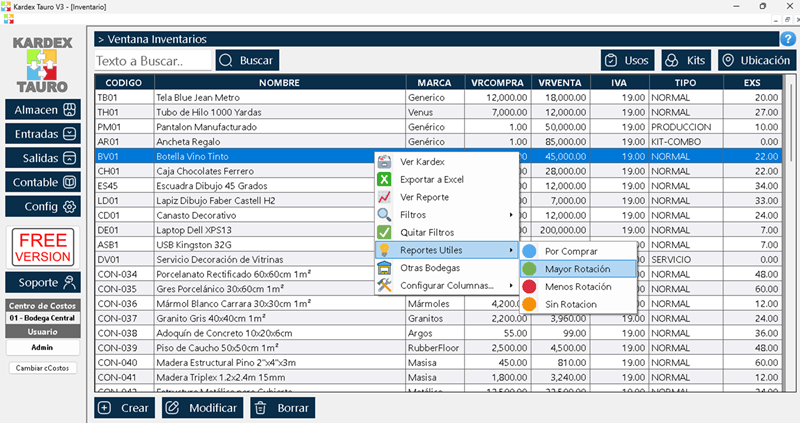
In a well-kept inventory ledger, every adjustment stays as a movement with its reference and its owner. That is why tools like Kardex Tauro let you record overages as adjustment receipts and shortages as shrinkage or count-difference issues, keeping the traceability an audit demands. A log of adjustments with documented causes turns every count into evidence instead of a simple change of figures.
Advantages over the annual physical count
Compared with the general physical count, cycle counting offers advantages you notice from the first quarter:
- Less disruption: operations never close, and sales and shipments keep running while counting advances in parallel with daily work.
- Errors caught earlier: a difference is found weeks after it happens, when the movements involved are still fresh and traceable.
- Staff specialized by zone: whoever always counts the same area knows it deeply, counts faster, and spots anomalies an outside team would miss.
- Inventory accuracy measured all year: every week you know the precision percentage of what was counted and can correct the trend before the problem grows.
- Smaller accounting impact: adjustments are small, continuous, and documented, instead of a year-end global adjustment that forces you to explain months of differences.
- Distributed counting costs: the annual effort spreads across short routines that use existing staff, with no massive overtime or temporary hiring.
Cycle counting also changes the team's culture: inventory stops being a dreaded once-a-year event and becomes a permanent responsibility, and that shows in how carefully receipts, issues, and locations are handled.
When a general physical count still makes sense
Cycle counting does not completely remove the need for a wide physical count. There are moments when a general sweep is wise even if the cyclical plan works well:
- At the accounting year-end close, when the law or your accountant requires a valued inventory cut to a specific date.
- When the warehouse or store manager changes, to hand over and receive with agreed figures and clear responsibilities.
- After a serious incident: a theft, fire, flood, or system migration that puts the integrity of the records in doubt.
- When implementing a new inventory system, to load the opening inventory with real, verified quantities.
- When inventory accuracy stays below an acceptable level for several months in a row, as a cleanup measure before resuming the cyclical plan.
In those cases, the general sweep and the cyclical plan complement each other: the full count restores the baseline, and cycle counting keeps it there. Even the sweep can be organized by zone following the same ABC logic, counting the highest-value groups first and with extra care.
Where to start this week
If your warehouse still depends on the annual count, you do not need an engineering project to begin: you need a simple plan and consistency. First, get a list of your items with last year's sales value and classify them into A, B, and C. Second, set the frequencies: monthly for A, quarterly for B, and semiannual or annual for C. Third, calculate how many items per week you must count and divide them into zones. Fourth, schedule the first Group A round for next week and assign someone responsible. Fifth, define the difference procedure: recount, investigate, adjust with a cause, and review patterns.
Within a couple of months you will have a metric the annual count never gave you: the inventory accuracy of each zone, measured weekly. And when December arrives, instead of the usual chaos, you will have an inventory already verified in sections throughout the year, with differences corrected on time and documented. Recording those counts and adjustments in a system like Kardex Tauro, where every movement keeps its date, reference, and owner, turns the ABC plan into an auditable habit rather than one more notebook promise.
