Components of inventory cost: what your merchandise really costs you

Components of inventory cost: what your merchandise really costs you
When you buy merchandise, the first number you look at is the total on the supplier invoice. That is natural: it is the biggest figure and the easiest to read. But that total is almost never the real cost of your inventory. Between the purchase price and the moment the merchandise is ready to sell in your shop there is a chain of extra costs: freight, transit insurance, duties, unloading, special packaging. If you do not add them up, every product you sell carries a hidden, incomplete cost, and the profit you think you have is not the profit you really have.
In this article I walk you through, with a full worked example, what makes up the cost of an inventory under accounting rules: what gets capitalized, what does not, and what happens to your margin when you forget a single item. It is written for the owner of a small business who wants to decide with numbers, not for an accountant, so I will go straight to the point.
Why the supplier invoice is not the final cost
Accounting follows a simple rule that changes the way you look at purchases: the cost of an inventory includes all the outlays needed to bring the merchandise to the place where it is sold and into the condition in which it is sold. Everything you pay from the moment the product leaves the supplier warehouse until it reaches your shelf is part of that cost. The reason is practical: until you sell the merchandise, that money is tied up, and the figure you report as inventory must truly reflect what it cost you to get it there.
That process is called capitalization. It is not a technicality without consequences: your gross margin, the price you set for your products, the value of your inventory at year end and, ultimately, the profit on which you pay taxes all depend on it. Standards such as IAS 2, Section 13 of the IFRS for SMEs or US GAAP define the components precisely, but the logic underneath is common sense: any expense without which the merchandise would not be ready to sell is part of its cost.
What acquisition cost includes
For merchandise you buy ready-made, the cost of acquisition is made up of these elements:
- The purchase price, net of trade discounts, rebates and similar items. If the supplier gives you a discount for volume or for the season, that discount reduces the cost; it is not separate income.
- Import duties and non-recoverable taxes. A tax is recoverable when you can offset it or claim it back, as usually happens with VAT; the portion you cannot recover is added to the cost of the goods.
- Freight and transport to bring the merchandise to your premises. This includes inland freight when you pay for it and the supplier shipping charge when it appears separately on the invoice.
- Insurance for the shipment, while the merchandise is in transit to your warehouse.
- Other costs directly attributable to the acquisition: handling and unloading, special packaging or palletizing, certifications required to import, and fees of customs agents or purchasing agents.
Notice what all these items have in common: they exist so that the merchandise reaches your shop ready to sell. If an expense has nothing to do with that, it probably does not belong in the cost of inventory. Early-payment discounts are a separate case: as a rule they are treated as finance income, not as a reduction of the purchase cost.
Worked example: importing 100 units
Suppose you import a batch of 100 units of one product. The agreed price is $25.00 per unit, but before the merchandise reaches your warehouse you pay freight, insurance and duty. The full breakdown of the acquisition cost looks like this (illustrative amounts in US dollars):
| Item | Amount |
|---|---|
| Purchase price (100 units × $25.00) | $2,500.00 |
| Freight and transport to your premises | $380.00 |
| Transit insurance | $95.00 |
| Import duty (15% on the CIF value of $2,975.00) | $446.25 |
| Other direct costs: handling, unloading and special packaging | $120.00 |
| Supplier trade discount | -$250.00 |
| Total acquisition cost | $3,291.25 |
| Cost per unit ($3,291.25 ÷ 100) | $32.91 |
The cost per unit ended up at $32.91, not at the $25.00 on the price list: freight, insurance and duty added $921.25 before the $250.00 discount was applied. That $32.91 is the number you must compare against your selling price to know what you really earn. Any analysis that uses $25.00 as the cost is lying to you from the first line.
A note on the duty: in the example it is calculated on the CIF value, that is, on the sum of cost, insurance and freight ($2,500.00 + $380.00 + $95.00 = $2,975.00), which is how imports are normally assessed. In your case the base and the rate may vary by country and product, but the structure of the calculation is the same.
Conversion cost: when you make or finish the product
When your business does not only buy, but also manufactures, assembles or finishes the merchandise (for example, you produce food, make clothing or put together kits to sell), the cost of inventory gains a second layer: conversion cost. It includes the following components:
- Direct materials: the raw materials and inputs that become part of the finished product and can be identified with it without much effort.
- Direct labour: the wages and benefits of the people who make or transform the product, when their time can be clearly assigned to that task.
- Production overheads: power, machine maintenance, equipment depreciation, workshop rent and plant supervision, assigned to the product on a reasonable and systematic basis.
The tricky part is overheads: since they cannot be identified with a single unit, they are allocated using a reasonable and consistent basis, for example direct labour hours, machine hours or units produced. You do not need a sophisticated costing system to get started, but you do need a clear basis and the discipline to apply it the same way month after month, because that is where the real cost of what you produce comes from.
What should NOT be capitalized
Knowing what to leave out is as important as knowing what to add. If you add too much, you inflate the value of inventory and distort the margin. These expenses do not belong in the cost of your merchandise:
- Administration overheads, such as salaries of administrative staff, office supplies and general services. They are recorded as expenses of the period in which they occur.
- Selling and distribution expenses: advertising, sales commissions and the deliveries you make to the customer. Getting the product to your customer is not inventory cost; it is the cost of selling it.
- Storage after the merchandise is ready to sell. The warehouse where you keep finished goods is a period expense. The exception is storage that is part of the production process, such as the maturing of cheese or the ageing of spirits.
- Abnormal waste of materials, labour or other costs. Shrinkage that goes beyond what is reasonable is not spread over the good units: it goes straight to the profit and loss account.
- Interest and finance costs, as a rule. Financing the purchase is a cost of money, not of the goods; it is capitalized only in specific cases, such as producing assets that take a long time to get ready.
- Foreign exchange differences on purchases made in another currency once you hold the goods, as well as general inventory administration costs.
A practical way to remember it: if the expense still exists while the inventory is sitting quietly on your shelf, it is a period expense; if the expense would disappear because the merchandise does not exist, then it is probably inventory cost.
What happens when you forget to add the freight
Let us go back to the example and make the most common mistake: recording the purchase only at the invoice price minus the discount, forgetting the $380.00 freight. With that oversight, the total cost would be $2,911.25 and the cost per unit $29.11. If you sell each unit at $48.00, the comparison against the correct calculation looks like this:
| Item | Correct calculation | Forgetting the freight |
|---|---|---|
| Total cost of the batch | $3,291.25 | $2,911.25 |
| Cost per unit | $32.91 | $29.11 |
| Selling price per unit | $48.00 | $48.00 |
| Gross margin per unit | $15.09 | $18.89 |
| Gross margin as a share of the selling price | 31.4% | 39.4% |
| Gross profit of the batch (100 units) | $1,509 | $1,889 |
The $380.00 difference does not disappear: the freight is paid anyway and comes out of your pocket, but because you did not charge it to the cost of the product, it silently eats into the margin. You think you earn $18.89 per unit when you actually earn $15.09. Across the 100 units, that is $380 of profit that your books show as earned and that does not exist.
The problem multiplies when you repeat that incomplete record month after month, because the error becomes part of the cost of goods sold for every product you ship. And it gets worse when you use that inflated margin to set prices: you end up selling cheaper than you should, convinced that the business earns more than it really does.
Why it matters: margin, price, taxes and profit
Inventory cost is not a technical detail for year end: it is the basis of decisions you make every week:
- Real margin. If the cost is incomplete, the margin is inflated and any profitability analysis lies.
- Selling price. An underestimated cost leads you to set prices that do not cover what you actually paid for the merchandise.
- Taxes. Profit is calculated by subtracting the cost of goods sold from revenue; a miscalculated cost changes the profit you report and, with it, the taxes you pay.
- Inventory value. At closing, your inventory is an asset; if it is undervalued or overvalued, the balance sheet does not reflect the real situation of the business and financial decisions are made on false data.
And there is a subtler effect, perhaps the most expensive one in the long run: an incomplete cost contaminates your buying decisions. If you believe a line earns 39% when it earns 31%, you will easily reorder it aggressively or discount products that barely leave a profit. Wrong numbers make you work harder to earn less.
Putting it into practice
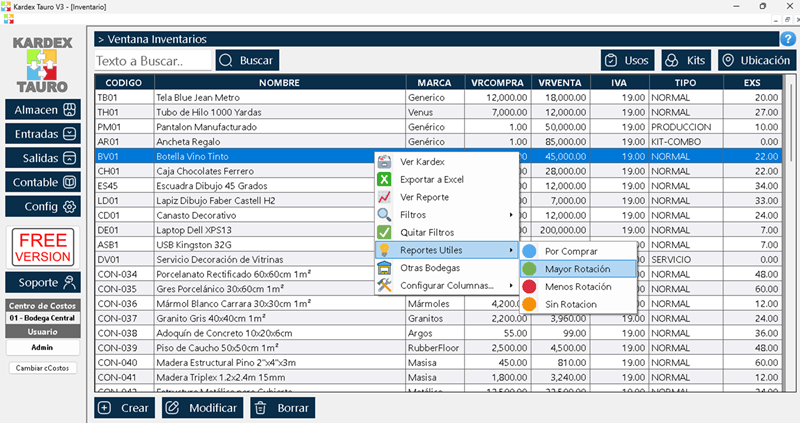
The good news is that capitalizing properly does not demand multinational-grade accounting: it demands disciplined recording of every purchase. When the invoice arrives, note the freight, the insurance and the other direct expenses tied to that batch and add them to the cost of the goods; when the goods arrive, check them against the purchase order and the transport document. Keeping the receipts, issues and costs of every product in a stock ledger system such as Kardex Tauro helps you keep the value of your inventory consistent from one purchase to the next, without relying on memory.
The mental rule to close with: always ask yourself what the merchandise cost you ready to sell, not what the supplier invoice said. In practice, the gap between those two numbers is often the difference between a business that believes it earns and a business that actually earns.
Educational note: this article explains the components of inventory cost for educational purposes and does not constitute accounting or tax advice. Standards, duty rates and tax treatments vary by country and by type of business; always review the criteria with your accountant before applying them to your books.