Standard cost vs actual cost: differences and which to use in your business

Standard cost vs actual cost: differences and which to use in your business
If you manufacture or assemble products, sooner or later you face a question that sounds simple: how much does what I produce really cost? There are two ways to answer it, and they get confused all the time. One is the standard cost, the target you calculate before production starts. The other is the actual cost, what you truly spent once production is finished. Neither is "the right one" on its own: each serves a different purpose, and knowing when to use each is what lets you control your costs instead of discovering problems too late.
This article explains what each concept means, why they are compared, what the difference between them tells you, and how to apply all of it in a small workshop or factory without a full cost accounting department.
What a standard cost is
A standard cost is a carefully built estimate of what one unit of your product should cost. It is calculated before you produce, based on your formulas or bills of materials, your historical labor times, and the way your overhead behaves. It is not a number pulled from intuition: it is a target built from data that represents the operation running as it should.
The standard is built from the three classic elements of product cost:
- Direct materials: the quantity of raw material that goes into each unit according to your formula, times the price you expect to pay. Normal expected scrap is included in this calculation.
- Direct labor: the hours of work each unit requires and the hourly rate you pay the people who make it.
- Manufacturing overhead: electricity, maintenance, machine depreciation, supervision, facility rent, and everything that supports production without touching the product directly.
Add the three elements together and you get the standard unit cost. That number is your benchmark for quoting customers, building budgets, and knowing, without waiting for month-end, roughly what the units coming off your line are worth.
What actual cost is
Actual cost is what you really spent to produce. It is not estimated: it is measured. It is calculated at the period close by adding what you actually paid for the raw material released from the warehouse, the hours actually worked at their real rates, and the overhead actually incurred and assigned to production. Everything comes from invoices, payroll records, and consumption logs.
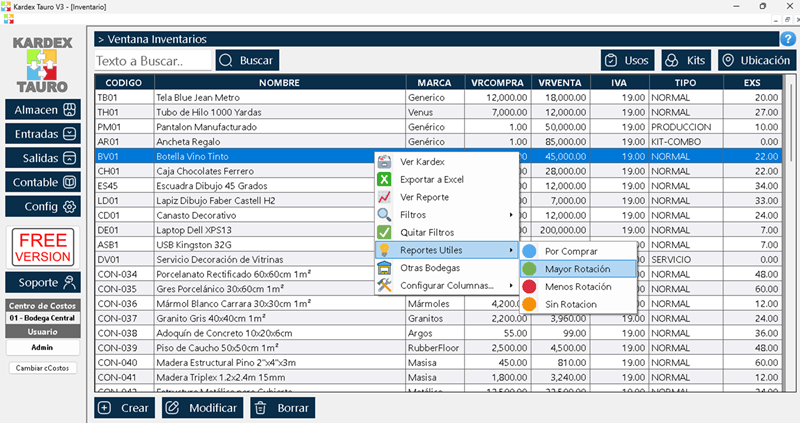
To calculate actual cost you need to know how much raw material left the warehouse for each production order and at what price. That information does not come from the supervisor's memory: it comes from inventory control, meaning a stock record (stock ledger) kept up to date. Kardex Tauro helps you keep that record organized and current, without loose spreadsheets nobody reconciles.
Actual cost also includes what was not in the plan: damaged material, overtime, machine downtime, rework. That is why it almost never matches the standard exactly, and that is fine. The point is not for the two numbers to match; it is to know why they do not.
Why compare them: variances
Comparing standard cost with actual cost is called variance analysis. A variance is the difference between what you expected to spend and what you spent, calculated for each cost element. If actual is lower than standard, you have a favorable variance. If it is higher, the variance is unfavorable.
The purpose of the analysis is not to blame people or celebrate blindly. It is to find the concrete cause behind each deviation so you can fix it or repeat it. A systematic variance in materials almost always has a clear explanation: the supplier raised prices, raw material quality changed, scrap went up, or the formula is outdated.
The same applies to labor: if actual hours exceed standard hours, the machine may be poorly adjusted, new staff may be slower, setup times may have changed, or the standard may have been wrong from the start. Overhead variances usually point to energy consumption, plant utilization, or expenses that got out of control.
Favorable and unfavorable: watch the labels
Favorable and unfavorable sound like good and bad, but it is rarely that simple. A favorable material variance may mean you bought cheaper raw material, and also that the cheaper material is lower quality and generates more rejects downstream. Today's saving can become tomorrow's rework or a customer return.
In the same way, an unfavorable labor variance can be a temporary investment: staff in training, a new product ramping up, or a small batch run just to validate the process. Judging a variance without understanding its cause leads to wrong decisions, like switching suppliers when the real problem was the material specification.
The practical rule is this: a variance is a signal, not a verdict. When one appears, your job is to ask why and separate what you control (efficiency, scrap, waste) from what you do not (market prices, wage rates). Only then does the signal become useful information for decision-making.
A numbers example: variance table
Suppose you make a simple product and your standard unit cost is built like this. At month-end you compare each element against actuals and get this table:
| Cost element | Standard cost | Actual cost | Variance | Type | Likely cause |
|---|---|---|---|---|---|
| Direct materials | $10.00 | $12.00 | +$2.00 | Unfavorable | Supplier price increase or higher scrap |
| Direct labor | $4.00 | $3.60 | -$0.40 | Favorable | Higher crew output on this batch |
| Manufacturing overhead | $3.00 | $3.50 | +$0.50 | Unfavorable | Electricity consumption above plan |
| Total unit cost | $17.00 | $19.10 | +$2.10 | Unfavorable | Driven by the materials variance |
The right reading is not "I lost $2.10 per unit." It is: materials deviated by two dollars and explain almost the whole gap; labor performed better than expected; overhead ran half a dollar over. Now you know where to look: renegotiate or find another material supplier, review scrap at the cutting stage, and audit the shift's power consumption.
How each one is used in practice
The standard cost has one huge advantage: it is available before you produce. That makes it the right tool for quoting customers quickly, building budgets, valuing the output that leaves your line without waiting for the close, and setting prices that cover your structure. If your business quotes against competitors, an outdated standard quietly makes you lose money, or lose orders by quoting too high.
Actual cost, on the other hand, is calculated when the period's information is complete: real warehouse issues, timesheets, supplier and utility invoices. It is the number that finally lands in your financial statements and in your inventory valuation. Its limitation is that it arrives late: if you only watch actuals, you learn about a problem after it has already happened.
The practice recommended in small and mid-sized shops is to combine both. Use the standard for day-to-day operations (quoting, buying, valuing) and compute the actual at each month-end to measure the variance. Tracking material movements against each production order is what makes that comparison possible, and inventory control organized with Kardex Tauro keeps the comparison honest instead of built on made-up numbers.
When to use each one
Not every business needs a standard cost system from day one. If your business is new, if your products are very different from each other, or if you do not yet have a reliable history of consumption and times, actual cost is your starting point: you need trustworthy data about what you spend before you can set believable targets. A standard built without history is just an opinion with decimals.
When your production is repetitive, with the same products, stable formulas, and known processes, the standard starts paying off: it spots deviations quickly, values inventory without waiting for the close, and gives early warnings about purchasing or plant problems. The condition is to review it periodically: every time a formula, supplier, wage rate, or machine changes, the standard must be updated. A standard frozen for years is worse than having none.
Production orders and bills of materials
Standard and actual costs do not float in the air: they anchor to two documents your shop probably already uses. The production order defines what will be made, in what quantity, and for which customer or warehouse. The bill of materials defines which inputs each unit needs and in what amounts. Together, they tell you what that order should cost according to the standard.
When the order runs, the warehouse issues materials, people record hours, and production reports finished units and scrap. Comparing what was issued against what the bill of materials required is the most direct way to catch quantity variances; comparing the prices you paid against standard prices catches price variances. Keeping those two causes separate matters because the fix is different: quantity problems are solved on the floor, price problems are solved in purchasing.
Over time, those same records let you fine-tune your standards. If real scrap at cutting is 6% and your formula assumes 3%, then either the standard must be corrected or the process must. That conversation, process versus standard, is one of the most productive a small manufacturer can have with their team.
Disclaimer: this article is for educational and informational purposes only and does not constitute professional accounting, financial, or tax advice. Before implementing a standard cost system, setting inventory valuation policies, or making decisions based on variances, consult a licensed accountant or trusted advisor who understands the regulations and realities of your country and industry.
