VAT and taxes when buying inventory in Colombia: what you deduct and what you do not

VAT and taxes when buying inventory in Colombia: what you deduct and what you do not
When your business buys merchandise to resell, the natural impulse is to record everything on the supplier's invoice as the cost of your inventory. That impulse is understandable, but in Colombia it can get expensive: part of what you pay may be a tax your company has the right to recover, and if you capitalize it into inventory, you are giving up a legitimate deduction. The key question is not how much you paid, but which part of what you paid is really the cost of the goods and which part is a tax that will be deducted later on.
This article explains, at a principles level, how the value added tax (VAT) and the national consumption tax behave when a Colombian small or medium business buys inventory: when VAT is deducted, when it ends up inside the cost, why the electronic purchase invoice is the centerpiece of the whole process, and which topics are worth reviewing case by case with an accountant. You will not find specific rates or citations of particular rules here, and that is deliberate: current regulations change, and what is valuable is understanding the mechanism so you can ask the right questions of the person advising you.
First, the basics: what VAT means in a purchase
VAT is a value added type of tax. That means it does not fall once on the final product; instead it moves along the entire chain: the seller charges the tax to its buyer, and that seller in turn paid the tax when it bought its own inputs. At the end of the chain, the final consumer bears the accumulated tax, but each business in the middle only hands over to the State the difference between the tax it collected on its sales and the tax it paid on its purchases.
When your company buys taxable merchandise from a supplier, you pay two things in a single transfer: the value of the merchandise and the VAT the supplier passes on to you. That VAT is not a service fee or a penalty for buying: it is a tax you advance and that, if the conditions are met, your business has the right to deduct. That is why the first accounting decision is not whether you have money left over, but what treatment you give to that VAT in your records: whether you treat it as cost or as an amount in your favor.
Deductible VAT: when the tax is not a cost
In general terms, the VAT paid on a purchase is deductible when the purchase is intended for operations taxed with the tax and is backed by an electronic purchase invoice that meets all the requirements. The idea is simple: if your business resells merchandise and charges VAT to its customers on those sales, it would make no sense for it to also carry the VAT on its purchases. That paid VAT becomes a deduction that is offset against the VAT your company collects on the sales of the period.
The accounting consequence is important: when VAT is deductible, it is not part of the cost of the inventory. The inventory is capitalized at the value of the merchandise without the tax, and the VAT is recorded separately, as an amount in favor of the company. If your business loses sight of that separation and records the full purchase as cost, it will be inflating the value of its merchandise, showing less profit than the real one at the moment of the sale, and failing to recover a tax it is entitled to.
Think about the full flow: you buy merchandise and pay VAT to the supplier; you sell that merchandise and charge VAT to your customers; when you settle the tax of the period, you deduct the VAT paid on purchases from the VAT collected on sales and hand over to the tax authority only the difference, if it is positive. If in one period your purchases with VAT exceed your taxable sales, a balance in your favor may remain, and it is handled according to the rules in force. In none of those scenarios is deductible VAT an expense of your business: it is money that goes out and comes back in through the mechanism of the tax itself.
When VAT does become part of the cost of inventory
Not every purchase gives the right to deduct VAT. In certain cases the tax paid is not deductible, and then it does end up forming part of the cost of the inventory. The most common situations in a small business are two: purchases intended for operations in which there is no right to deduct, such as some excluded or exempt operations depending on the case, and purchases in which the supporting document is not valid, for example because no electronic invoice was received or the one received does not meet the requirements.
When that happens, the VAT paid is not recovered: it stays inside the value of the merchandise. A purchase that cost one hundred now costs one hundred and nineteen, and that higher value is what you will need to recover in the selling price if you want to keep your margin. It is a silent effect: the business does not see a penalty or an extra bill, it simply sees more expensive merchandise and thinner margins, without always understanding why.
The practical lesson is that the treatment of VAT depends on the destination of the purchase, not on anyone's goodwill. Before assuming that all VAT is deductible, it is worth reviewing what that merchandise will be used for and what kind of operations the business carries out. When the destination mixes operations with and without the right to deduct, the topic stops being routine and starts requiring professional judgment.
The electronic purchase invoice: your best ally
No invoice, no deduction; it is that simple. Deductible VAT does not materialize because your business paid the tax: it materializes when the purchase is backed by an electronic purchase invoice that meets the required conditions. That invoice is, at the same time, the accounting support for the cost of the inventory and the document that supports the VAT deduction. Losing it, or receiving one that does not meet the requirements, can leave your company paying a tax it did have the right to recover.
That is why it is worth reviewing each electronic purchase invoice before filing it away: that the supplier's data is complete, that the description of the merchandise matches what you actually received, that the VAT is itemized and computed correctly, and that the document was issued through the authorized channel. A five-minute review routine when you receive the merchandise prevents surprises months later, when nobody remembers the circumstances of the purchase anymore.
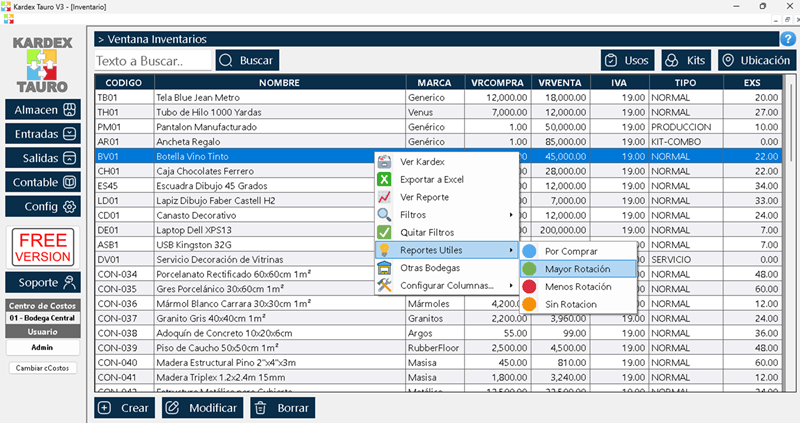
And here an organizing habit pays more than it seems: keeping the cost of merchandise up to date, separating the value of the inventory from the deductible VAT, with orderly records you can consult. Inventory control tools such as Kardex Tauro help keep that information organized and have the supporting documents at hand when it is time to review the figures with the accountant or to respond to the authority.
A numeric example with two cases
The best way to see the effect is with an example. Imagine that your company buys merchandise worth one hundred pesos, plus the VAT computed at the rate in force for that good, and pays the total to the supplier. Let us see what happens to the cost of the inventory in two scenarios:
| Item | Case 1: merchandise to resell in taxable operations (deductible VAT) | Case 2: purchase without the right to deduct VAT |
|---|---|---|
| Value of the merchandise (purchase base) | $100 | $100 |
| VAT computed at the rate in force | $19 | $19 |
| Total paid to the supplier | $119 | $119 |
| Deductible VAT (to be offset against the VAT on your sales) | $19 | $0 |
| Cost capitalized in the inventory | $100 | $119 |
In case 1, the cost of the merchandise is one hundred pesos: the nineteen pesos of VAT do not inflate the inventory, they are recorded as an amount in your favor and are deducted when your company settles the tax on its sales. In case 2, those same nineteen pesos stay inside the cost: the inventory is capitalized at one hundred and nineteen pesos and, to keep your margin, the selling price will have to carry that difference. The merchandise is identical, the supplier is the same and the outlay was the same: the only thing that changes is the destination of the purchase and, with it, the structure of your cost.
The figures in the example are illustrative: the amount of VAT depends on the rate in force for each good and on the rules applicable at each moment. What the example shows is not a number but the mechanism: deductible VAT protects the margin because it does not capitalize, and non-deductible VAT makes the inventory more expensive because it does capitalize.
The national consumption tax: another levy that can appear on the invoice
Besides VAT, Colombia has a national consumption tax, which falls on certain specific goods and services. If your business acquires any of those goods or services, you may find that tax computed on the purchase invoice, and then the same question as always appears: is it cost or is it deductible?
The honest answer is that it depends. The treatment of the national consumption tax in the acquisition of inventory does not follow exactly the same rules as VAT in every case, and the particularities of each operation carry weight. That is why, when the national consumption tax appears on a purchase invoice, the prudent thing is not to apply general recipes but to review the specific case: what good or service it is, what your company will use it for, and what the rules in force say. Your accountant is in a better position than any article to tell you how to treat that amount in your records.
Frequently asked questions from small business owners
- If I pay VAT to the supplier, can I always deduct it? No. The right to deduct depends on the destination of the purchase and on the operation being backed by an electronic invoice that meets the requirements. If the purchase does not give the right to deduct, the VAT is part of the cost.
- What happens if I lose the electronic purchase invoice? Without the valid supporting document, the deduction weakens. That is why the recommendation is to file and keep every electronic invoice received, in an orderly way and for as long as the rules require.
- Is deductible VAT returned to me in cash? Not necessarily. In general it is offset against the VAT your company collects on the sales of the period; if a balance in your favor remains, its handling is governed by the rules in force at that moment.
- Is buying without an invoice cheaper? It may seem so in the short term, but the VAT you cannot deduct stays inside the cost of the merchandise and the business is left without supporting documents. Almost always, the formal purchase is the most convenient one.
- Where do I record the VAT of a purchase: in the inventory or separately? If the VAT is deductible, separately from the cost. If it is not, inside the cost. That distinction is precisely the heart of this article.
Practical conclusion
Buying inventory in Colombia is not only about negotiating price: it is also about deciding, purchase by purchase, how much of what you pay is real cost and how much is a tax that will be deducted. The golden rule fits in one sentence: deductible VAT does not capitalize, and non-deductible VAT does capitalize. Understanding that difference lets you protect your margin, present more realistic figures and recover what legitimately belongs to you.
To put it into practice you only need three habits: review the destination of each purchase before recording it, always demand and keep the electronic invoice with its complete requirements, and keep the cost of the inventory separate from the deductible VAT in your records, something that an orderly inventory control, with a tool such as Kardex Tauro or whatever your business already uses, makes much easier. The VAT money is not the supplier's, and it does not belong in your company's pocket until its destination is settled: knowing what that destination is separates a business that deducts from one that gives tax away.
Colombian tax regulations change frequently; verify the current rules with your accountant or the DIAN before making decisions.